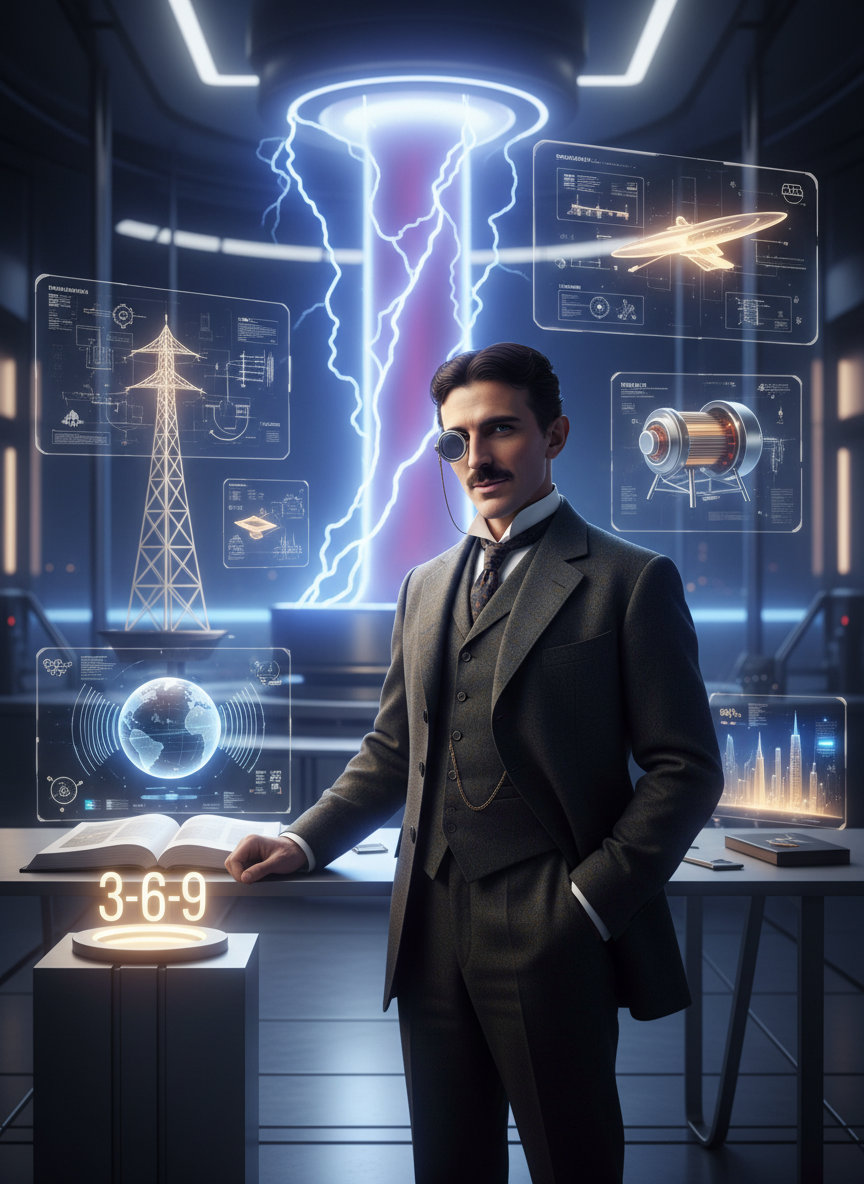
What if the modern world was designed by a man who talked to lightning?
Prompted by A NerdSip Learner
Understand the 5 inventions that built our modern world.
Imagine a world where you need a power plant on every street corner. That was the reality Thomas Edison pitched with his Direct Current (DC) system. It worked well for lightbulbs but couldn't travel long distances without losing power. Enter Nikola Tesla, a brilliant immigrant with a better idea: Alternating Current (AC).
Tesla understood that by letting electricity flow back and forth rapidly, it could be stepped up to high voltages, zip across hundreds of miles of wire, and then be stepped down safely for your home. Edison fought dirty—even electrocuting animals to prove AC was dangerous—but Tesla's system was simply more efficient.
In the end, physics won. When Tesla’s AC generators powered the Chicago World's Fair in 1893, the world saw the light. Today, every time you plug a charger into a wall socket, you are shaking hands with Nikola Tesla.
Key Takeaway
Tesla's Alternating Current (AC) defeated Edison's DC because it could transmit electricity efficiently over long distances.
Test Your Knowledge
Why did Tesla's Alternating Current (AC) eventually win over Edison's Direct Current (DC)?
Winning the War of the Currents was just the warm-up. The real test came at Niagara Falls. Investors were desperate to harness the massive energy of the falling water to power the industrial city of Buffalo, New York. It was a massive engineering gamble, and they bet everything on Tesla’s designs.
In 1895, the Adams Power Plant went live. It used Tesla’s revolutionary induction motor technology to convert the kinetic energy of the falls into electrical energy. This wasn't just a science experiment; it was the birth of the modern power grid.
The system worked flawlessly, sending massive amounts of power 26 miles to Buffalo. This success proved that hydroelectric power was viable and scalable, setting the standard for how we generate electricity globally to this day.
Key Takeaway
The Niagara Falls power plant proved that Tesla's AC technology could harness natural energy to power distant cities.
Test Your Knowledge
What was the primary significance of the Niagara Falls project?
Ask most people who invented the radio, and they’ll say Guglielmo Marconi. But here is the plot twist: Marconi used 17 of Tesla's patents to make his device work! Tesla had actually demonstrated radio transmission in 1893, years before Marconi’s famous trans-Atlantic signal.
Tesla described radio waves as a way to control things remotely (he even built a radio-controlled boat!), not just for speaking. He famously said, "Marconi is a good fellow. Let him continue. He is using seventeen of my patents."
However, money talks. Marconi had powerful financial backers, and the patent office eventually reversed its decision, handing the credit to Marconi. It wasn't until 1943, months after Tesla's death, that the U.S. Supreme Court restored Tesla’s status as the true inventor of radio.
Key Takeaway
Although Marconi got the fame and Nobel Prize, the U.S. Supreme Court ruled that Tesla is the true inventor of radio technology.
Test Your Knowledge
When was Tesla officially recognized by the U.S. Supreme Court as the inventor of radio?
Tesla wasn't satisfied with just sending information through the air; he wanted to send power. Imagine charging your phone just by walking into a room—no cords, no pads. That was Tesla's vision for the Wardenclyffe Tower on Long Island.
Construction began in 1901. It was a massive, mushroom-shaped wooden tower designed to transmit electricity wirelessly across the globe. Tesla believed the Earth itself could be used as a conductor. He envisioned a "World Wireless System" that would provide free energy to everyone, everywhere.
Unfortunately, his financier, J.P. Morgan, wasn't interested in "free" energy that couldn't be metered and sold. Funding was pulled, the project collapsed, and the tower was eventually scrapped for scrap metal. It remains one of history's greatest "what ifs."
Key Takeaway
Tesla's Wardenclyffe Tower was an ambitious attempt to transmit electricity wirelessly globally, but it failed due to lack of funding.
Test Your Knowledge
Why did J.P. Morgan reportedly stop funding the Wardenclyffe Tower?
Tesla was often called a mad scientist, but he was actually a futurist. In a 1926 interview, he described a device that sounds exactly like a smartphone: "We shall be able to communicate with one another instantly, irrespective of distance... and the instruments through which we shall be able to do this will be amazingly simple compared with our present telephone. A man will be able to carry one in his vest pocket."
He didn't stop there. He predicted the rise of artificial intelligence, robots, and the eventual necessity of renewable energy like solar and wind to replace finite fossil fuels.
While he died penniless and alone, the modern world is essentially built on his blueprints. He didn't just invent gadgets; he invented the infrastructure of the 21st century.
Key Takeaway
Decades before they existed, Tesla accurately predicted smartphones, global wireless communication, and the shift to renewable energy.
Test Your Knowledge
Which modern device did Tesla accurately describe in a 1926 interview?
Track your progress, earn XP, and compete on leaderboards. Download NerdSip to start learning.