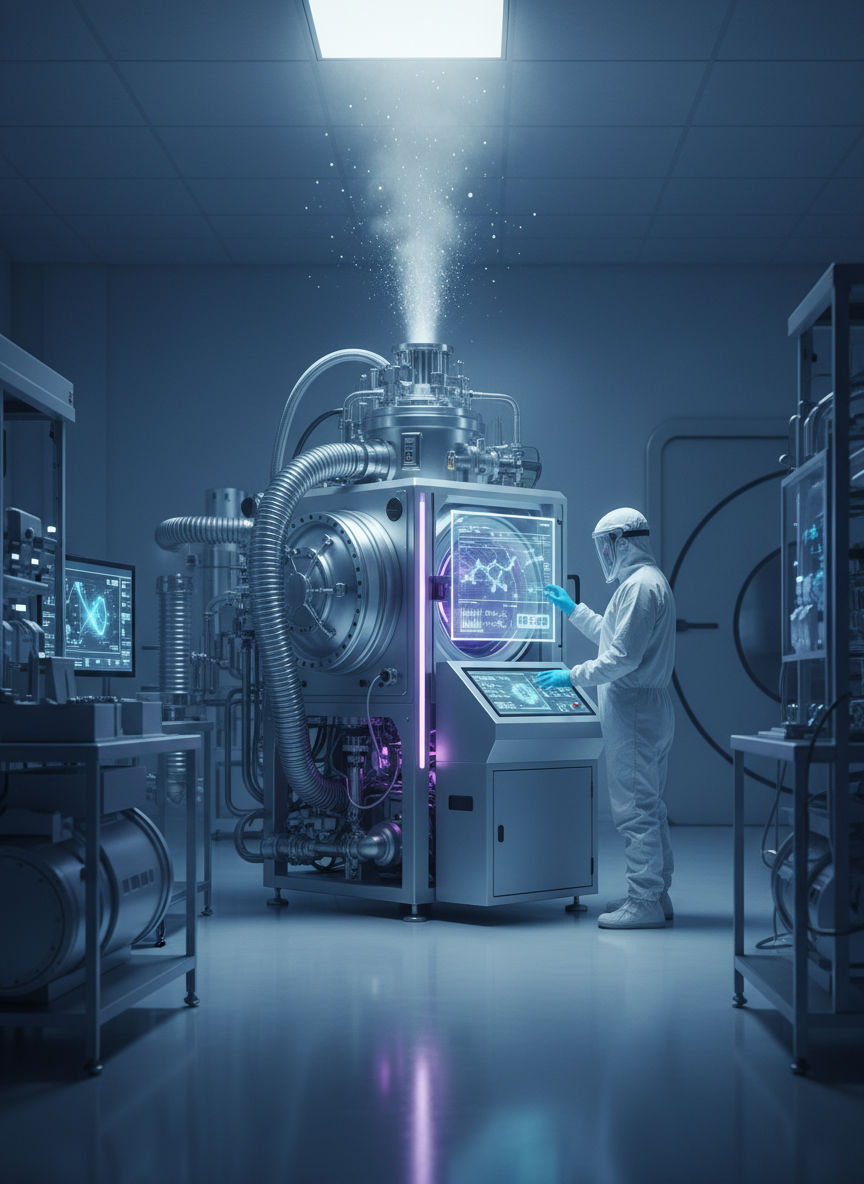
From -273°C to quantum chips. Ready to enter the deep freeze?
Prompted by A NerdSip Learner
Hack the physics of absolute zero and master the tech behind cryogenics.
Imagine temperature as a wild dance party. The hotter it is, the more chaotic the atoms and molecules move. As things cool down, the music slows, and the particles settle into a more relaxed groove.
Absolute Zero is the moment the music stops completely. At exactly -273.15° Celsius (or 0 Kelvin), atoms almost completely freeze. They stop racing and only vibrate at a microscopic level. In our universe, nothing can ever be colder than this physical limit!
Why does this excite scientists? Because at this edge, matter starts acting weird. Electricity flows without resistance, and strange quantum effects emerge that are usually hidden. To stop this atomic party, we need a high-tech machine: the cryostat.
Key Takeaway
Temperature is motion. At absolute zero (-273.15°C), atoms practically stand still.
Test Your Knowledge
What happens to atoms as they approach absolute zero?
How do you reach extreme cold when the room around you is "boiling" by comparison? The engineering answer is the cryostat. Think of it as the world’s most advanced, high-tech thermos.
Your morning coffee stays hot because of a vacuum layer in your thermos that prevents heat from escaping. A cryostat uses the same logic, but in reverse. It shields an icy, sensitive interior from the destructive "heat" of our normal environment.
By using nested layers of polished metal and an incredibly powerful vacuum, the cryostat blocks every tiny spark of external heat. This perfect isolation is the absolute requirement for cooling matter down to extreme temperatures in a controlled way.
Key Takeaway
A cryostat uses a vacuum to shield its frozen core from the warmth of the outside world.
Test Your Knowledge
How does a cryostat primarily prevent heat from leaking in?
A standard fridge compressor won't cut it here. To reach deep-freeze levels, we need special tools: liquid gases. These are the lifeblood of the cryostat's cooling power.
The first stage is often liquid nitrogen. Nitrogen is the invisible gas you breathe every day, but when compressed and cooled to -196°C, it turns into a bubbling liquid. It strips away the initial heat and chills the outer protective shields of the system.
The real star, however, is liquid helium. You know it from party balloons, but as a liquid, it reaches a staggering -269°C! It bathes the heart of the cryostat, pulling out the remaining warmth and bringing us within striking distance of absolute zero.
Key Takeaway
Liquid nitrogen and liquid helium act as extreme "ice packs" inside the cryostat.
Test Your Knowledge
Which gas brings components closest to absolute zero?
Liquid helium gets us to -269°C—colder than deep space. But for many experiments, we need to go even lower. How do we shave off those last few degrees? We use a trick your own body uses in summer.
When you sweat and it evaporates, it cools you down. This physical change draws heat away from the surroundings. Scientists replicate this by sealing liquid helium and using vacuum pumps to suck away the vapor above it.
This forces the liquid to evaporate much faster, causing its temperature to plummet even further. High-end systems even mix two types of rare helium to reach temperatures just a fraction above absolute zero. Welcome to the coldest spot in the known universe!
Key Takeaway
By forcing liquid helium to evaporate, scientists pull the final remnants of heat from the system.
Test Your Knowledge
What everyday effect is used to cool liquid helium even further?
Why spend millions on a machine that hits -273°C? Because at these temperatures, matter develops genuine "superpowers." It’s where the magic of modern technology begins.
Near absolute zero, electrical resistance vanishes in certain materials. They become superconductors. This means electricity can flow in circles forever without losing energy as heat—a technology essential for the massive MRI scanners found in hospitals.
Furthermore, this extreme cold is the only place where quantum computers can live. These futuristic processors are so sensitive that even a tiny heat vibration would ruin their calculations. The cryostat is the high-tech vault protecting humanity’s most delicate technology!
Key Takeaway
Extreme cold enables breakthroughs like MRI scanners and the quantum computers of the future.
Test Your Knowledge
Which modern technology absolutely requires a cryostat to function?
Track your progress, earn XP, and compete on leaderboards. Download NerdSip to start learning.