Is everything we see just tiny, vibrating rubber bands?
Prompted by A NerdSip Learner
Master the wildest theory in physics and unlock the 11th dimension.
Imagine you have a god-tier microscope. Zoom into your own hand, and you’ll see skin cells. Zoom deeper, and you find atoms—the tiny Lego bricks that build absolutely everything around you.
For decades, the world’s brightest minds thought that inside these atoms sat tiny, solid spheres. Scientists called these ultimate building blocks quarks and electrons. It was supposed to be the end of the journey.
But what if we could zoom in even further? This is where String Theory hacks the system. It makes a wild claim: if we could look close enough, we wouldn't see solid particles at all.
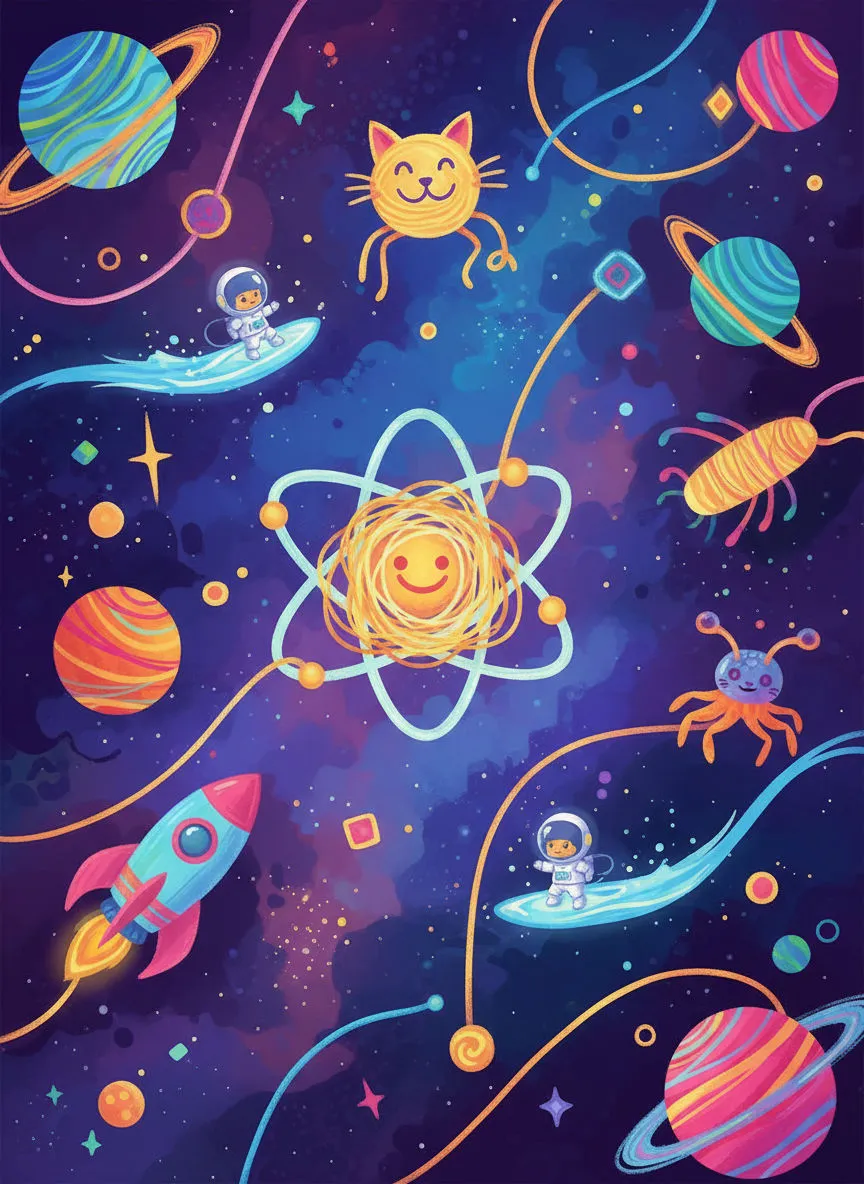
Instead, we’d find microscopic, invisible threads wiggling like tiny rubber bands. These are Strings. If this theory is right, every object in our universe is actually made of these shimmering, vibrating loops!
Key Takeaway
String theory claims the universe isn't made of solid dots, but tiny, vibrating threads.
Test Your Knowledge
What are "Strings" in String Theory?
Ever plucked a guitar string? Depending on how fast it vibrates, you hear a different note—maybe a deep bass or a high-pitched ring. It’s all about the frequency.
String Theory suggests the universe works like a cosmic instrument! Deep inside every atom, those tiny strings are constantly wiggling in a variety of complex ways.
If a string vibrates one way, it appears to us as a particle of light. If it shakes a different way, it becomes a particle that makes up your skin or a piece of wood! Different vibrations create every particle we know.
This means reality—from the neon stars in the sky to the phone in your hand—is actually a giant, beautiful symphony of shimmering strings. We are all living inside a cosmic masterpiece!
Key Takeaway
Just like guitar strings make music, different string vibrations create every building block in existence.
Test Your Knowledge
Why do strings look like different particles to us?
In daily life, we only know three dimensions: forward/back, left/right, and up/down. Add time, and that’s four. But String Theory is far stranger: for the math to work, the universe needs ten or eleven dimensions!
Where are they hiding? Imagine a long garden hose from a distance. It looks like a simple 1D line with no thickness. It’s just a flat wire in your eyes.
But if you get close, you see the hose is round. A tiny insect could crawl in circles around it. That "circular" direction is a hidden dimension that was invisible from far away!
String Theory says our extra dimensions are curled up so tightly that humans can't perceive them. Only the tiny strings are small enough to feel them and wiggle through these hidden corridors!
Key Takeaway
String theory suggests extra dimensions exist but are curled up too small for us to see.
Test Your Knowledge
Which example is used to explain hidden dimensions?
Why do geniuses obsess over such a wild theory? Because modern physics has a massive bug. We have two sets of rules that flat-out contradict each other.
One set, from Einstein, explains the big stuff like stars and gravity. The other set explains the ultra-tiny world of atoms. When you try to use both at the same time, the math literally breaks.
Physicists have spent decades looking for a bridge. String Theory is that bridge! It’s the "magic glue" that finally makes the big and the small play nice together.
By imagining everything as strings, the rules of gravity and atoms finally align. That’s why it’s often called the "Theory of Everything"—it’s the code that explains the entire game!
Key Takeaway
String theory aims to bridge the gap between the laws of massive planets and tiny atoms.
Test Your Knowledge
What major problem does String Theory try to solve?
After all this talk of wiggling strings and hidden worlds, you have to ask: "Have we actually seen these strings in real life?" The honest scientific answer is: Not yet!
Strings are so impossibly small that even our most powerful microscopes can't find them. If an atom were as big as our solar system, a string would still be as small as a single tree on Earth!
That’s why it’s a theory and not a law. It’s a beautiful mathematical model that works perfectly on paper, but it hasn't been proven in a lab experiment yet.
Physicists still debate if it’s the truth. But even if it’s not the final answer, String Theory has unlocked incredible new ways to look at our mysterious, neon-lit universe and its secrets!
Key Takeaway
Strings are too small to see, making the theory mathematically brilliant but still unproven.
Test Your Knowledge
Have scientists ever seen strings with a microscope?
Track your progress, earn XP, and compete on leaderboards. Download NerdSip to start learning.