What creates the most famous structures in our galaxy?
Prompted by A NerdSip Learner
Understand how stars are born in deep space.
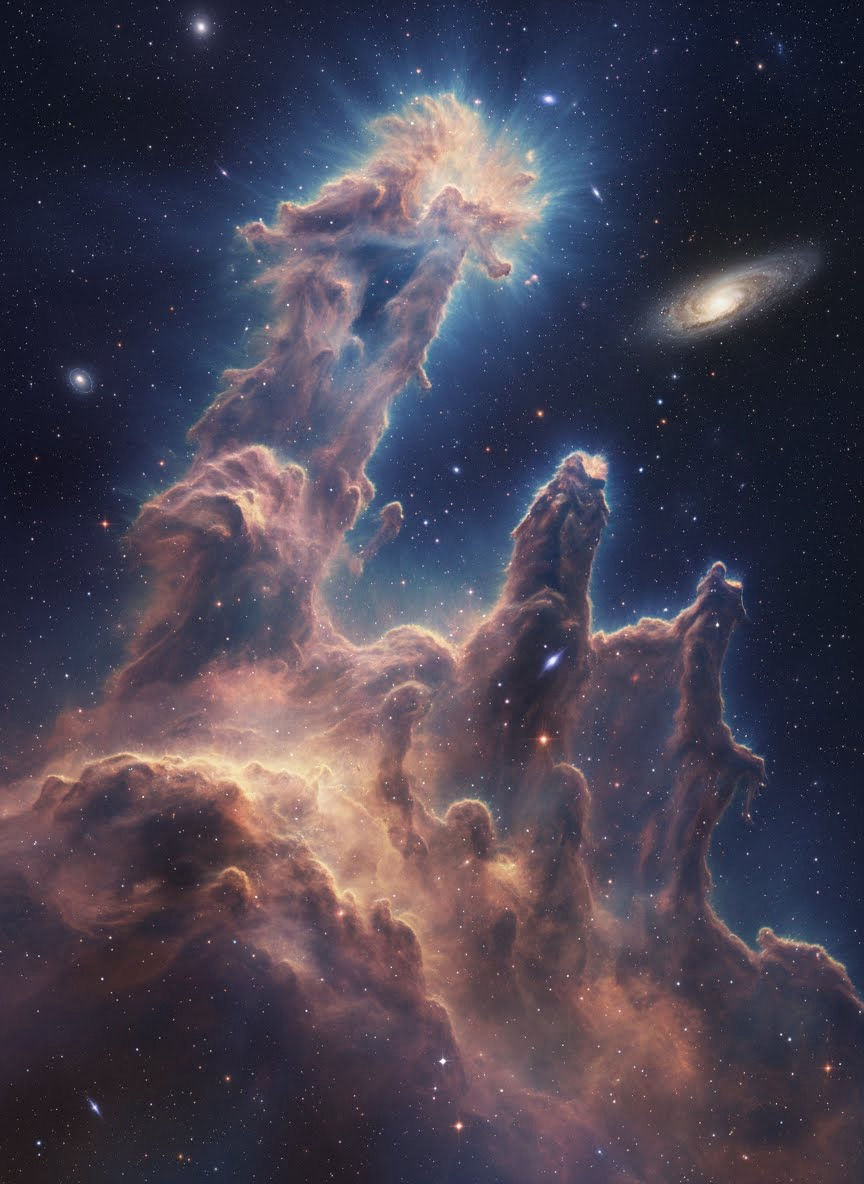
Imagine standing at the base of a tower so tall that it would take light—the fastest thing in the universe—four years to travel from bottom to top. These are the Pillars of Creation.
First captured in iconic detail by the Hubble Space Telescope, these structures look like jagged rock formations from a desert canyon. However, looks can be deceiving! They aren't solid rock at all. They are colossal, dense clouds of cold molecular gas and dust.
Think of them as pockets of thick interstellar smog floating in the vacuum of space. While most of space is empty, these regions are packed with the raw materials needed to build solar systems. They act as a protective barrier, shielding the interior from the harsh radiation of deep space, setting the stage for something miraculous to happen inside.
Key Takeaway
The Pillars are not rock, but massive clouds of gas and dust light-years tall.
Test Your Knowledge
Despite looking like rock, what are the Pillars of Creation primarily made of?
Why do we call these dusty columns "nurseries"? Because deep inside those dark clouds, baby stars are waking up.
The process begins with gravity. Inside the pillars, pockets of gas and dust start to clump together. As a clump gets bigger, its gravity gets stronger, pulling in even more material. Picture a snowball rolling down a hill, gathering more snow and growing larger every second.
As this material gets squeezed tighter and tighter, the center heats up. When the pressure becomes absolutely immense, nuclear fusion ignites. Suddenly, the dark clump turns into a blazing ball of fire. A star is born! Currently, these infant stars are often hidden inside the dust, visible only to telescopes that can see through the fog using infrared light.
Key Takeaway
Gravity pulls gas clumps together until they get hot enough to ignite into new stars.
Test Your Knowledge
Which force is responsible for pulling the dust together to form a star?
Here is the tragic twist of the Pillars of Creation: the stars they birth eventually destroy them.
When massive new stars light up, they are violent and energetic. They blast out intense ultraviolet radiation and high-speed particles known as stellar winds. Imagine pointing a powerful hair dryer at a sculpture made of dry ice. Slowly but surely, the sculpture evaporates.
This process is called photoevaporation. The beautiful pillar shapes we see are actually the result of being eroded away! The winds from nearby giant stars are stripping the gas away, leaving the denser parts behind for a while. Eventually, the pillars will disappear completely, leaving only the cluster of bright, young stars behind.
Key Takeaway
New stars emit powerful winds that slowly erode and destroy the Pillars.
Test Your Knowledge
What happens to the Pillars over millions of years?
Track your progress, earn XP, and compete on leaderboards. Download NerdSip to start learning.