Can we really build a miniature sun inside a metal donut on Earth?
Prompted by A NerdSip Learner
Understand how we replicate stellar physics to generate clean energy.
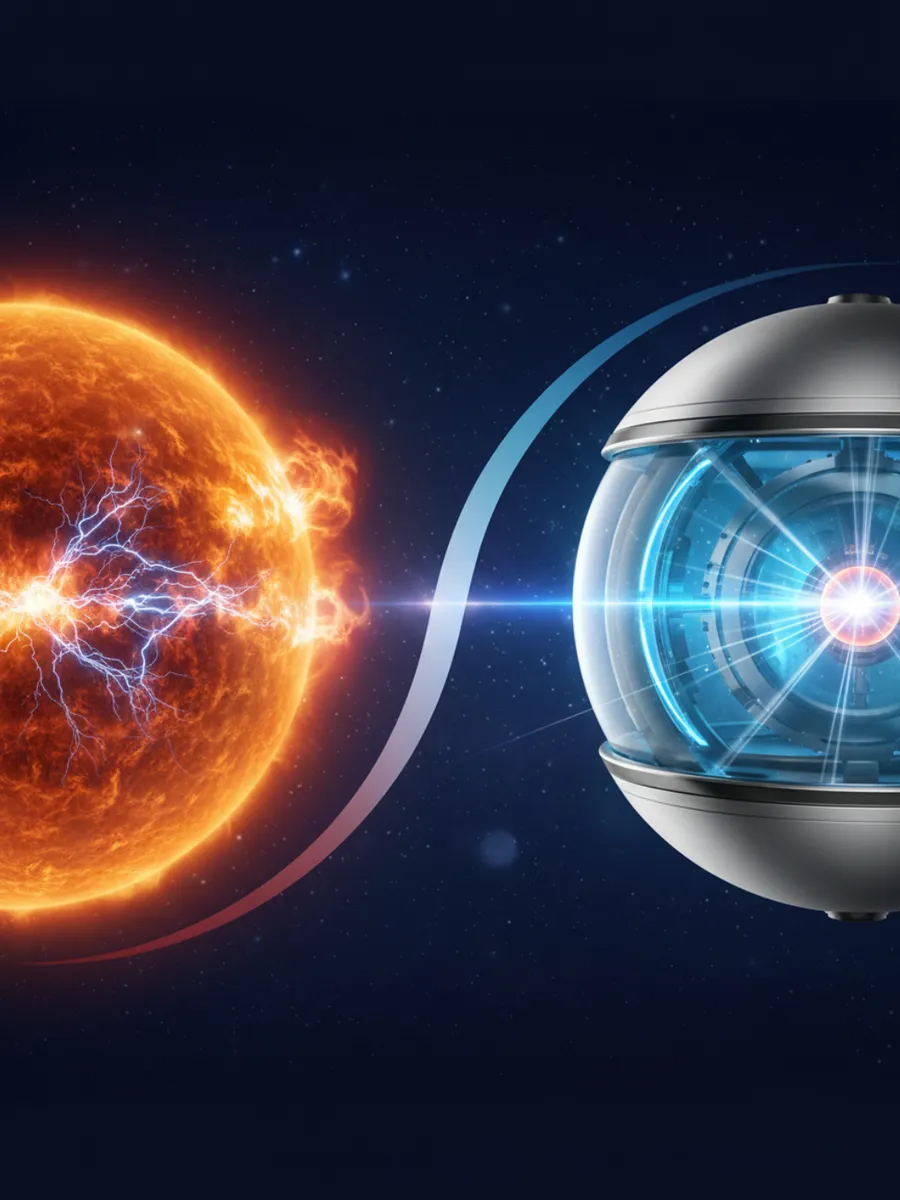
Imagine trying to squeeze two magnets together when they are pushing apart. That’s what hydrogen atoms do—they naturally repel each other. To get them to fuse and release energy, you need an incredible amount of force. The Sun has a secret weapon for this: Gravity.
The Sun is so massive that its gravity crushes the core with unimaginable pressure. This creates a natural confinement system. Inside this chaotic crush, hydrogen nuclei are forced together at roughly 15 million degrees Celsius. They smash, fuse into helium, and release the light and heat we feel today.
Because the Sun is so heavy, it doesn't have to work very hard to keep the fuel in one place. Gravity does the heavy lifting, keeping the plasma (a soup of charged particles) trapped in the core for billions of years. It’s the ultimate sustainable reactor, running on pure mass and crushing force!
Key Takeaway
The Sun uses its massive gravity to trap plasma and force fusion at 15 million degrees.
Test Your Knowledge
What is the primary force keeping the Sun's plasma contained?
Here on Earth, we have a problem: we can't create a machine as heavy as the Sun. Without that crushing gravity, how do we get atoms to smash together? We have to compensate by making things much, much hotter.
Artificial fusion reactors need to reach temperatures of over 150 million degrees Celsius—that’s 10 times hotter than the center of the Sun! At these temps, no solid material can hold the plasma without melting. Enter the Tokamak.
A Tokamak is a donut-shaped machine that uses massive magnetic fields to trap the plasma. Since the plasma is magnetic, these invisible field lines act like a 'magnetic bottle,' keeping the super-heated fuel hovering away from the metal walls. It’s like trying to hold a ball of lightning in place using only magnets!
Key Takeaway
On Earth, we use magnetic fields and higher temperatures to compensate for the lack of gravity.
Test Your Knowledge
Why must Earth-based fusion reactors be hotter than the Sun?
The Sun is patient. It burns plain hydrogen protons, a process that is actually quite slow and inefficient, but works because the Sun is huge. On Earth, we don't have billions of years. We need a faster, easier reaction.
Scientists use a special fuel mix of Deuterium and Tritium. These are isotopes (cousins) of hydrogen that have extra neutrons, making them heavier. They are much eager to fuse than plain hydrogen.
When they smash together in our magnetic donut, they create Helium and a spare neutron. That spare neutron flies off carrying massive amounts of kinetic energy, which we catch and turn into heat to drive turbines. The best part? The only byproduct is Helium (the stuff in balloons) and there are no greenhouse gases. It is the holy grail of clean energy!
Key Takeaway
Earth reactors use Deuterium and Tritium (heavy hydrogen) for a faster, more efficient reaction.
Test Your Knowledge
What is the main waste product of a Deuterium-Tritium fusion reaction?
Track your progress, earn XP, and compete on leaderboards. Download NerdSip to start learning.