Did you know a fleck of paint can crack a space shuttle window?
Prompted by A NerdSip Learner
The growing danger of debris circling our planet at 17,000 mph.
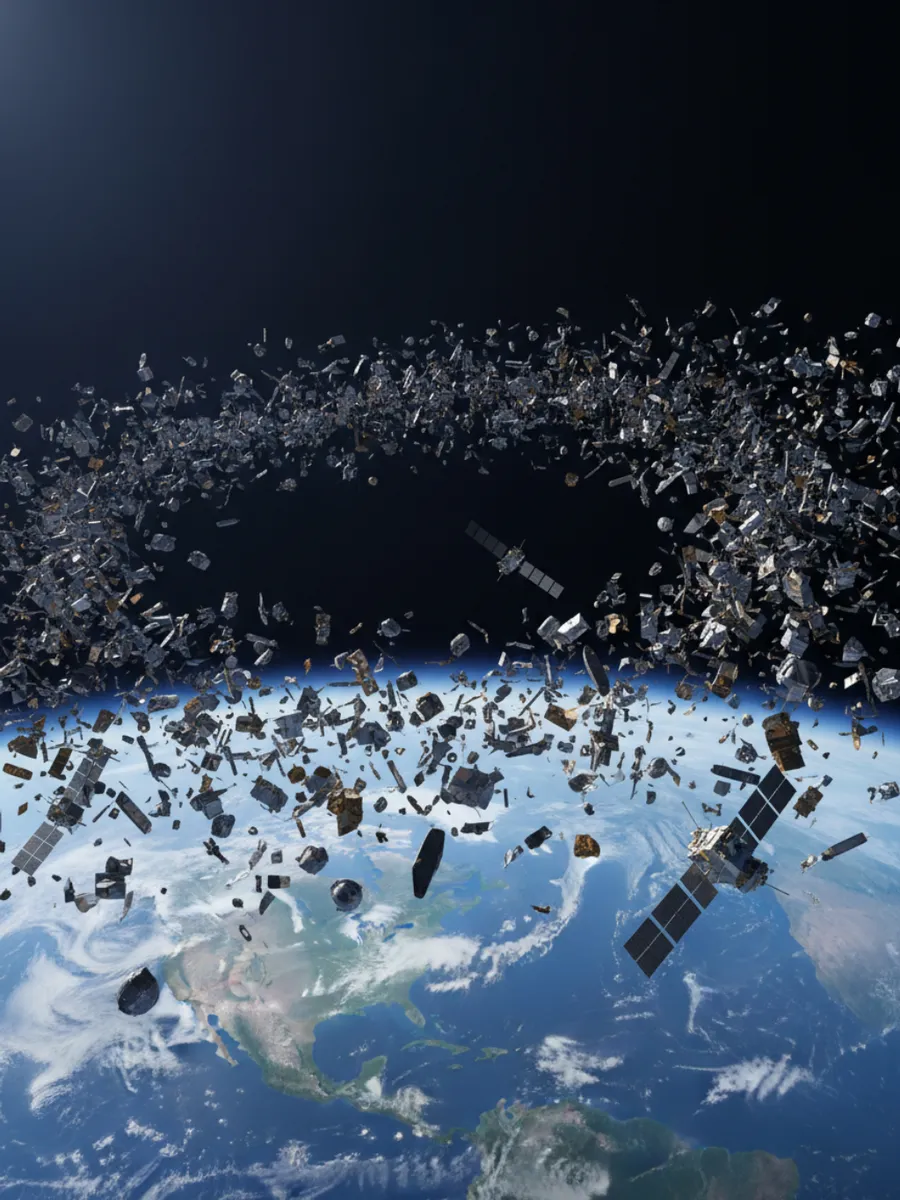
Imagine driving on a highway where even a loose bolt could hit you with the force of a hand grenade. This is the reality of Low Earth Orbit (LEO). Since the launch of Sputnik in 1957, humanity has left behind a growing trail of 'space junk'—discarded rocket stages, defunct satellites, and tiny fragments from past collisions.
These objects don't just sit there; they zoom around the planet at roughly 17,500 mph (approximately 28,000 km/h). At these velocities, kinetic energy is the primary danger. A piece of debris the size of a marble has as much energy as a bowling ball traveling at 300 mph. Even a fleck of paint can crack the thick, reinforced windows of a space shuttle.
As of early 2025, the European Space Agency (ESA) estimates there are over 130 million pieces of debris smaller than 1 centimeter orbiting Earth. While most are tiny, their sheer numbers and extreme speeds make them a persistent hazard to the satellites we rely on for GPS, weather forecasting, and global communications.
Key Takeaway
Orbital velocity is so extreme that even microscopic debris can cause catastrophic damage due to high kinetic energy.
Test Your Knowledge
Roughly how fast does space junk travel in Low Earth Orbit?
Space junk isn't just one type of trash. It is generally categorized into three groups. The first are 'intact' objects, such as dead satellites and spent rocket upper stages. These are the 'ticking time bombs' of orbit because they are large and can break apart into thousands of smaller pieces if they collide or explode.
The second group consists of fragments from 'fragmentation events.' These occur when leftover fuel or aging batteries inside old satellites explode. According to recent ESA statistics, there have been more than 650 such break-ups or explosions in history. These events create clouds of shrapnel that are nearly impossible to track individually.
The third group includes 'mission-related' items: lens covers, fragments of insulation, and even tools dropped by astronauts. While most missions now aim to be 'zero debris,' decades of older launches have left a legacy of clutter that remains in orbit for years, or even centuries, depending on their altitude.
Key Takeaway
Space debris consists of dead satellites, rocket stages, and fragmentation shards produced by explosions and collisions.
Test Your Knowledge
Which of these is considered a major cause of 'fragmentation events' in space?
To understand the danger, we look at the formula for kinetic energy: $KE = 1/2 mv^2$. Because the velocity ($v$) is squared, doubling the speed quadruples the energy. In space, where speeds are ten times faster than a rifle bullet, the damage potential is astronomical.
A collision with a 1-centimeter fragment is often enough to completely disable a functional satellite. Shielding, like the 'Whipple Shield' used on the International Space Station, can stop debris smaller than 1 cm by breaking it into a fine mist upon impact. However, anything larger than 10 cm is generally considered 'unshieldable.'
If a 10-cm object—about the size of a grapefruit—hits a satellite, it doesn't just leave a dent. It causes a total fragmentation of both objects. This creates a new cloud of thousands of pieces, each of which then becomes a new projectile capable of causing further destruction.
Key Takeaway
Because kinetic energy increases with the square of velocity, even tiny objects carry enough energy to destroy entire satellites.
Test Your Knowledge
What happens to the kinetic energy of an object if its velocity is doubled?
For a long time, the risk of two intact satellites hitting each other was thought to be statistically remote. That changed on February 10, 2009. An active American Iridium 33 communications satellite and a defunct Russian military satellite, Cosmos 2251, collided nearly 500 miles above Siberia.
The two satellites slammed into each other at a relative speed of roughly 26,000 mph. The impact was instantaneous and total. Within seconds, two functioning or intact machines were transformed into two massive clouds of debris.
This single event created over 2,000 pieces of trackable debris (larger than 10 cm) and countless thousands of smaller shards. Years later, much of that debris remains in orbit, forcing other satellites—and even the International Space Station—to perform 'collision avoidance maneuvers' to stay safe.
Key Takeaway
The 2009 Iridium-Cosmos collision proved that satellite-to-satellite impacts are a real and present danger.
Test Your Knowledge
What was significant about the 2009 Iridium-Cosmos event?
In 1978, NASA scientist Donald Kessler proposed a chilling theory: what if the debris itself starts creating more debris? This is known as the Kessler Syndrome, or a 'collisional cascade.'
The theory suggests that once the density of objects in orbit reaches a certain threshold, a single collision creates fragments that then hit other satellites, which create more fragments, and so on. This chain reaction could eventually turn entire orbital paths into a permanent 'no-fly zone.'
Many experts believe we have already passed the tipping point in certain altitudes, such as 800–1,000 km above Earth. At these heights, even if we stopped launching rockets tomorrow, the amount of debris would continue to grow due to existing objects slowly bumping into each other over the coming decades.
Key Takeaway
The Kessler Syndrome is a self-sustaining chain reaction of collisions that could make certain orbits unusable for generations.
Test Your Knowledge
What is the core idea of the Kessler Syndrome?
To prevent collisions, we first have to see the junk. The U.S. Space Surveillance Network (SSN) uses a global network of ground-based radars and telescopes to track orbital objects. As of 2025, they are actively monitoring roughly 40,000 to 45,000 objects.
However, there is a catch: we can only reliably track objects larger than about 10 centimeters (the size of a soft ball). For anything smaller, our current radar technology isn't precise enough to provide 'conjunction alerts' (warnings of a close pass).
This means that for the millions of pieces between 1 cm and 10 cm—which are still large enough to destroy a satellite—operators are essentially flying blind. They rely on statistical models to estimate the risk, but they cannot steer away from an object they cannot see.
Key Takeaway
Current technology can only track about 40,000 large objects, leaving millions of smaller, deadly fragments unmonitored.
Test Your Knowledge
What is the approximate size limit for objects that can be reliably tracked from the ground?
How do we fix the problem? Solutions are split into two categories: Mitigation and Remediation. Mitigation means stopping the creation of new junk. Modern guidelines now suggest satellites should 'de-orbit' and burn up in the atmosphere within 5 to 25 years after their mission ends.
Remediation involves actively removing the junk already up there. Companies like Astroscale and ClearSpace are testing 'space tow trucks' equipped with robotic arms, nets, and even harpoons to grab dead satellites and pull them down into the atmosphere to burn up safely.
International cooperation is key. In 2024 and 2025, more nations signed onto the 'Zero Debris Charter,' pledging to make all future missions debris-neutral by 2030. While the technology is expensive, the cost of losing access to space—and the services we depend on—would be far higher.
Key Takeaway
Solving the crisis requires both better habits (de-orbiting new satellites) and active cleanup of existing large debris.
Test Your Knowledge
What is 'Active Debris Removal' (ADR)?
Track your progress, earn XP, and compete on leaderboards. Download NerdSip to start learning.