Ever wonder why one star outshines all others in the winter sky?
Prompted by A NerdSip Learner
Master the physics and history of the Dog Star.
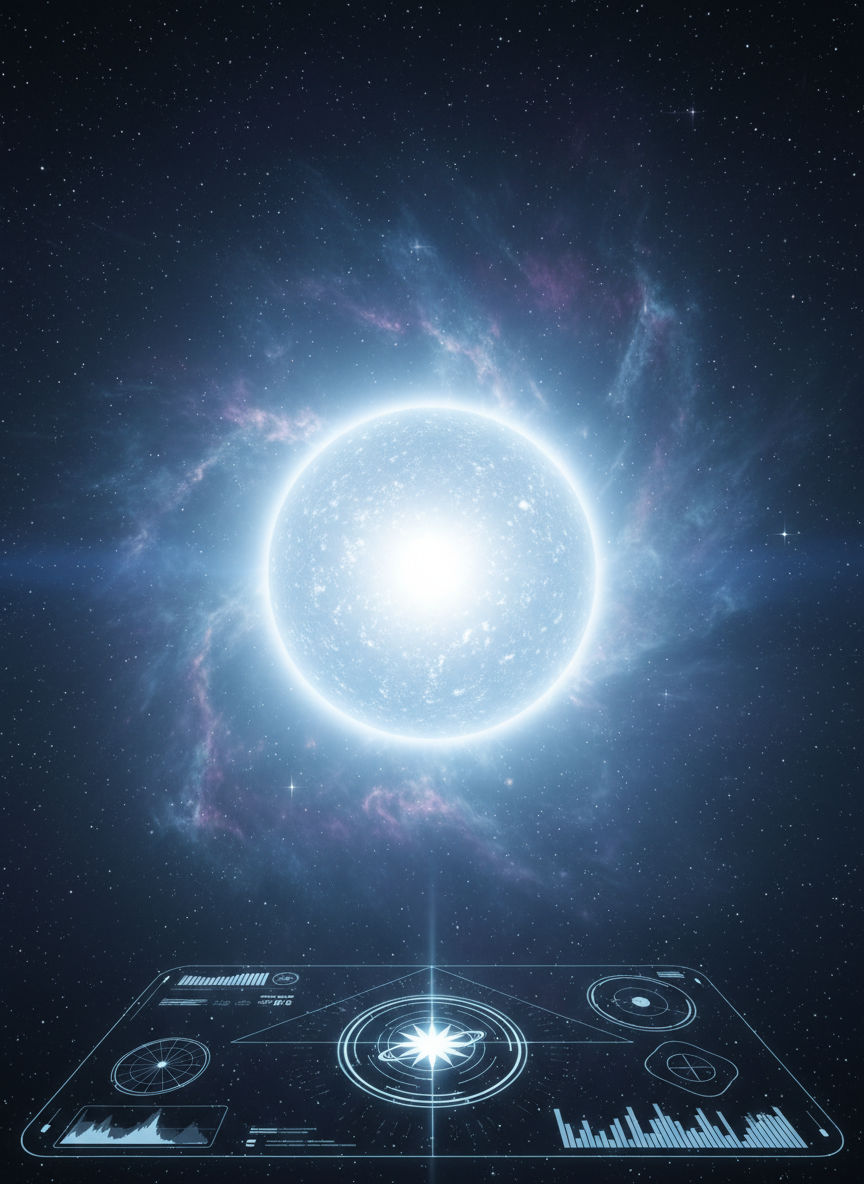
Sirius A is the brightest star in Earth's night sky, sparkling with a brilliant bluish-white light. It is the lead star of the constellation Canis Major (The Greater Dog), which is why it is famously known as the Dog Star. Located only 8.6 light-years away, it is one of our closest stellar neighbors.
For thousands of years, humans have used Sirius as a celestial guide. The ancient Egyptians watched for its 'heliacal rising'—when it first appeared just before sunrise—to predict the annual flooding of the Nile. This event was so vital that it marked the start of their calendar year.
You can easily find Sirius by using Orion’s Belt. If you follow the three stars of the belt in a straight line toward the horizon, they point directly to this dazzling beacon. It is so bright that it can even be seen in light-polluted cities!
Key Takeaway
Sirius A is the brightest star in our night sky and has been a vital historical guide for millennia.
Test Your Knowledge
In which constellation is Sirius A located?
Compared to our Sun, Sirius A is a true heavyweight. It is a Main Sequence star, meaning it is currently in the prime of its life, fusing hydrogen into helium. However, it is an A-type star, which makes it much hotter and more massive than our yellow G-type Sun.
Sirius A has about twice the mass of the Sun and is roughly 25 times more luminous. Its surface temperature sizzles at nearly 10,000 Kelvin, compared to the Sun's 5,800 Kelvin. This high temperature is what gives Sirius its characteristic white-blue glow.
Because it burns its fuel so intensely, it has a much shorter lifespan than the Sun. While the Sun will live for 10 billion years, Sirius A is only about 240 million years old and is already a significant portion of the way through its life cycle.
Key Takeaway
Sirius A is twice as massive and 25 times more luminous than our Sun.
Test Your Knowledge
What gives Sirius A its distinctive bluish-white color?
Sirius isn't a lone wolf; it is part of a binary star system. It has a hidden companion named Sirius B, nicknamed 'The Pup.' This partner is a White Dwarf, which is the collapsed, super-dense core of a star that was once even larger than Sirius A.
Sirius B is a master of density. While it is only about the size of Earth, it packs the mass of our entire Sun into that tiny volume. This makes it incredibly heavy—a single teaspoon of its material would weigh several tons on Earth!
These two stars dance around each other in an elliptical orbit every 50 years. Because Sirius A is so incredibly bright, 'The Pup' is very difficult to see. It was only discovered in 1862 when astronomers noticed Sirius A was 'wobbling' due to the gravitational tug of its invisible partner.
Key Takeaway
Sirius B is an Earth-sized white dwarf with the mass of the Sun and incredible density.
Test Your Knowledge
What is the relationship between Sirius A and Sirius B?
Track your progress, earn XP, and compete on leaderboards. Download NerdSip to start learning.