How do we print chip features smaller than the wavelength of light?
Prompted by A NerdSip Learner
Master the core mechanics of billion-dollar EUV lithography tools.
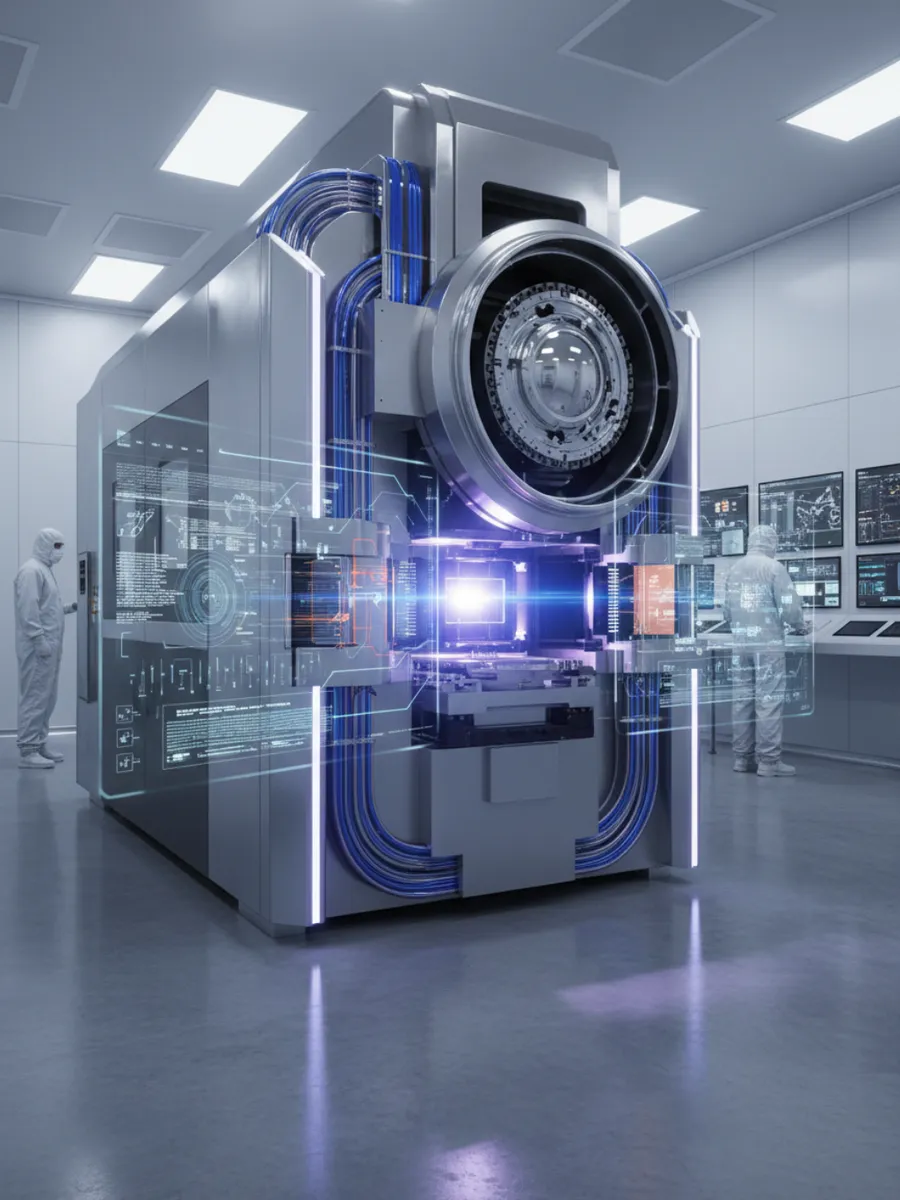
Imagine trying to draw a masterpiece on a grain of rice using a thick crayon. It’s impossible, right? To make the tiny brains of our smartphones—called microchips—we need the world's thinnest 'pen.' This is where EUV (Extreme Ultraviolet) lithography comes in. Think of it like a super-high-tech stencil machine. Instead of using ink, it uses a special kind of invisible light to 'print' billions of tiny components onto a slice of silicon.
This light is special because it has an extremely short wavelength. In the world of science, a shorter wavelength is like having a much sharper pencil. Because the 'pencil' is so fine, engineers can cram billions of transistors—the tiny switches that make computers work—into a space no bigger than a fingernail. Without this technology, your phone would be the size of a suitcase and much slower than it is today!
Key Takeaway
EUV lithography uses invisible light with tiny wavelengths to 'print' incredibly small circuits onto computer chips.
Test Your Knowledge
Why is EUV light better for making chips than regular light?
Creating EUV light isn't as easy as flipping a wall switch. You can’t just buy an EUV lightbulb at the hardware store! To make it, engineers use a process that sounds like something out of a superhero movie. Inside a massive machine, tiny droplets of molten tin are dropped 50,000 times per second. While they are falling, a high-power laser blasts each droplet twice.
The first laser hit flattens the tin droplet into a pancake shape. The second hit, which is much more powerful, vaporizes the tin into a glowing plasma. This plasma is what actually emits the EUV light we need. It’s like hitting a falling grape with a laser beam to create a tiny, controlled sun inside a box! This incredible precision is happening every single second that the machine is running.
Key Takeaway
EUV light is created by vaporizing tiny droplets of molten tin with high-powered lasers to create plasma.
Test Your Knowledge
What material is vaporized by a laser to create the EUV light?
In a normal camera or a pair of glasses, light travels through glass lenses. However, EUV light is so 'extreme' that glass actually absorbs it! If we tried to use a regular lens, the light would just disappear inside the glass. To guide the light to the chip, we have to use a series of the world's most perfect mirrors. These aren't like the mirror in your bathroom; they are made of dozens of layers of special materials designed to bounce EUV light perfectly.
These mirrors must be unimaginably smooth. To give you an idea of how flat they are: if one of these mirrors were expanded to be the size of the entire United States, the largest 'mountain' or bump on its surface would be less than one millimeter tall! This extreme smoothness ensures the light doesn't scatter, allowing the machine to print patterns that are only a few atoms wide.
Key Takeaway
EUV machines use ultra-smooth mirrors instead of glass lenses because regular glass absorbs EUV light.
Test Your Knowledge
Why doesn't an EUV machine use standard glass lenses?
Track your progress, earn XP, and compete on leaderboards. Download NerdSip to start learning.