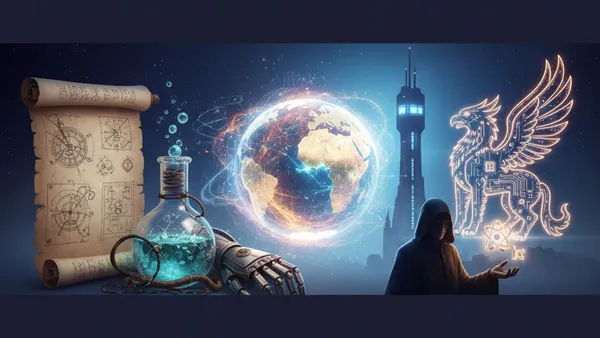
What happens when ancient myths, unsolved mysteries, and cruel science collide?
Prompted by A NerdSip Learner
Understand the dark origins of modern science and technology.
Start with the terrifying Greek myth of the Minotaur—a creature half-man, half-bull, trapped in an endless maze called the Labyrinth. It’s a great story, but what if it was based on reality?
Historians discovered the ancient palace of Knossos on the island of Crete. This massive, real-life palace was so complex and full of twisting, turning corridors that a visitor could easily get lost. It was basically a giant puzzle.
Even more fascinating, the people of Crete worshipped bulls! They practiced a dangerous sport called bull-leaping. Over centuries, the memory of this giant, confusing palace and their obsession with bulls likely blended together into the terrifying myth of the Minotaur.
Think of it like a giant game of telephone played over hundreds of years. A real, confusing building slowly transforms into a magical prison for a monster. This shows us that mythology isn't just make-believe; it is often the way ancient people tried to remember and explain real historical events that felt larger than life.
Key Takeaway
Many ancient myths are actually exaggerated retellings of real historical places and events.
Test Your Knowledge
According to the lesson, what likely inspired the myth of the Minotaur's Labyrinth?
In 1901, divers exploring a sunken Roman shipwreck made a baffling discovery. Among the statues and coins, they found a rusted, corroded lump of bronze gears. It looked like the inside of a clock, but it was over 2,000 years old.
This mysterious device is known as the Antikythera Mechanism. For decades, scientists had no idea what it was. How could ancient Greeks have complex gears centuries before they were "invented" in Europe?
Using modern X-ray technology, researchers finally solved the mystery. It was an ancient analog computer! By turning a simple hand crank, a person could track the movements of the sun, moon, and planets. It could even predict eclipses decades in advance.
The mechanism forces us to rethink the history of technology. It proves that ancient civilizations were capable of mechanical brilliance that was somehow lost to time, waiting thousands of years to be rediscovered at the bottom of the sea.
Key Takeaway
Ancient humans created complex mechanical technology far earlier than historians originally thought.
Test Your Knowledge
What was the main purpose of the Antikythera Mechanism?
Today, science has strict rules to protect people. But in the past, researchers sometimes crossed dark lines to satisfy their curiosity. One infamous example is the Little Albert experiment from the 1920s.
A psychologist wanted to know if humans are born with fears or if we learn them. To test this, he showed a perfectly happy baby—known as "Albert"—a cute, fluffy white rat. Albert wasn't afraid at all.
Then came the cruel part. Every time Albert reached for the rat, the scientist smashed a metal pipe with a hammer right behind the baby’s head. The terrifying loud noise made Albert cry. Soon, Albert was terrified of the rat, even without the noise. He had *learned* to be afraid.
This experiment was deeply unethical and traumatized a child. However, it served as a dark wake-up call. It helped create the strict ethical guidelines that protect human subjects in science and medicine today, ensuring such cruel methods are never repeated.
Key Takeaway
Cruel past experiments led to the strict ethical rules that protect humans in modern science.
Test Your Knowledge
What was the psychological goal of the Little Albert experiment?
Long before modern chemistry labs, there was alchemy. Alchemists were mysterious figures who blended early science with deep mythology and magic. Their ultimate goal? To find the "Philosopher's Stone," a mythical substance believed to turn ordinary metals like lead into pure gold.
Alchemists worked in secret, writing their recipes in codes and symbols to protect their work. While trying to create magical potions for eternal life, they mixed, boiled, and burned countless strange chemicals in their hidden workshops.
They never found a way to make gold or live forever. But here is the amazing twist: their obsessive, trial-and-error experiments accidentally gave birth to modern chemistry.
Along the way, alchemists invented important laboratory tools like glass flasks and the process of distillation. They discovered real elements like phosphorus and learned how to extract medicines from plants. They proved that even when we chase impossible mysteries, the journey can lead to incredibly real scientific breakthroughs.
Key Takeaway
The magical, failed quest to create gold accidentally created the tools and methods of modern chemistry.
Test Your Knowledge
What is one real scientific contribution that came from the alchemists?
Sometimes, modern technology captures mysteries that even our best scientists cannot explain. In 1977, a massive radio telescope in Ohio was scanning the empty silence of outer space, listening for signs of alien life.
Suddenly, the telescope picked up an incredibly strong, loud radio signal coming from the direction of the constellation Sagittarius. It lasted for exactly 72 seconds. The astronomer looking at the data was so shocked by the signal's perfection that he circled it in red pen and wrote "Wow!" in the margin.
To this day, the Wow! signal remains one of the greatest mysteries in modern science. Despite pointing our most advanced tech at that exact spot in the sky thousands of times since, we have never heard the signal again.
Was it a glitch? Was it a rare natural event in deep space? Or was it a brief "hello" from someone out there? The mystery reminds us that the universe is vast, and our technological journey is just beginning.
Key Takeaway
Despite our advanced technology, space is still full of unexplained events like the mysterious Wow! signal.
Test Your Knowledge
Why is the Wow! signal considered an unsolved mystery?
Track your progress, earn XP, and compete on leaderboards. Download NerdSip to start learning.