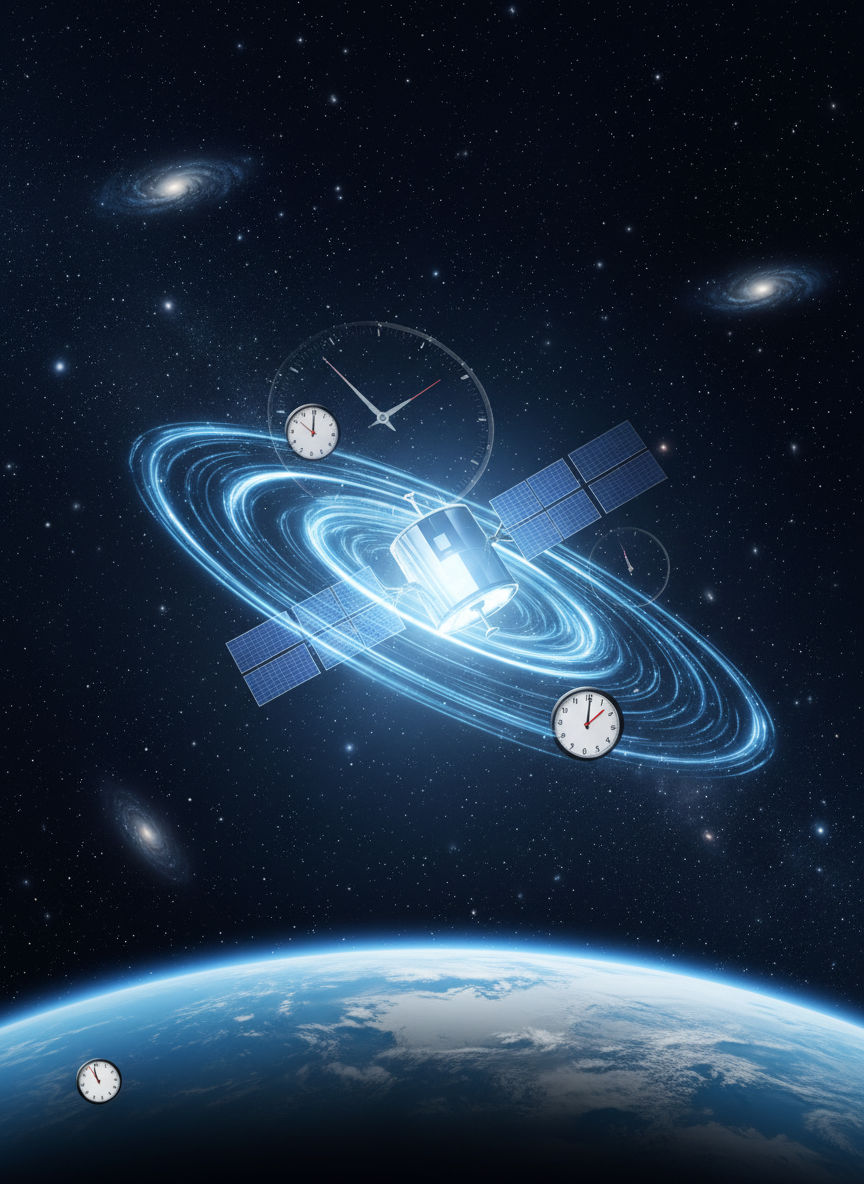
Does Earth's rotation physically twist time?
Prompted by NerdSip Explorer #5776
Master relativistic geodesy and frame-dragging.
In classical physics, the Doppler effect only kicks in when an object moves directly *towards* or *away* from you. If a satellite flew perfectly sideways—tangentially to your position—classical mechanics dictates its signal frequency wouldn't change at all, because the radial velocity is zero.
But relativity shatters this intuitive, classical assumption. Thanks to Special Relativity, a satellite moving at high orbital speeds experiences time dilation purely from its kinetic velocity. This creates the Transverse Doppler Effect (often called the second-order Doppler effect).
Even at the exact point of closest approach in the sky, when the satellite is moving strictly horizontally relative to the receiver, the satellite's signal shifts to a measurably lower frequency from the perspective of an Earthbound observer. It is a purely relativistic phenomenon that GPS systems must constantly account for mathematically. It conclusively proves that time dilation does not care about the geometric *direction* of the object's motion, but only the absolute magnitude of its speed through space.
Key Takeaway
Velocity induces a relativistic frequency shift even when a satellite moves perfectly perpendicular to the observer.
Test Your Knowledge
Why does the Transverse Doppler Effect occur even when radial velocity is zero?
General Relativity dictates that clocks tick slower when placed deeper in a gravitational well. Since Earth's mass is distributed unevenly—bulging significantly at the equator, flattened at the poles, and dotted with incredibly dense mountain ranges—the gravitational potential ($W_0$) is not perfectly uniform across the globe.
Enter the cutting-edge field of Relativistic Geodesy. By placing ultra-precise clocks in orbit and comparing them to clocks stationary on the ground, physicists can literally map the Earth's interior mass distribution simply by measuring how time behaves differently in different regions.
Instead of defining the Earth's standard "geoid" (its true physical shape) based on mean sea level, relativistic geodesy allows us to define an isochronometric surface. This is a theoretical boundary where distributed standard atomic clocks exhibit exactly zero mutual redshift and tick at the exact same rate. We are now utilizing the localized flow of time to weigh entire mountain ranges and map hidden underground aquifers!
Key Takeaway
Earth's internal mass distribution can be mapped by measuring the gravitational redshift between highly precise clocks.
Test Your Knowledge
What defines an isochronometric surface in relativistic geodesy?
We usually conceptualize Earth's gravity as a static, immobile dimple in the fabric of spacetime. But Earth is actively rotating, and as it spins, it physically drags the surrounding spacetime along with it—a fascinating phenomenon known as frame-dragging or the Lense-Thirring effect.
Imagine spinning a tennis ball submerged in a jar of thick molasses; the sticky fluid will naturally swirl around it. Spacetime behaves in the exact same manner around massive rotating bodies. This "gravitomagnetic" force introduces an entirely new, albeit tiny, relativistic perturbation to any satellite's orbital trajectory.
Dedicated space missions like *Gravity Probe B* and *LAGEOS* were specifically engineered to detect this elusive twist. They definitively proved that a satellite's internal gyroscope will subtly precess (tilt on its axis) just because the Earth's rotation is physically twisting the local spacetime coordinate system. It is an incredibly weak effect, but mapping it is absolutely vital for advancing extreme-precision astrophysics.
Key Takeaway
A massive spinning body physically drags the fabric of spacetime around it, subtly altering satellite orbits.
Test Your Knowledge
What is the primary cause of the Lense-Thirring effect?
Satellites do not merely rely on General Relativity to function; they serve as our most powerful tools for testing if Einstein's equations are completely correct. To do this, physicists use the Parameterized Post-Newtonian (PPN) formalism, a mathematical framework that adds adjustable parameters to metric theories of gravity to see exactly where they might break down.
Two critical PPN parameters are $\gamma$ (measuring how much space is curved by unit rest mass) and $\beta$ (measuring how non-linear gravity is). In Einstein's pure theory, both of these parameters must exactly equal 1.
By bouncing lasers off highly reflective, super-dense satellites in orbit, scientists can measure precise orbital deviations over a span of years. If $\gamma$ or $\beta$ were found to deviate from 1 by even a tiny fraction of a percent, it would immediately signal the existence of new physics beyond General Relativity. So far, tracking satellites confirms Einstein's math flawlessly, severely restricting any alternative theories of gravity.
Key Takeaway
Satellite laser ranging tests the precise mathematical boundaries of General Relativity using the PPN formalism.
Test Your Knowledge
In the PPN formalism, what does a $\gamma$ and $\beta$ value of exactly 1 indicate?
The atomic clocks currently powering modern GPS constellations are astonishingly accurate, but the next frontier of satellite timekeeping relies on Optical Lattice Clocks. These advanced devices trap elements like strontium or ytterbium atoms in a microscopic grid of lasers and measure their ultra-high-frequency optical transitions.
These revolutionary clocks achieve a fractional frequency stability of $10^{-18}$. At this extreme, mind-bending level of precision, raising a clock by just *one single centimeter* on the surface of the Earth measurably changes its tick rate due to gravitational redshift.
When launched into the vacuum of space, these hyper-sensitive clocks will do much more than just improve deep-space navigation; they will act as vast quantum sensors. They possess the sensitivity required to potentially detect the passage of dark matter, measure the subtle tidal stretching of spacetime from distant celestial bodies, and test the fundamental constancy of the speed of light. Timekeeping is officially evolving from mere navigation into fundamental physics discovery.
Key Takeaway
Next-generation optical lattice clocks are so sensitive that a one-centimeter height difference significantly alters their tick rate.
Test Your Knowledge
Why are optical lattice clocks incredibly valuable for fundamental physics in space?
Track your progress, earn XP, and compete on leaderboards. Download NerdSip to start learning.