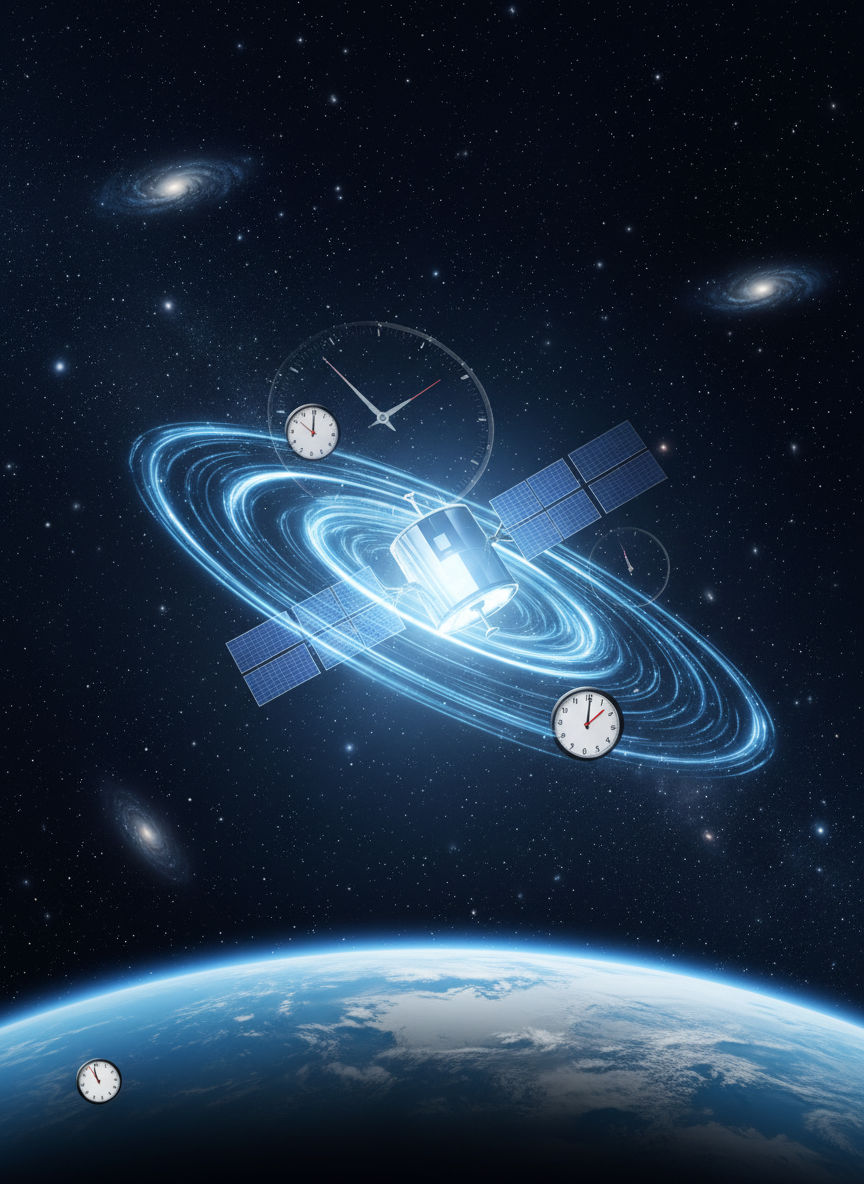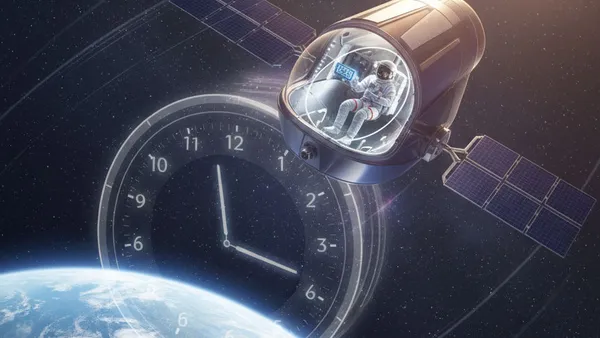
What happens to time when satellite orbits aren't perfect circles?
Prompted by NerdSip Explorer #5776
Master the advanced relativistic mechanics of satellites.
In your previous module, you learned about the orbital tug-of-war. But exactly where does this relativistic battle end in a mathematical draw?
To find the neutral zone where a satellite's clock ticks at the exact same rate as a clock on Earth's surface, physicists pit the Schwarzschild metric (calculating gravity) against the Lorentz factor (calculating speed).
By combining these equations for a circular orbit, the math reveals a strict cancellation point: when the orbital radius is exactly 1.5 times the radius of the Earth. At this specific distance—roughly 3,185 kilometers above the surface—the time-slowing effect of orbital velocity perfectly matches the time-speeding effect of the weaker gravitational potential.
If a satellite orbits below this altitude, velocity wins, and its clock runs slower than ours. If it orbits above it—like GPS satellites do at over 20,000 kilometers—gravity overwhelmingly wins, and its clock runs faster.
Key Takeaway
Time dilation effects perfectly cancel out at exactly 1.5 times the Earth's radius.
Test Your Knowledge
What happens to a clock on a satellite orbiting exactly at the 1.5 Earth radius cancellation point?
The basic tug-of-war theory assumes perfect circular orbits, allowing engineers to simply detune satellite clocks by a fixed fraction before launch. However, real orbits are mildly elliptical, possessing what physicists call orbital eccentricity.
This creates a dynamic, continuously shifting relativistic problem. As a satellite approaches perigee (its closest point to Earth), it dips deeper into the gravity well and simultaneously accelerates. Both factors compound to aggressively slow the satellite's clock.
Conversely, as it swings out to apogee (its furthest point), it climbs higher out of the gravity well and loses velocity. The combined effects cause the clock to rapidly speed up relative to the ground.
Because this periodic error constantly fluctuates, a static factory reset isn't enough. Earth-based receivers must actively compute an eccentricity correction in real-time, solving complex relativistic equations on the fly just to pinpoint your location.
Key Takeaway
Elliptical orbits require real-time math because velocity and altitude are constantly changing.
Test Your Knowledge
Why does a satellite's clock slow down maximumly at perigee?
Relativity isn't just about the satellite; it's also about the rotating reference frame of the Earth itself. While a GPS signal travels down from space—a journey taking about 70 milliseconds—the Earth continues to rotate.
This means the receiver on the ground is moving toward or away from the signal during its transit. In physics, reconciling signals between rotating and non-rotating frames requires accounting for the Sagnac effect.
If we treated the Earth as completely stationary, the speed of light would appear inconsistent between different ground receivers. To fix this, engineers calculate coordinates in an Earth-Centered Inertial (ECI) frame—a theoretical grid that does not rotate with the planet.
The Sagnac correction mathematically transforms the signal's arrival time from the non-rotating inertial frame back to our rotating Earth reality, preventing massive navigation errors.
Key Takeaway
The Sagnac effect corrects for the fact that Earth rotates while a satellite's signal is traveling.
Test Your Knowledge
What specifically does the Sagnac correction account for in navigation systems?
We have discussed how clocks run at different speeds, but General Relativity also affects the very path the electromagnetic signal takes. This is known as the Shapiro Time Delay.
Massive objects like Earth physically curve the fabric of spacetime. When a satellite beams a microwave signal down to your phone, that signal isn't traveling through a flat, straight line. It is traveling through a gravitational dent.
Because spacetime is curved, the actual distance the signal must traverse is slightly longer than the simple Euclidean geometric distance. To an outside observer, it appears as though the speed of light has slowed down as it passes through the gravity well.
While the Shapiro delay is minuscule for satellites orbiting Earth—on the order of fractions of a nanosecond—it is a critical relativistic calculation in advanced astrophysics, deeply affecting signals sent to deep-space probes.
Key Takeaway
Gravity bends spacetime, causing signals to travel a longer, curved path which creates a slight delay.
Test Your Knowledge
What happens to an electromagnetic signal traversing a gravity well according to the Shapiro Delay?
When we leave Earth's orbit entirely, comparing moving clocks becomes a massive mathematical headache. If you send a probe to Jupiter, whose clock do you use? Earth time is continuously warped by both our own gravity and the Sun's.
To solve this, astrophysicists use distinct relativistic time scales. Terrestrial Time (TT) is the theoretical time kept at Earth's sea level. But for deep space navigation, they utilize Barycentric Coordinate Time (TCB).
TCB is the time kept by an imaginary clock resting at the exact center of mass of the solar system, entirely outside the gravitational influence of the Sun and planets. It represents a pure, un-warped tick rate.
Because Earth is deep within the Sun's gravity well and zooming around at 30 kilometers per second, our Terrestrial Time runs noticeably slower than TCB. Every deep space mission relies on continuous mathematical conversions between these intricate coordinate systems.
Key Takeaway
Deep space navigation requires theoretical coordinate times, like TCB, to standardize clocks across the solar system.
Test Your Knowledge
Why does Terrestrial Time (TT) run slower than Barycentric Coordinate Time (TCB)?
Track your progress, earn XP, and compete on leaderboards. Download NerdSip to start learning.