What if you could walk through walls simply because you were very, very small?
Prompted by NerdSip Explorer #4482
Understand how particles pass through solid barriers like ghosts through walls.
If you throw a tennis ball against a solid brick wall, it bounces back. It doesn't matter how many times you throw it; classical physics dictates that the ball simply lacks the energy to punch through an impenetrable barrier.
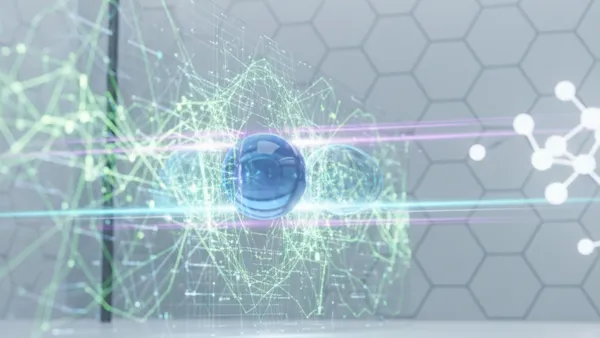
But what if you were the size of an electron? Welcome to the bizarre realm of quantum mechanics. In the microscopic world, particles don't always behave like solid little marbles. Instead, they exhibit wave-like properties.
Because of this wave-like nature, a strange phenomenon occurs when a tiny particle meets a thin, seemingly impenetrable barrier. Instead of bouncing off, there is a small but real probability that it will simply appear on the other side. It doesn't break the wall, and it doesn't go over it. It literally passes through it.
This is called quantum tunnelling, and it sounds like pure magic. Throughout this course, we will explore exactly how this ghostly behavior works, and why the universe as we know it couldn't exist without it.
Key Takeaway
In the quantum world, particles can pass through solid barriers without breaking them, defying classical physics.
Test Your Knowledge
What happens to a particle when it successfully "tunnels" through a barrier?
To understand how a particle can walk through a wall, we have to entirely rethink what a "particle" actually is. In our everyday lives, objects have definite locations. Your keys are either on the table, or they aren't.
In the quantum realm, things are not so clear-cut. An electron is best described by a "wave function"—a mathematical description that looks like a blurry cloud of probability. This cloud doesn't tell us exactly where the electron *is*, but rather where it *might* be if we decide to measure it.
Because the particle's existence is smeared out over space, its exact position is inherently uncertain. Most of the probability cloud might be clustered in one spot, but the edges of the cloud fade out gradually, stretching into the distance.
This means an electron doesn't stop abruptly. When it encounters a barrier, its probability cloud doesn't just halt; it presses into the obstacle. If the barrier is thin enough, the edge of the cloud might reach all the way to the other side!
Key Takeaway
Quantum particles act like blurry clouds of probability, meaning their exact locations are spread out rather than pinned to a single point.
Test Your Knowledge
Why can a quantum particle be described as being "smeared out" over space?
Imagine pushing a wet sponge against a fine wire mesh. Most of the sponge is stopped by the metal, but a little bit of water seeps through the tiny holes. Quantum tunnelling works in a somewhat similar way, but with probability instead of water.
When an electron's probability cloud hits a solid energy barrier, the wave function doesn't instantly drop to zero. Instead, it decays exponentially inside the wall. The thicker and higher the barrier, the faster the cloud fades away.
However, if the barrier is incredibly thin—we're talking nanometers thick—the probability cloud won't completely vanish by the time it reaches the other side. A tiny fraction of the wave function survives. Because the wave function exists on the far side, there is a real, measurable chance that the particle will suddenly be found there.
It is crucial to note that the particle doesn't dig a physical hole. It just "fades out" on one side and "fades in" on the other, cleanly bypassing the obstacle as if it were a ghost.
Key Takeaway
When a barrier is incredibly thin, an electron's probability cloud can reach the other side before decaying, allowing the particle to tunnel.
Test Your Knowledge
What happens to an electron's probability cloud when it enters a solid barrier?
Quantum tunnelling isn't just a quirky laboratory trick; it is literally the reason you are alive to read this. To understand why, we have to look up at the Sun.
The Sun generates immense energy through nuclear fusion, slamming hydrogen protons together to create helium. However, protons are all positively charged. Just like two north poles of a magnet, they fiercely repel each other with an electromagnetic force.
According to classical physics, the core of the Sun isn't nearly hot enough or dense enough for protons to overcome this massive repulsive wall. Classically, the Sun shouldn't be able to shine!
Thankfully, quantum mechanics steps in to save the day. Because the protons act as probability clouds, they don't actually need enough energy to physically climb over the repulsive barrier. Every so often, a proton simply tunnels *through* the barrier, allowing the nuclei to fuse. Even though the chance of this happening is incredibly small for any single pair of protons, there are so many of them in the Sun that it happens constantly.
Key Takeaway
Quantum tunnelling allows protons in the Sun to bypass their electromagnetic repulsion, enabling the nuclear fusion that creates sunlight.
Test Your Knowledge
Why is quantum tunnelling essential for the Sun to generate energy?
You probably have quantum tunnelling in your pocket right now. It is a fundamental part of the technology we use every day, especially in digital memory.
Consider a standard USB flash drive or the solid-state drive (SSD) in your computer. These devices store data by trapping electrons in microscopic "cages" called floating gates. To erase the data, you have to get the electrons out. But they are surrounded by an insulating barrier that, classically, they cannot cross.
By applying a specific electrical voltage, engineers can manipulate the energy barrier, encouraging the trapped electrons to quantum tunnel through the solid insulation and escape. This resets the memory without physically degrading the barrier.
However, tunnelling is also a massive headache for engineers. As computer chips get smaller and smaller, the insulating walls between transistors become incredibly thin. Electrons start tunnelling through these barriers when they aren't supposed to, causing "current leakage." This unwanted tunnelling drains battery life and makes your devices heat up!
Key Takeaway
Modern flash memory relies on quantum tunnelling to erase data, but accidental tunnelling in microscopic chips causes battery drain and heating.
Test Your Knowledge
Why does quantum tunnelling present a challenge for modern computer engineers?
How do scientists actually look at individual atoms? Optical microscopes use light, but atoms are far smaller than the wavelength of visible light. To see them, we have to rely on the magic of quantum tunnelling.
In 1981, researchers invented the Scanning Tunneling Microscope (STM), a device that revolutionized nanotechnology. Instead of using optical lenses, an STM uses an incredibly sharp metal needle, sometimes tapering down to a single atom at its tip.
The needle is brought extremely close to the surface of a material—so close that their electron probability clouds overlap—but they never actually touch. When a small voltage is applied, electrons begin to tunnel across the empty vacuum gap between the tip and the surface.
The number of electrons that tunnel (the current) is incredibly sensitive to the distance. By moving the needle across the surface and measuring this microscopic current, computers can map out the exact bumps and valleys of the material. This allows scientists to create breathtaking 3D images of individual atoms.
Key Takeaway
The Scanning Tunneling Microscope (STM) maps individual atoms by measuring the electrical current of electrons tunnelling across a tiny gap.
Test Your Knowledge
How does a Scanning Tunneling Microscope (STM) generate an image of a surface?
The strange world of tunnelling might not be confined to stars and computer chips; it could be happening inside your own body. This brings us to the cutting-edge field known as quantum biology.
For years, chemists have been puzzled by how certain enzymes speed up chemical reactions so efficiently. It turns out that some enzymes may hold molecules in just the right position to allow hydrogen protons to quantum tunnel through chemical barriers. This acts as a chemical shortcut, vastly accelerating reactions essential for life.
Even more astonishing, researchers are investigating if quantum tunnelling plays a role in genetic mutations. DNA is held together by hydrogen bonds. If a proton in these bonds tunnels to the wrong side of the molecular strand just as the DNA is unzipping to replicate, it could lead to a spontaneous mutation.
While this hypothesis is still being heavily researched and debated, it highlights a profound truth: the ghostly, counter-intuitive rules of quantum mechanics don't just govern isolated particles in a vacuum. They are woven into the very fabric of our reality.
Key Takeaway
In the emerging field of quantum biology, researchers believe tunnelling may accelerate enzyme reactions and even cause spontaneous DNA mutations.
Test Your Knowledge
How might quantum tunnelling potentially cause spontaneous DNA mutations?
Track your progress, earn XP, and compete on leaderboards. Download NerdSip to start learning.