Why does oxygen glow emerald at 100km but blood-red at 300km?
Prompted by A NerdSip Learner
Master the quantum mechanics of atmospheric spectral emissions.
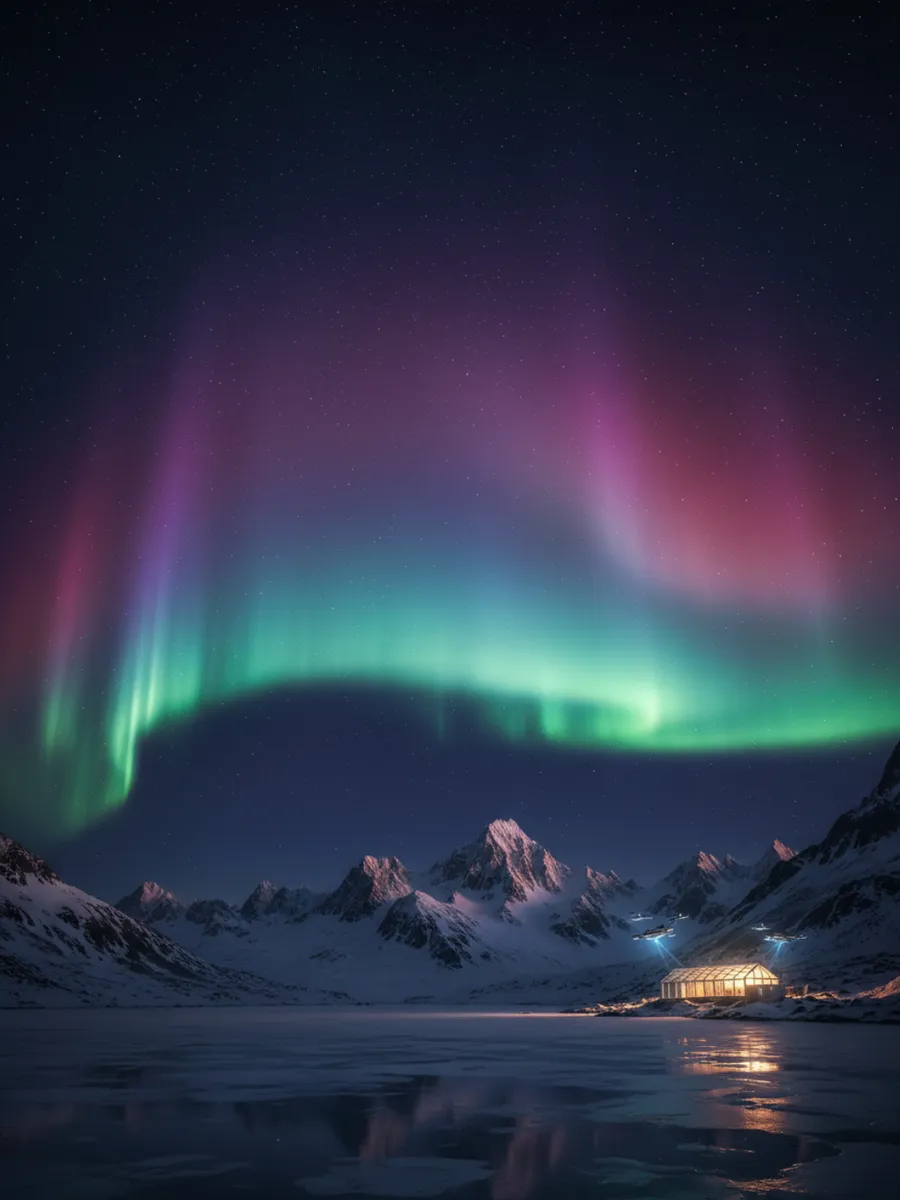
The iconic neon green of the Aurora Borealis is a masterpiece of quantum mechanics occurring roughly 100 to 240 kilometers above the Earth. This specific hue is emitted by atomic oxygen ($O$) in a highly specific excited state. When high-energy solar electrons collide with oxygen atoms, they kick the atoms into a metastable state.
As the atom relaxes to a lower energy level, it releases a photon at a wavelength of 557.7 nanometers. While this transition is theoretically 'forbidden' by certain selection rules in quantum mechanics, it occurs frequently in the thin upper atmosphere.
The dominance of green is primarily due to the atmospheric density at this altitude. It is low enough that the oxygen atom has time to emit its photon before it can be 'quenched' (losing energy via collision with another particle), yet dense enough that there are plenty of atoms available to produce a bright, visible glow. This represents the 'Sweet Spot' of auroral activity.
Key Takeaway
Green auroras occur when atomic oxygen undergoes a 557.7 nm forbidden transition at mid-altitudes where collisional quenching is minimal.
Test Your Knowledge
What is the primary factor that allows the 'forbidden' green transition to dominate at 100-240km?
At altitudes exceeding 300 kilometers, the aurora shifts from emerald to a haunting, ethereal red. This 630.0 nanometer emission is also produced by atomic oxygen, but it involves a much lower energy transition than the green light. You might wonder: if it requires less energy, why isn't it seen lower down?
The answer lies in the radiative lifetime of the state. The excited state responsible for red light is incredibly 'fragile,' taking up to 110 seconds to release a photon. In the denser regions where green light thrives, an atom in this state would almost certainly collide with another particle and lose its energy long before it could glow red.
Only in the extremely tenuous 'top' of our atmosphere—where atoms can travel for kilometers without hitting one another—does the red oxygen emission survive. Because the human eye is less sensitive to red than green, these high-altitude displays often appear as a faint, diffuse glow compared to the sharp ribbons of green below.
Key Takeaway
Red auroras are high-altitude phenomena (300km+) where the 110-second radiative lifetime of the red oxygen state isn't interrupted by collisions.
Test Your Knowledge
Why is red oxygen light rarely seen at lower altitudes (e.g., below 150km)?
While oxygen handles the greens and reds, molecular nitrogen ($N_2$ and $N_2^+$) is responsible for the striking blues, purples, and pinks. These colors typically appear at the very bottom edge of the auroral curtains, roughly 80 to 100 kilometers high. Because nitrogen is a sturdy molecule, it requires much higher-energy incoming electrons to reach an excited or ionized state.
When ionized nitrogen ($N_2^+$) relaxes, it emits light in the blue (427.8 nm) and violet (391.4 nm) spectrums. During intense geomagnetic storms, these high-energy particles penetrate deeper into the atmosphere, hitting the dense nitrogen layers and creating a vibrant magenta or pink fringe where the blue nitrogen light mixes with the green oxygen light.
Capturing these colors is a sign of high Kp-index activity. Since our eyes are poorly adjusted to blue light in the dark (the Purkinje effect), these colors often appear much more vivid in long-exposure photography than to the naked eye, where they might simply look like a shimmering white or pale lilac.
Key Takeaway
Blue and purple hues come from ionized nitrogen at low altitudes and are markers of high-energy particle precipitation during intense solar storms.
Test Your Knowledge
Which molecule is responsible for the purple and blue fringes seen at the base of auroral curtains?
Track your progress, earn XP, and compete on leaderboards. Download NerdSip to start learning.