Why can't you see magnetic fields if your eye proteins actually can?
Prompted by A NerdSip Learner
Master the quantum and structural limits of human magnetoreception.
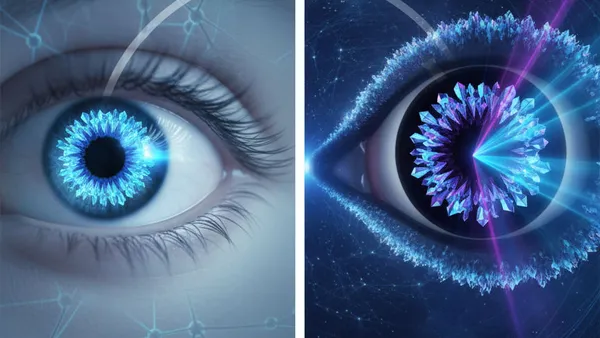
To understand magnetoreception, we must zoom into the quantum realm. When blue light enters the eye, it strikes a light-absorbing cofactor within the cryptochrome protein called Flavin Adenine Dinucleotide (FAD).
Upon absorbing a photon, the FAD cofactor becomes highly excited and rapidly pulls an electron from a nearby chain of amino acids known as the tryptophan triad (or tetrad, in some birds). This cascading electron transfer creates a radical pair—two molecules that each possess an unpaired electron.
Thanks to quantum mechanics, the spins of these two unpaired electrons become instantly entangled. They rapidly oscillate back and forth between two distinct quantum states: a parallel state (triplet) and an antiparallel state (singlet).
Here is the magic: the Earth's magnetic field directly influences how much time the radical pair spends in the singlet versus the triplet state. This subtle quantum tilt dictates the resulting chemical shape of the cryptochrome protein, beautifully converting a magnetic line of force into a tangible biological signal.
Key Takeaway
The Earth's magnetic field alters the quantum spin states of unpaired electrons within the cryptochrome protein.
Test Your Knowledge
What specifically oscillates between the singlet and triplet quantum states within cryptochrome?
If human and avian cryptochromes both undergo radical pair reactions, why can birds navigate while we cannot? The secret lies not just in the protein itself, but in the highly specialized, microscopic architecture of the avian retina.
Migratory birds rely on a specific cryptochrome variant called Cry4a. Rather than being scattered randomly, Cry4a is densely packed into the outer membranes of specialized photoreceptors known as double cones. Humans completely lack these unique cellular structures.
In the bird's eye, these double cones form a highly ordered geometric mosaic. This strict spatial alignment is crucial. It ensures that the cryptochrome molecules are perfectly anchored in the exact same orientation, acting much like an array of synchronized satellite dishes.
Without this cellular scaffolding, a magnetic response is useless for navigation. Because human cryptochromes (like Cry1 and Cry2) lack this rigid, aligned mosaic structure, any magnetic signals they generate are likely chaotic, firing randomly and making it impossible for the brain to decode them as directional information.
Key Takeaway
Birds use highly aligned double cone cells to orient their cryptochrome, acting as a structural directional antenna that humans lack.
Test Your Knowledge
Why is the structural arrangement of double cones essential for avian navigation?
Given our lack of double cones, is the magnetic capability of human cryptochrome completely dead? To answer this, scientists performed a fascinating transgenic experiment using *Drosophila* (fruit flies).
Researchers took mutant fruit flies that had been genetically stripped of their native cryptochrome, rendering them "magnetically blind." They then inserted the gene for human cryptochrome-2 (hCRY2)—the exact protein variant found heavily expressed in the human retina.
The results were stunning. The human protein successfully "rescued" the flies' magnetic sense. When placed in a customized maze, the transgenic flies with human cryptochrome could once again navigate using magnetic fields, provided there was blue light to trigger the radical pair mechanism.
This proves that human cryptochromes still possess the functional molecular machinery to act as light-dependent magnetic sensors. However, somewhere along our evolutionary journey, we simply lost the precise retinal scaffolding and the downstream neural pathways required to translate those quantum signals into a conscious compass.
Key Takeaway
Human cryptochrome retains its magnetic sensitivity at a molecular level, but our biology lacks the cellular architecture to utilize it.
Test Your Knowledge
What did the transgenic fruit fly experiment reveal about human cryptochrome-2 (hCRY2)?
Track your progress, earn XP, and compete on leaderboards. Download NerdSip to start learning.