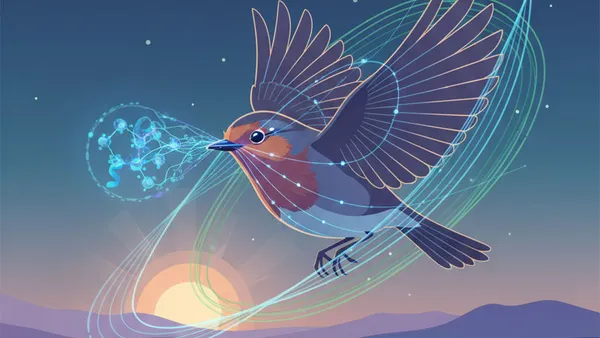
How do birds cross oceans without a map?
Prompted by A NerdSip Learner
Understand the quantum protein guiding bird migration.
Have you ever wondered how a tiny European robin can travel thousands of miles across featureless oceans without a GPS? For a long time, scientists thought birds had tiny bits of iron in their beaks acting like a magnetic compass needle.
But recent discoveries have turned that theory on its head. The secret to avian navigation is actually hidden right inside their eyes! It comes down to a special light-sensitive protein called Cryptochrome 4 (or CRY4).
Located in the bird's retina, CRY4 is a unique photoreceptor. Interestingly, this built-in biological compass relies on light to function. Specifically, it needs blue light to activate. Current evidence strongly suggests that when blue light enters the bird's eye, it kicks off a chemical reaction that is thought to allow the bird to literally "see" the Earth's magnetic fields as a visual pattern overlaid on their environment.
Key Takeaway
Migratory birds likely navigate by visually perceiving magnetic fields through a light-sensitive protein in their retinas called Cryptochrome 4.
Test Your Knowledge
Where is the protein Cryptochrome 4 located in a bird?
It sounds like science fiction, but migratory birds are practically flying quantum computers! To understand how Cryptochrome 4 works, we have to zoom down to the subatomic level, into the weird world of quantum physics.
When a particle of blue light hits the CRY4 protein, it knocks an electron out of place. This creates what chemists call a radical pair—two molecules with unpaired electrons that are quantumly entangled.
Because electrons have a property called "spin," they are incredibly sensitive to magnetic forces. Even the Earth's extremely weak magnetic field is enough to subtly alter how these electrons spin and eventually recombine. This tiny quantum wobble changes the chemical output of the protein. The bird's nervous system then translates this unique chemical signal into directional information, pointing them toward their destination!
Key Takeaway
Cryptochrome 4 relies on a quantum physics phenomenon called the radical pair mechanism to detect the Earth's magnetic field.
Test Your Knowledge
What does blue light create when it hits the Cryptochrome 4 protein?
Birds actually have several types of cryptochromes in their bodies. Proteins like Cry1 and Cry2 are famous for regulating the biological clock—the circadian rhythm. Because they manage sleep and wake cycles, their levels naturally rise and fall throughout the day.
But Cryptochrome 4 is remarkably different. Researchers studying zebra finches and European robins found that CRY4 levels remain beautifully constant, day and night. This makes it the perfect candidate for a biological compass, as a migrating bird needs reliable navigation regardless of what time it is!
Furthermore, laboratory tests have shown that the CRY4 protein in migratory birds is significantly more magnetically sensitive than the same protein found in non-migrating birds, like chickens. While scientists are still working to definitively prove exactly what the bird "sees" in the wild, this incredible intersection of biology and quantum mechanics is our best explanation yet for one of nature's greatest mysteries.
Key Takeaway
Unlike other proteins that fluctuate with the biological clock, CRY4 remains constant, providing a reliable compass for long-distance migration.
Test Your Knowledge
Why is Cryptochrome 4 better suited for navigation than Cry1 or Cry2?
Track your progress, earn XP, and compete on leaderboards. Download NerdSip to start learning.