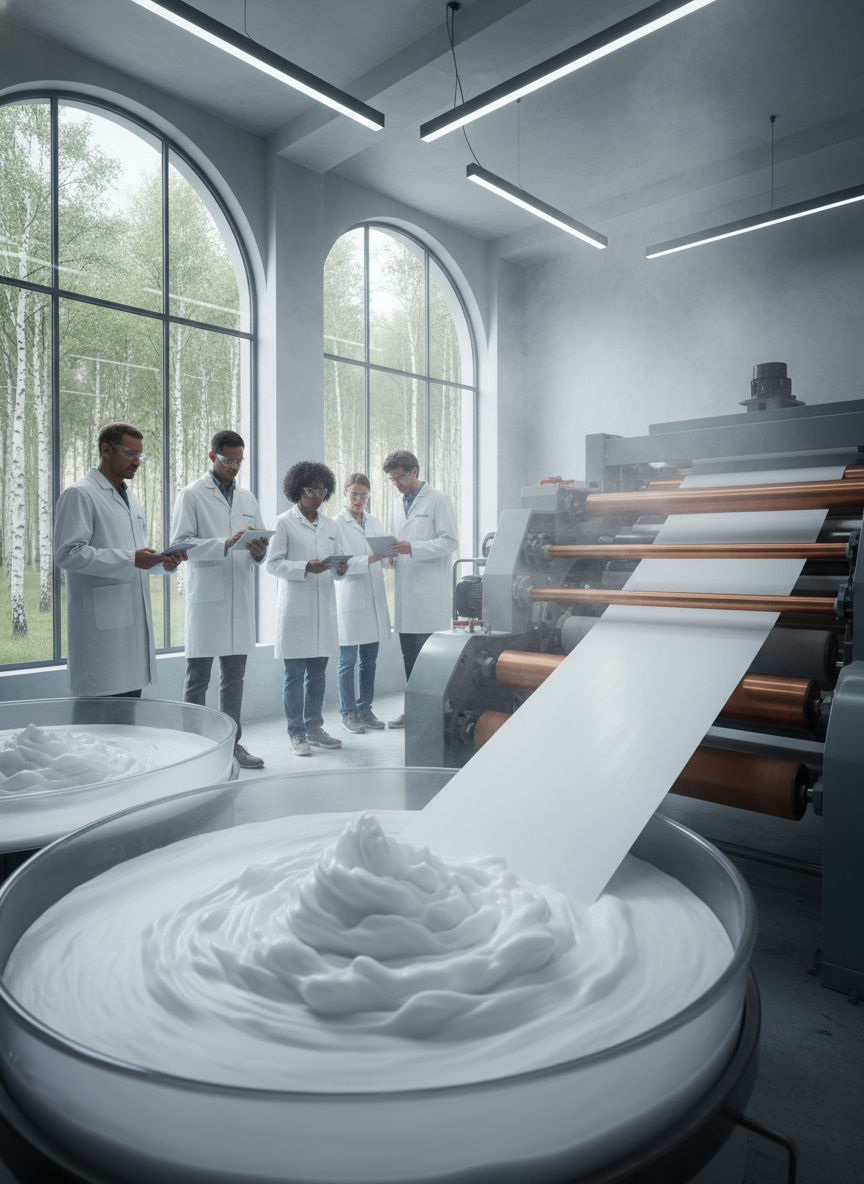
Ever wondered how a massive tree becomes a razor-thin sheet of paper?
Prompted by NerdSip Explorer #3276
Master the chemistry and engineering behind paper production.
Think papermaking is just giant factories? It actually started nearly 2,000 years ago in China. An official named Cai Lun perfected the craft in 105 AD by using boiled bark and old rags to create the first true fiber pulp.
The secret ingredient is a natural wonder: cellulose. These long, plant-based fibers form the skeleton of almost all plants. When you dissolve these fibers in water and then let the liquid drain away, something microscopic happens.
As they dry, the fibers form hydrogen bonds. They interlock and "velcro" together at a molecular level without any extra glue. While wood became the main source in the 1800s, the chemical principle of this matted plant web hasn't changed in centuries.
Key Takeaway
Paper is a dried web of plant cellulose held together by natural chemical bonds—no extra glue required.
Test Your Knowledge
Why do paper fibers naturally stick together after drying?
To turn a solid log into paper, the wood must be broken down into microscopic fibers. This is called stock preparation. Depending on the final product, manufacturers use either raw mechanical force or clever chemistry.
In the mechanical process (groundwood), debarked logs are pressed against giant rotating grindstones under running water. It's efficient because nearly the whole tree is used. However, a natural wood "glue" called lignin stays in the fibers. Lignin is light-sensitive—that’s why old newspapers turn yellow and brittle on a sunny windowsill!
For high-quality paper, the chemical pulping method is used. Wood chips are cooked in large vats with chemicals to dissolve the unwanted lignin. What's left are long, pure, and strong cellulose fibers. This paper doesn't yellow and is much tougher—the perfect base for your books and legal contracts.
Key Takeaway
Groundwood pulp contains lignin which causes yellowing, while chemical pulp yields pure, long-lasting paper.
Test Your Knowledge
Which wood component causes newsprint to turn yellow in the sun?
Modern paper machines are some of the largest industrial systems on Earth. Often over 100 meters long, they run 24/7. Their primary job is surprisingly simple: they must remove all the water from a watery mush called fiber suspension.
The journey begins in the forming section. The slurry—99% water and only 1% fiber—is sprayed onto a fast-moving mesh screen. As the water drains away, the fibers interlock on the surface. The first delicate web of paper is born!
Next, the wet web speeds into the press section. Heavy rollers squeeze the damp sheet like a sponge, forcing out more water. Finally, the drying section uses steam-heated steel cylinders to evaporate the remaining moisture. Out of 99% water comes a solid, dry sheet.
Key Takeaway
A paper machine creates a sheet by removing water from a 99% liquid mix through draining, pressing, and heating.
Test Your Knowledge
In which part of the machine do fibers first interlock into a continuous web?
The paper exiting the drying cylinders is often rough and absorbent—known as "uncoated" paper. If you printed on this with ink, the colors would bleed like a paper towel. To make it premium, it needs finishing.
The most important step is "coating." A coating machine applies a liquid layer of pigments (like chalk or clay) and binders. This "coating color" fills the microscopic valleys between fibers, creating a smooth, sealed surface—essential for crisp, high-gloss images.
To achieve the perfect finish, the paper is then calendered. A calender is a massive stack of heavy, heated steel rollers. The paper passes through these rollers under immense pressure. Much like a hot iron smooths wrinkles out of a shirt, the calender densifies the paper, giving it its final thickness and a silky, professional shine.
Key Takeaway
Coating with pigments and "ironing" with a calender makes raw paper smooth, ink-resistant, and ready for high-quality printing.
Test Your Knowledge
Which household tool best describes how a calender works?
Recycling paper saves massive amounts of water, energy, and wood. The key trick in processing old paper is de-inking, because old printer ink has to disappear completely.
Waste paper is dissolved in water in giant vats called "pulpers." Special soaps are added, and air is blown in from the bottom. The water-repellent ink particles latch onto the rising bubbles. A gray foam forms at the top, carrying the ink away to be skimmed off.
But the system has limits. Paper can’t be recycled forever. Every time fibers are pulped and pumped, they break and get shorter. After about 5 to 7 cycles, the fibers become too weak to interlock effectively. This is why virgin fibers must be added to the mix to ensure the recycled paper doesn't just fall apart.
Key Takeaway
Paper can be recycled roughly 5 to 7 times before the fibers become too short and weak to form a stable sheet.
Test Your Knowledge
Why can't a piece of paper be recycled an infinite number of times?
Track your progress, earn XP, and compete on leaderboards. Download NerdSip to start learning.