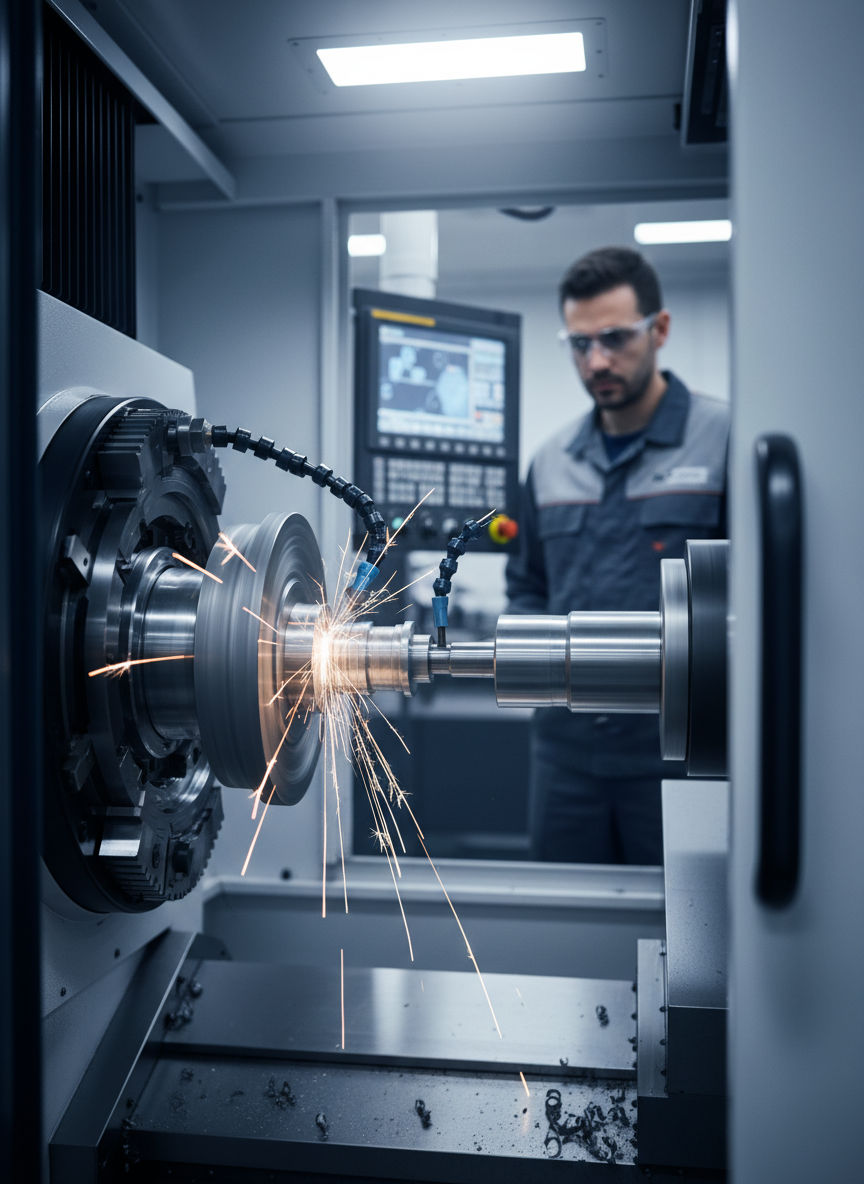
How do we carve solid steel into high-tech components?
Prompted by NerdSip Explorer #3276
Master the high-precision essentials of CNC turning.
Imagine a sculptor carving marble into a masterpiece. A CNC turner does the same thing, but with metal, extreme precision, and computers!
You command advanced machines. Instead of manual filing, you use computer-controlled systems to transform raw metal into gleaming components. These parts are found in cars, aircraft, and even medical devices.
The role is a fusion of craftsmanship and high-tech. You must understand metal behavior while thinking like a programmer. You feed the machine commands, which it executes with accuracy thinner than a human hair!
Every day, you create tangible, high-precision products that wouldn't exist without your unique digital and mechanical skills.
Key Takeaway
A CNC turner is a modern craftsman using computers to manufacture extremely precise metal components.
Test Your Knowledge
What is the primary task of a CNC turner?
What does the acronym "CNC" actually stand for? It means "Computerized Numerical Control". Essentially, it's the digital brain behind the metalwork.
In the old days, craftsmen had to turn heavy cranks by hand to shape metal. It required immense strength and was nearly impossible to replicate the same part perfectly every time.
Today, the computer takes over. "Numerical" refers to coordinates, much like the game Battleship. You tell the machine via code: "Move to point X, then cut into the material until point Y."
The computer translates this plan into lightning-fast, precise movements. The best part? Repeatability. Once you’ve programmed the blueprint, the machine can produce a thousand identical parts with zero variation.
Key Takeaway
CNC stands for computer control, allowing machines to work with extreme precision based on programmed coordinates.
Test Your Knowledge
What does CNC control replace in modern machinery?
The heart of a CNC turner’s world is the lathe. To understand how it works, think of a classic pottery wheel.
On a pottery wheel, wet clay spins while the potter uses their hands to shape the material. The lathe uses this exact principle! The raw metal piece is clamped and rotates at high speeds around its own axis.
Instead of hands, the machine uses an incredibly hard tool to shape the spinning metal. Because the piece rotates, the material is stripped away evenly from the outside.
That’s why the job is called "turning." The results are usually cylindrical or round. Think of bolts, car axles, or rings. If it’s round and made of metal, it likely met a lathe!
Key Takeaway
On a lathe, the workpiece rotates rapidly around its axis to create primarily round components.
Test Your Knowledge
Which everyday object best illustrates the principle of a lathe?
When a massive block of steel is spinning, a normal blade won't cut it. You need tools that are much harder than the metal being shaped.
A CNC turner uses specialized cutting tools called indexable inserts. These are small plates made of ultra-tough materials like carbide or even synthetic diamond.
When this hard insert meets the spinning metal, the excess material is peeled away like a tiny curl. In the industry, we call these metallic curls chips.
Choosing the right tool is a vital skill. Aluminum needs different tools than tough stainless steel. You must also sense when a tool is dull and replace it to keep every part perfect.
Key Takeaway
To shape metal precisely, the turner uses specialized tools that are harder than the material being processed.
Test Your Knowledge
Why must a CNC turner's cutting tools be made of special materials?
Everything begins with a technical drawing. This is the blueprint that defines exactly how long, thick, and shaped the final part must be.
As a CNC turner, you read this drawing like a musician reads a score. Then, you write the CNC program, translating the blueprint into the machine's digital language.
Once the program is ready, you secure the raw metal and perform a test run to ensure accuracy. This is the moment of truth.
When you hit start, the doors lock, coolant sprays to prevent overheating, and chips fly. Within minutes, a rough block is transformed into a shiny, high-precision masterpiece!
Key Takeaway
The process begins with a technical drawing, which is translated into a program before the machine starts production.
Test Your Knowledge
What is usually the first step in a CNC turner's workflow?
Track your progress, earn XP, and compete on leaderboards. Download NerdSip to start learning.