Think polar bears are white? You’ve been living a lie. Here is why.
Prompted by A NerdSip Learner
Uncover the physics behind animal camouflage.
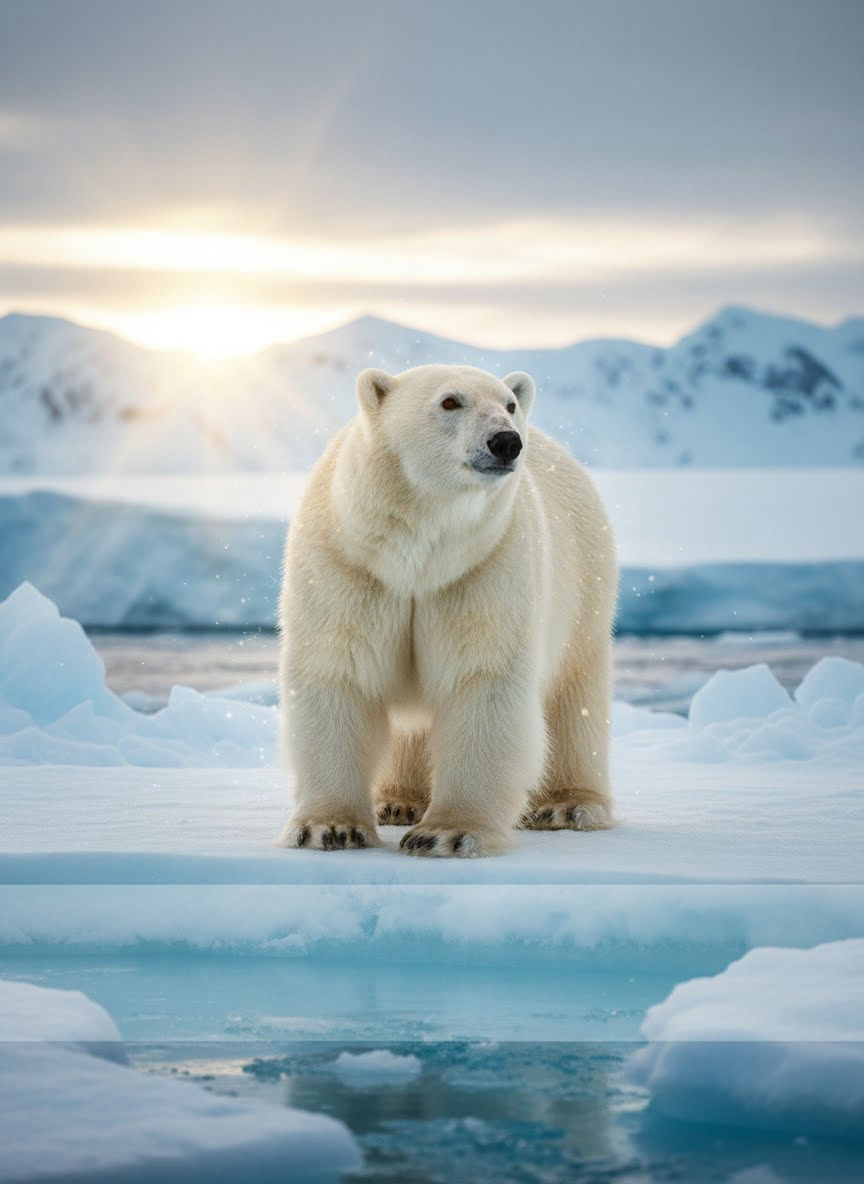
Here is a mind-blowing fact to kick things off: Polar bears are not actually white. If you looked at a single strand of their fur under a high-powered microscope, you would see that it is completely transparent, just like a glass tube!
So, why do they look like fluffy marshmallows? It all comes down to physics. When sunlight hits the clear hair strands, it bounces around inside the hollow core and scatters in every direction. This process is called luminescence.
Because the sun's light is white, the scattering light reflects that whiteness back to your eyes. It is the same reason a heap of crushed clear glass looks white, or why a cloud looks white even though it is made of clear water droplets. Their color is a trick of the light!
Key Takeaway
Polar bear fur is pigment-free and transparent; it only appears white due to scattered light.
Test Your Knowledge
What is the actual color of a polar bear's individual hair strand?
Now that we know the fur is clear, let's look deeper. If you were to shave a polar bear (please don't try this!), you would find that their skin is jet black.
This is a brilliant evolutionary adaptation for survival in the freezing Arctic. In physics, black absorbs heat while white reflects it. The transparent fur allows sunlight to pass straight through the coat and hit the black skin, which absorbs the infrared radiation (heat) from the sun to keep the bear warm.
It is a perfect thermal engineering system! The clear fur acts like a greenhouse, trapping the solar energy against the dark skin while simultaneously scattering visible light to camouflage the bear against the snow. They are essentially solar-powered heat sponges wrapped in an invisibility cloak.
Key Takeaway
Polar bears have black skin to absorb solar heat efficiently, while their fur lets the sunlight in.
Test Your Knowledge
Why is black skin advantageous for a polar bear?
Let's zoom back in on those hair strands. Not only are they transparent, but they are also hollow. This is distinct from most other mammals, whose hair is solid keratin.
This hollow core serves two massive purposes. First, it assists in the light-scattering effect we talked about earlier, making the white color more intense. But more importantly, it provides incredible insulation.
Air is a terrible conductor of heat (which means it's a great insulator). By trapping a column of stationary air inside every single hair, the bear creates a barrier that stops body heat from escaping into the frozen air. It is the same principle used in double-glazed windows or your favorite puffer jacket. This insulation is so effective that polar bears are practically invisible to infrared cameras!
Key Takeaway
The hollow core of the fur traps air, acting as powerful insulation similar to a puffer jacket.
Test Your Knowledge
What is the primary thermal function of the hollow space inside the fur?
We know *how* they look white, but *why* did evolution push them this way? The obvious answer is camouflage, but specifically for hunting, not hiding from predators (polar bears are apex predators; nothing hunts them except humans).
Their main food source is the ringed seal. Seals are fast in the water but vulnerable when they surface for air or rest on the ice. A dark brown bear would be spotted instantly against the stark white backdrop of the Arctic sea ice.
By blending in seamlessly with the snow, a polar bear can creep remarkably close to a seal before launching an attack. This represents aggressive mimicry. Without this white camouflage, they would struggle to catch enough calorie-dense blubber to survive the extreme cold. Their color isn't just for style; it is a critical tool for dinner!
Key Takeaway
The white appearance is an evolutionary adaptation primarily for stealthy hunting on sea ice.
Test Your Knowledge
Why is camouflage most important for the polar bear?
Sometimes, you might visit a zoo and see a polar bear that looks yellow or even green. If their fur is transparent, how is this possible?
The yellowing usually happens to wild bears due to age and diet—oils from seal blubber can stain the fur, much like a white t-shirt gets stained over time. Oxidation from the sun also plays a role.
The green color, however, is a unique problem for bears in warmer climates (like zoos). Remember those hollow hair tubes? In humid conditions, algae can grow *inside* the hollow cores of the hair! The bear isn't sick; it just has a mini garden growing inside its coat. The algae is protected inside the hair shaft, making it hard to wash out until the bear sheds its coat in the spring. It is a weird side effect of their specialized biology!
Key Takeaway
Polar bears can appear green in captivity because algae grows inside their hollow hair shafts.
Test Your Knowledge
What causes a captive polar bear to look green?
Track your progress, earn XP, and compete on leaderboards. Download NerdSip to start learning.