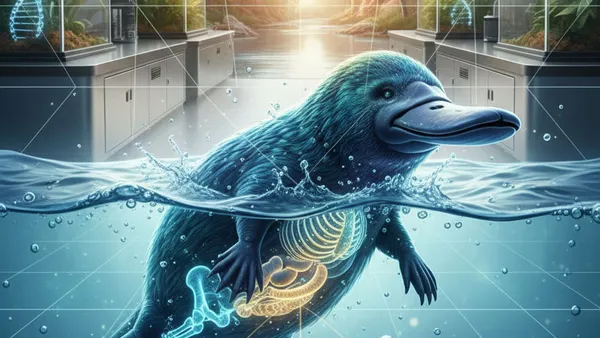
Think you know the platypus? Prepare to have your mind blown.
Prompted by NerdSip Explorer #6412
Master 5 advanced biological secrets of the platypus.
Most mammals, including humans, determine sex using a simple two-chromosome system: XX for females and XY for males. The platypus, however, completely rewrites the genetic rulebook with a staggering 10 sex chromosomes.
A male platypus possesses a chromosomal makeup of XXXXXYYYYY. During meiosis—the process of creating sperm cells—these ten chromosomes must perfectly align. They form a massive, alternating chain (X1-Y1-X2-Y2...) that carefully unzips to ensure each sperm gets exactly five Xs or five Ys.
What makes this even more fascinating is the evolutionary link it reveals. The platypus X chromosomes share deep genetic homologies with the Z chromosome found in birds. Furthermore, the platypus completely lacks the *SRY* gene, which is the master switch for male development in most other mammals.
This unique chromosomal chain suggests that the platypus sits at a genetic crossroads. It provides a living snapshot of how sex determination evolved, bridging the gap between ancient reptilian/avian ancestors and modern therian mammals.
Key Takeaway
Platypuses possess a complex 10-sex-chromosome system that links mammalian and avian genetics.
Test Your Knowledge
How many sex chromosomes does a male platypus have?
The modern platypus is famous for its rubbery, duck-like bill, but its evolutionary past paints a much more intimidating picture. If we rewind the clock 25 million years to the Late Oligocene epoch, we meet an extinct ancestor known as *Obdurodon insignis*.
Unlike today's toothless platypuses, *Obdurodon* sported a full set of highly developed, permanent teeth. Recent fossil discoveries from South Australia have uncovered large, pointed premolars and robust molars. These strong teeth indicate that *Obdurodon* had a remarkably powerful bite.
Paleontologists believe this ancient monotreme occupied a slightly different ecological niche than its modern descendants. While today's platypus hunts soft-bodied invertebrates, *Obdurodon* used its permanent teeth to crush the tough shells of large crustaceans, small turtles, and even frogs.
The eventual loss of teeth in the platypus lineage highlights a fascinating evolutionary trade-off. Over millions of years, as their specialized electroreceptive bills became more advanced for detecting hidden prey, the need for heavy, bone-crushing jaws slowly faded away.
Key Takeaway
Ancient platypus ancestors like Obdurodon possessed permanent teeth to crush hard-shelled prey.
Test Your Knowledge
What did the extinct ancestor Obdurodon possess that modern adult platypuses lack?
Given that adult modern platypuses lack permanent teeth, you might wonder how they manage to chew their food. The answer lies in a remarkable combination of anatomical adaptation and clever foraging behavior.
Shortly after a platypus hatches, it actually possesses tiny vestigial teeth. However, these drop out early in development. In their place, the platypus grows heavily keratinized pads—tough, horny plates located at the top and bottom of their mouths, made of the same protein as human fingernails.
When a platypus dives to the bottom of a river, it uses its sensitive bill to scoop up worms, insect larvae, and freshwater shrimp. Crucially, it intentionally scoops up coarse gravel, mud, and river grit along with its meal, storing everything in specialized cheek pouches.
Once the platypus surfaces to breathe, the real work begins. It uses the ingested gravel as a makeshift set of teeth, violently mashing the grit against its keratin pads to grind the prey into a digestible paste before swallowing.
Key Takeaway
Modern platypuses use a combination of ingested river gravel and keratinized mouth pads to physically grind their food.
Test Your Knowledge
What does a modern adult platypus use to mash its food before swallowing?
Platypuses spend hours foraging in rivers that can drop to near-freezing temperatures, yet they maintain a constant core body temperature of roughly 32°C (90°F). They achieve this through a masterclass in mammalian thermoregulation.
First, their incredibly dense, waterproof fur traps a layer of air against their skin, preventing cold water from ever touching their bodies. But their exposed rubbery bill, webbed feet, and paddle-like tail are vulnerable to heat loss.
To counter this, platypuses utilize a countercurrent heat exchange system in their limbs. As warm arterial blood pumps from the heart toward the feet, it runs parallel to the cold venous blood returning to the body. The heat transfers between the vessels, warming the returning blood and preventing the animal's internal organs from freezing.
Furthermore, the platypus uses its flat, beaver-like tail as a metabolic thermal battery. In times of abundance, a platypus stores up to 50% of its total body fat directly in its tail, providing vital insulation and a massive energy reserve for winter.
Key Takeaway
Platypuses survive freezing waters using tail-fat storage and countercurrent heat exchange in their limbs.
Test Your Knowledge
Where does the platypus store up to half of its total body fat?
When a platypus curls up tightly in its burrow to sleep, it enters a neurological state that continues to baffle scientists. Research indicates that the platypus experiences more Rapid Eye Movement (REM) sleep than any other animal on the planet.
While a human might get about two hours of REM sleep a night, a platypus averages between 5.8 and 8 hours of REM sleep every single day. During this phase, they exhibit classic signs of deep dreaming: their bills twitch violently, their legs paddle in the air, and their closed eyes dart rapidly.
However, brain wave monitoring reveals a bizarre twist. While their bodies are clearly in REM, their electrical brain activity (EEG) looks moderate-to-high in voltage, closely resembling the deep, non-REM sleep of other mammals.
Scientists hypothesize that this overlapping sleep state is an ancient evolutionary relic. Because monotremes branched off from other mammals over 100 million years ago, their massive REM requirements might reflect the original, primitive sleep patterns of the earliest proto-mammals.
Key Takeaway
Platypuses hold the record for the most REM sleep of any mammal, hinting at the sleep patterns of ancient proto-mammals.
Test Your Knowledge
What sleep-related record does the platypus hold among mammals?
Track your progress, earn XP, and compete on leaderboards. Download NerdSip to start learning.