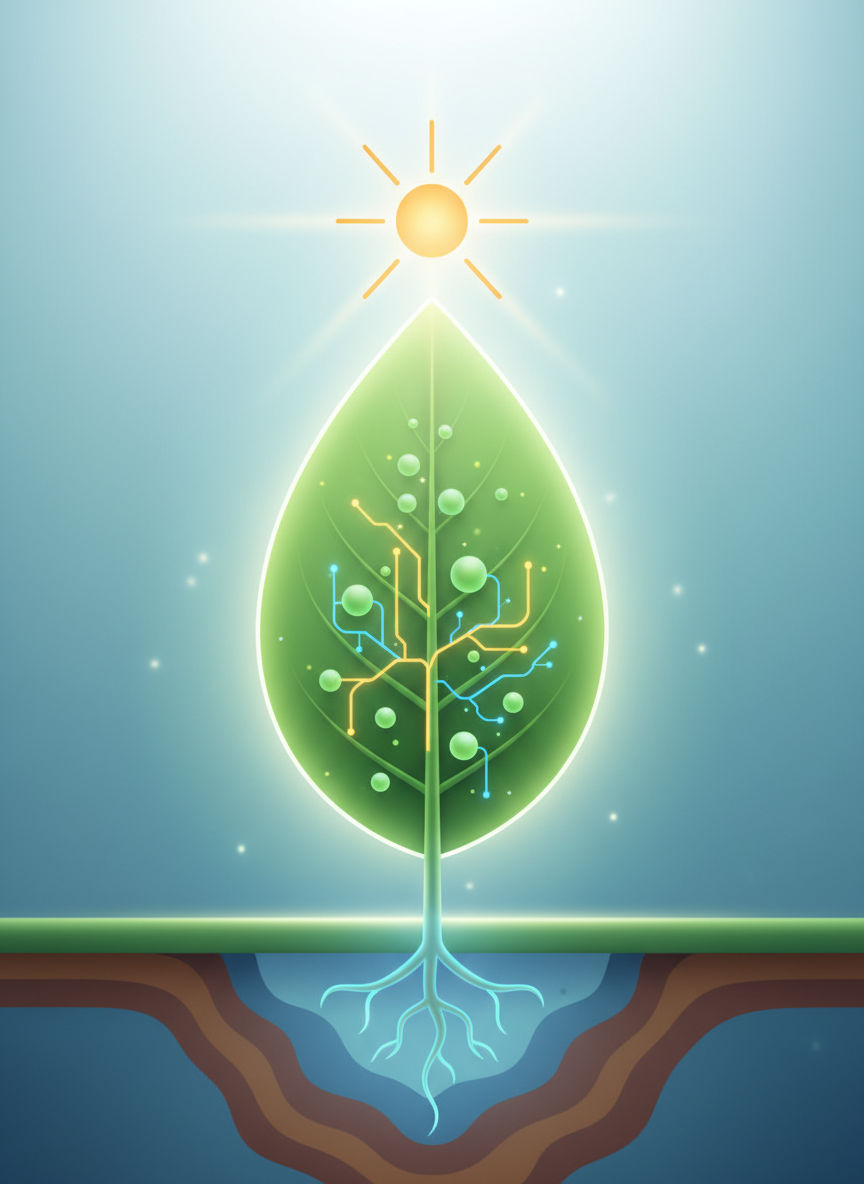
Ever wonder how plants pull food straight out of thin air?
Prompted by A NerdSip Learner
Understand how plants turn sunlight and air into energy.
At its core, photosynthesis is the process plants use to make their own food. But unlike us, they don’t need to commute to a grocery store or cook in a kitchen. Instead, they act as miniature, highly efficient solar-powered factories, pulling their ingredients right out of the surrounding environment!
There are three main ingredients in this botanical recipe: sunlight, water (drawn up through an intricate network of roots), and carbon dioxide (absorbed invisibly from the air). By combining these three basic elements, plants are able to perform one of the most important and elegant chemical reactions on Earth.
Inside the plant's leaves are microscopic structures called chloroplasts. These tiny compartments contain a special green pigment called chlorophyll, which acts exactly like a biological solar panel. It catches the radiant energy from sunlight and uses it to kickstart the entire food-making process.
Without this incredible, quiet ability to harvest light, life on Earth as we know it simply couldn't exist. Plants form the very foundation of our entire global food chain, beautifully converting raw solar energy into a physical form that the rest of us can eventually consume.
Key Takeaway
Plants use sunlight, water, and carbon dioxide to create food inside microscopic structures called chloroplasts.
Test Your Knowledge
Which pigment acts like a biological solar panel to capture energy from sunlight?
So, what exactly happens when the plant mixes that sunlight, water, and carbon dioxide together? A brilliant and complex chemical transformation takes place within the leaves! The raw solar energy captured by the chlorophyll is forcefully used to break apart the absorbed water molecules into their base components: oxygen and hydrogen.
Next, the plant takes that newly freed hydrogen and carefully combines it with the carbon dioxide it pulled from the air. This specific combination creates an energy-rich, simple sugar known as glucose. You can think of glucose as the plant's personal, rechargeable battery pack. It provides all the essential energy the plant requires to grow taller, bloom into flowers, and repair any cellular damage.
But there is an absolutely incredible byproduct to this daily chemical reaction. When the plant breaks apart the water molecules, it has oxygen left over. Since it doesn’t need to hold onto all this extra oxygen, the plant simply exhales it back into the atmosphere.
This means that while the plant is busily cooking up sweet sugar to feed itself, it is simultaneously producing the very oxygen that humans and animals require to breathe.
Key Takeaway
Plants convert water and carbon dioxide into glucose for energy, releasing pure oxygen as a natural byproduct.
Test Your Knowledge
What is the primary product plants create for their own energy during photosynthesis?
It is quite easy to think of photosynthesis as something that just happens quietly in a backyard garden, but it is actually a massive, ongoing global operation. The profound impact of this biological process extends far beyond single plants; it literally regulates the entire planet's atmosphere and climate.
First, by continuously pulling massive amounts of carbon dioxide out of the air, plants act as a crucial and immense carbon sink. Carbon dioxide is a known greenhouse gas, meaning it traps atmospheric heat. By actively absorbing it, our global forests and ocean algae help keep the Earth's temperature balanced and mitigate the effects of climate change.
Second, remember that vital oxygen byproduct? Roughly half of the oxygen we breathe every single day doesn't even come from terrestrial trees, but from phytoplankton—microscopic, photosynthesizing organisms living largely unseen in our oceans.
Ultimately, every breath you take and every bite of food you eat fundamentally connects back to this elegant process. Photosynthesis acts as the invisible engine of the entire biosphere, continually recycling the air and transforming the sun's raw energy into vibrant life.
Key Takeaway
Photosynthesis balances the global climate by absorbing carbon dioxide and provides the oxygen necessary to sustain most life on Earth.
Test Your Knowledge
Where does roughly half of the oxygen humans breathe actually come from?
Track your progress, earn XP, and compete on leaderboards. Download NerdSip to start learning.