Why does one of Saturn's moons look exactly like a frozen ravioli?
Prompted by A NerdSip Learner
Uncover the strange physics of Saturn's innermost moon.
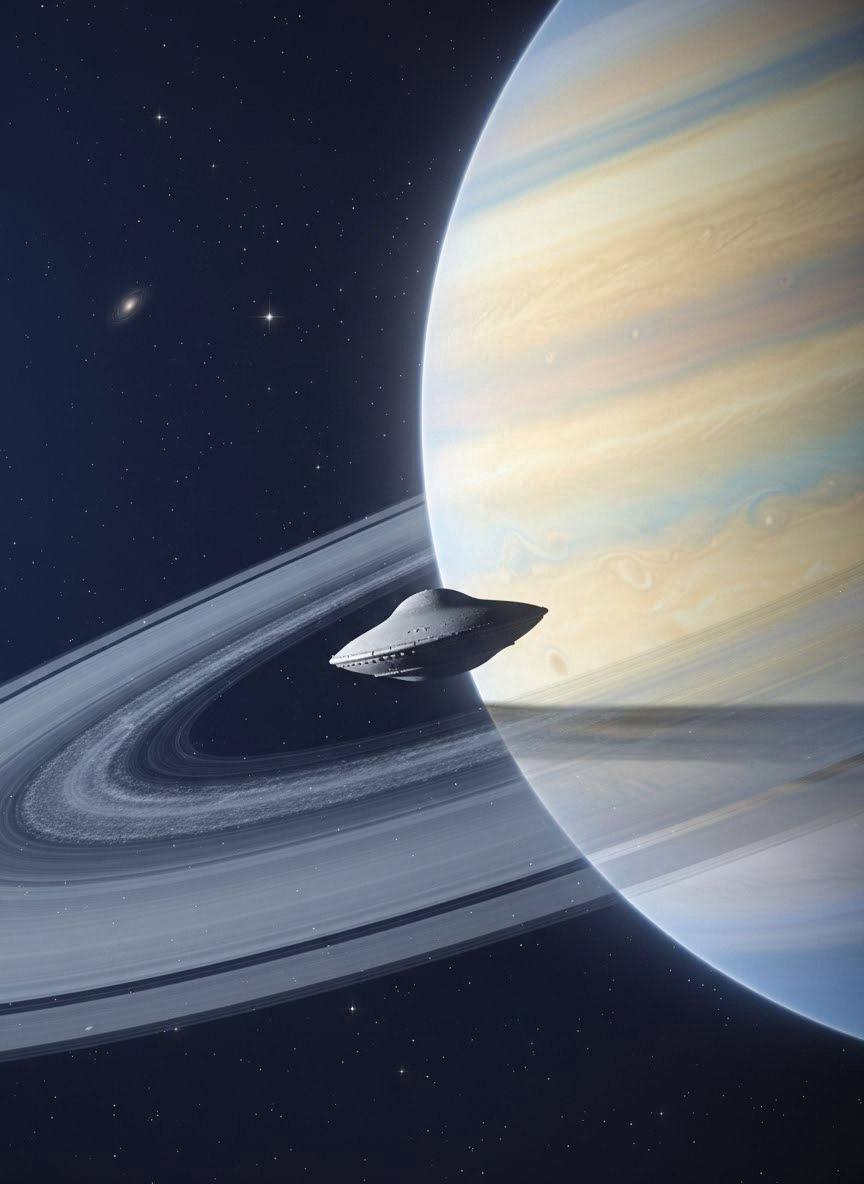
Imagine you are flying through space, approaching the mighty rings of Saturn, and you spot a tiny rock that looks... delicious? Meet Pan, the innermost named moon of Saturn. When the Cassini spacecraft sent back high-resolution photos in 2017, the internet went wild. Why? Because Pan looks exactly like a giant ravioli or a walnut!
This tiny moon is only about 35 kilometers (22 miles) wide, but it has a massive ridge running along its equator that gives it that distinct dumpling shape. Unlike our round Moon, Pan is too small for its own gravity to crush it into a perfect sphere.
Pan isn't just a funny-shaped rock, though. It is a cosmic time capsule. Its strange appearance tells us a unique story about how moons interact with ring systems, acting almost like a vacuum cleaner in space. Let's dive into where this space dumpling hangs out.
Key Takeaway
Pan is Saturn's innermost named moon, famous for its distinct ridge that makes it look like a ravioli.
Test Your Knowledge
Why doesn't Pan look like a perfect sphere?
Pan might be small, but it has a very important job. It lives inside Saturn’s A Ring, in a 325-kilometer wide highway called the Encke Gap. You might think this gap is empty space, but Pan is the reason it exists!
Pan is classified as a shepherd moon. Just like a sheepdog keeps a flock in line, Pan's gravity pushes ring particles away. As it orbits, it clears a path, forcing particles either ahead of it or behind it to speed up or slow down, effectively kicking them out of its lane.
But it doesn't just clear the road; it makes waves. As Pan cruises through the gap, its gravity creates beautiful, rippled wakes on the edges of the rings on either side. These wakes look like the waves a speedboat leaves behind in water, proving that gravity acts like an invisible tether even in the vacuum of space.
Key Takeaway
Pan creates and maintains the Encke Gap in Saturn's rings by pushing particles away with its gravity.
Test Your Knowledge
What is the specific term for a moon that clears a gap in a ring system?
So, how did Pan get that weird equatorial ridge? The answer lies in its diet. Pan essentially eats ring particles. Because Pan orbits right inside the rings, it is constantly surrounded by dust and ice.
Scientists believe the ridge formed via accretion. Over millions of years, ring material rained down onto Pan. Since the moon spins, this material naturally landed on the equator—similar to how a spinning pizza dough flattens out. But because Pan's gravity is so weak, the material didn't smash down flat; it just sort of piled up softly.
Think of it as a 'soft landing' for ice particles. This ridge is huge compared to the moon's body—about 10% of its volume! It suggests that Pan was once a smaller core that grew a 'tutu' of ice by sweeping up the leftovers in the Encke Gap.
Key Takeaway
Pan's ridge was formed by ring particles softly piling up on its equator over time.
Test Your Knowledge
Which process describes how Pan's ridge was formed?
Track your progress, earn XP, and compete on leaderboards. Download NerdSip to start learning.