What mountain is 3 times taller than Everest and the size of Arizona?
Prompted by A NerdSip Learner
Discover the incredible science behind Mars' biggest volcano.
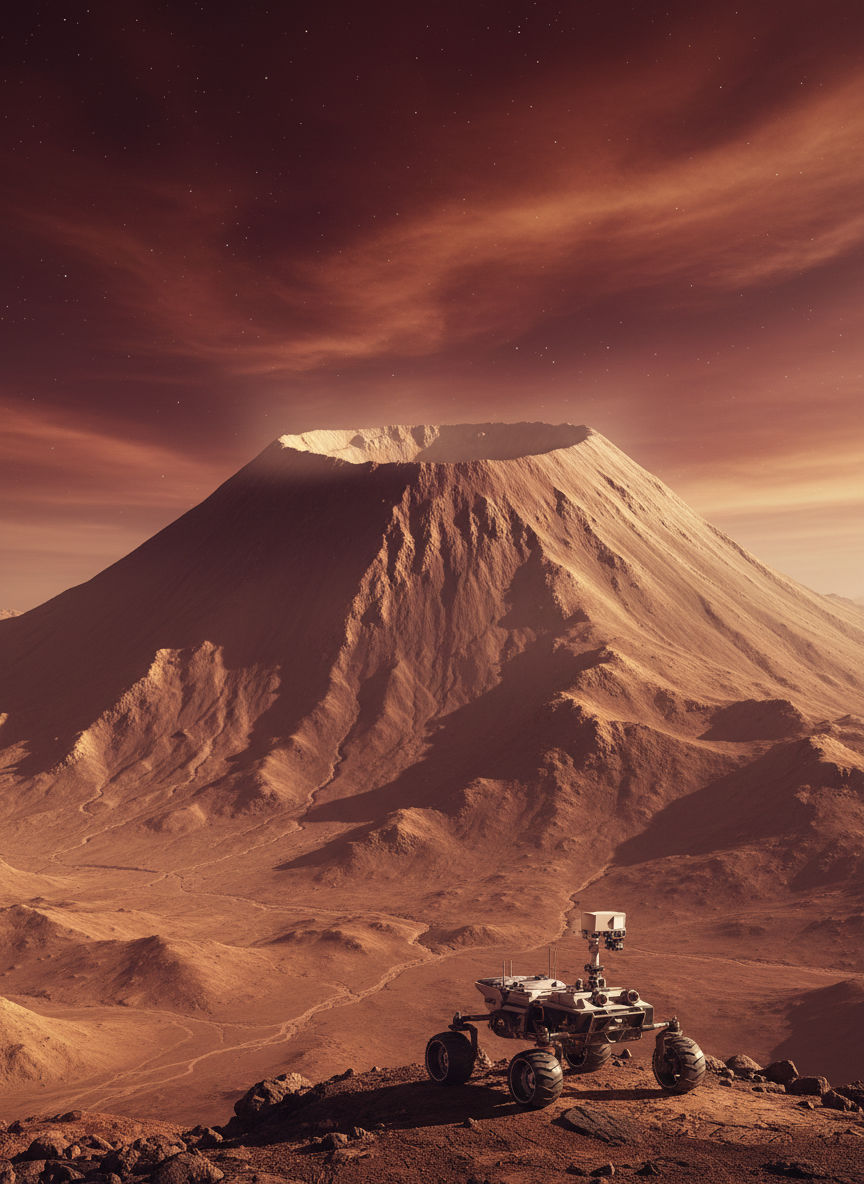
Imagine a mountain so massive that if you stood at its peak, you'd effectively be looking out into the vacuum of space. Welcome to Olympus Mons, the undisputed heavyweight champion of our solar system.
Located on Mars, this gargantuan shield volcano stands an astonishing 16 miles (25 kilometers) high. To put that sheer scale into perspective, that is almost three times the height of Mount Everest above sea level! If you were to somehow uproot Olympus Mons and drop it onto Earth, its base—stretching roughly 370 miles wide—would completely cover the entire state of Arizona or the country of France.
Despite its mind-boggling height, Olympus Mons doesn't actually look like a jagged, steep peak. Because it is a "shield volcano," it has a very gentle average slope of only about 5%. If you were hiking it, you might not even realize you were climbing a mountain until you reached the edges, which suddenly drop off into dramatic, 6-mile-high cliffs. It's a true alien landscape.
Key Takeaway
Olympus Mons is a Martian shield volcano nearly three times taller than Mount Everest and as wide as Arizona.
Test Your Knowledge
What is the approximate width of the base of Olympus Mons?
How exactly did a single Martian volcano get so absurdly huge? The answer lies in the fundamental geological differences between Mars and Earth.
On our home planet, the outer crust is broken into slowly shifting puzzle pieces called tectonic plates. These plates constantly move over stationary "hot spots" of deep, bubbling magma. This movement creates long chains of smaller volcanoes, just like the Hawaiian Islands. But Mars is entirely different. It does not have active, moving tectonic plates; its crust is firmly locked in place.
For billions of years, the magma plume churning beneath Olympus Mons just kept pumping hot lava into the exact same spot. Instead of spreading the magma out into a chain of islands, Mars grew one continuously expanding mega-mountain.
Furthermore, Mars has much weaker gravity than Earth. On our planet, a mountain this incredibly massive would become so heavy that it would literally crush itself, sinking back into the Earth's mantle under its own colossal weight. Martian gravity allows Olympus Mons to stack lava miles high without collapsing.
Key Takeaway
Olympus Mons grew to its massive size because Mars lacks moving tectonic plates and has much weaker gravity than Earth.
Test Your Knowledge
Why didn't Olympus Mons form a chain of smaller volcanoes like the Hawaiian Islands?
You might naturally assume that a giant volcano on a dry, dusty red planet has been dead and completely dormant for eons. However, planetary geologists have a rather surprising theory: Olympus Mons might actually still be an active volcano.
While the underlying structure of the mountain began forming over three billion years ago, scientists studying high-resolution images of its surface have discovered incredibly fresh, solidified lava flows. In the grand scheme of geological time, some of these flows are considered extremely young—estimating them to be only a few million years old. That is practically yesterday in the lifespan of our 4.5 billion-year-old solar system!
Because Olympus Mons is classified as a shield volcano, any potential future eruption wouldn't look like a massive, catastrophic explosion blowing the top off the mountain. Instead, it would gently ooze immense volumes of glowing, fluid lava, slowly spreading out across the Martian plains and adding yet another layer to its already staggering width. We are still watching to see if Mars has a little fire left in its belly.
Key Takeaway
Despite forming billions of years ago, Olympus Mons has very young lava flows and may still be an active volcano.
Test Your Knowledge
If Olympus Mons were to erupt again, what kind of eruption would it likely be?
Track your progress, earn XP, and compete on leaderboards. Download NerdSip to start learning.