What if the most common planets in the universe have no sun?
Prompted by A NerdSip Learner
Understand the trillions of starless worlds in our galaxy.
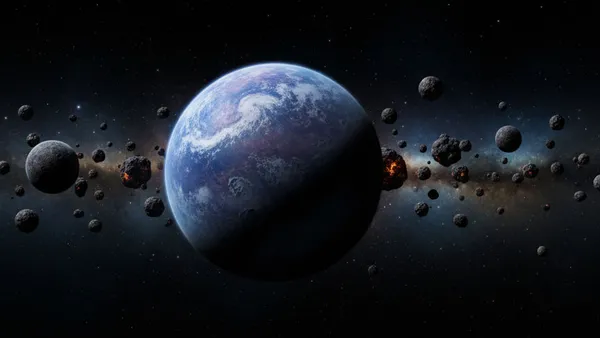
When you picture a planet, you probably imagine a world loyally orbiting a warm, glowing star. But the universe is full of rebels. Enter the rogue planet—a world that drifts completely alone through the pitch-black expanse of interstellar space.
Unlike Earth, these free-floating nomads have no sun to light their skies, govern their seasons, or dictate their years. They are trapped in a state of perpetual night. For a long time, astronomers assumed they were incredibly rare anomalies.
However, recent data has completely flipped this assumption. Scientists now estimate there could be trillions of rogue planets wandering through our Milky Way galaxy alone. In fact, current astronomical models suggest they might outnumber traditional stars by an incredible 20 to 1!
Rather than a rare cosmic oddity, these dark, lonely worlds might actually be the most common type of planet in the universe. Advanced space telescopes are now being designed specifically to hunt down these invisible wanderers using their gravitational pull.
Key Takeaway
Rogue planets are starless, free-floating worlds that likely outnumber the stars in our galaxy.
Test Your Knowledge
Based on recent estimates, how do the number of rogue planets compare to stars in the Milky Way?
How does a planet end up drifting through the freezing void without a star to call home? The most common scientific theory involves a dramatic, galaxy-sized game of cosmic billiards.
When a new solar system first forms, it is a highly chaotic and violent environment. Young, developing planets are packed closely together in a swirling disk of debris, and their respective gravitational fields constantly pull and tug at one another.
If a smaller, Earth-sized rocky planet gets too close to a massive gas giant, the larger planet's immense gravity acts like a slingshot. The smaller world gets violently "bullied" out of its orbit and ejected into deep space at incredible speeds, never to return to its home star.
Alternatively, some rogue planets might form completely on their own. Just as stars collapse from giant clouds of interstellar gas and dust, a smaller clump of material might collapse to form a rogue gas giant in the middle of nowhere.
Key Takeaway
Many rogue planets were violently ejected from their original solar systems by the gravity of larger planets.
Test Your Knowledge
What is the most common theory for how smaller rocky planets go rogue?
At first glance, a starless world seems like the ultimate dead zone. Without the warming rays of a sun, the surface temperatures on a rogue planet would rapidly plummet to hundreds of degrees below zero, plunging the world into an eternal, freezing winter.
Yet, astrobiologists believe these pitch-black wanderers might not be entirely dead. While the surface is almost certainly frozen solid, the deep core of a rogue planet could still be blazing hot from the friction of its original formation or the decay of radioactive elements.
If a rogue planet has a remarkably thick layer of surface ice, that ice could act as a giant thermal blanket. Beneath the frozen outer shell, geothermal heat could melt the interior, creating massive, pitch-black underground oceans of liquid water.
Alternatively, a rogue planet with an ultra-thick, dense atmosphere of hydrogen gas could potentially trap enough internal heat to keep its surface relatively warm. Even without a single sunrise, these solitary nomads might quietly harbor alien life in the dark!
Key Takeaway
Internal geothermal heat and thick atmospheric or icy blankets could potentially allow rogue planets to harbor underground oceans and life.
Test Your Knowledge
How could a rogue planet potentially support an ocean of liquid water without a sun?
Track your progress, earn XP, and compete on leaderboards. Download NerdSip to start learning.