Ever wonder why your wall outlet provides AC power? You have a forgotten genius to thank.
Prompted by A NerdSip Learner
Understand Tesla's legacy and the tech that powers our world.
In the late 1880s, the world was at a crossroads. Thomas Edison was the king of electricity, but his Direct Current (DC) system had a major flaw: it couldn't travel more than a mile without losing power. Enter Nikola Tesla, a brilliant immigrant who proposed Alternating Current (AC).
Tesla’s AC system used transformers to 'step up' voltage for long-distance travel and 'step down' for home use. This was revolutionary! Edison, fearing for his profits, launched a smear campaign against AC, even going so far as to publicly electrocute animals to prove it was 'dangerous.'
Despite the drama, Tesla teamed up with George Westinghouse and proved his tech was superior. The turning point came in 1893 when they lit up the Chicago World’s Fair. Soon after, they harnessed Niagara Falls for power, effectively winning the 'War' and establishing the electrical grid we still use today.
Key Takeaway
Tesla’s Alternating Current (AC) won the 'War of Currents' because it could be efficiently transmitted over long distances.
Test Your Knowledge
What was the primary technical advantage of Tesla's AC system over Edison's DC system?
Tesla wasn't just a power grid guy; he wanted to cut the wires entirely. In 1891, he invented the Tesla Coil. This wasn't just for cool sparks; it was a high-frequency transformer that laid the groundwork for wireless technology.
While Guglielmo Marconi is often credited with inventing the radio, Tesla was actually years ahead. He held the key patents and even demonstrated a remote-controlled boat (the 'teleautomaton') in 1898, shocking onlookers who thought it was magic or a trained monkey inside!
Tesla’s vision was vast. He experimented with X-rays, early robotics, and even neon lighting. He didn't just want to light a bulb; he wanted to communicate across the globe and see through solid objects using the power of waves.
Key Takeaway
Tesla's work with high-frequency electricity paved the way for radio, remote controls, and modern wireless communication.
Test Your Knowledge
Which invention did Tesla use to demonstrate the first version of remote control?
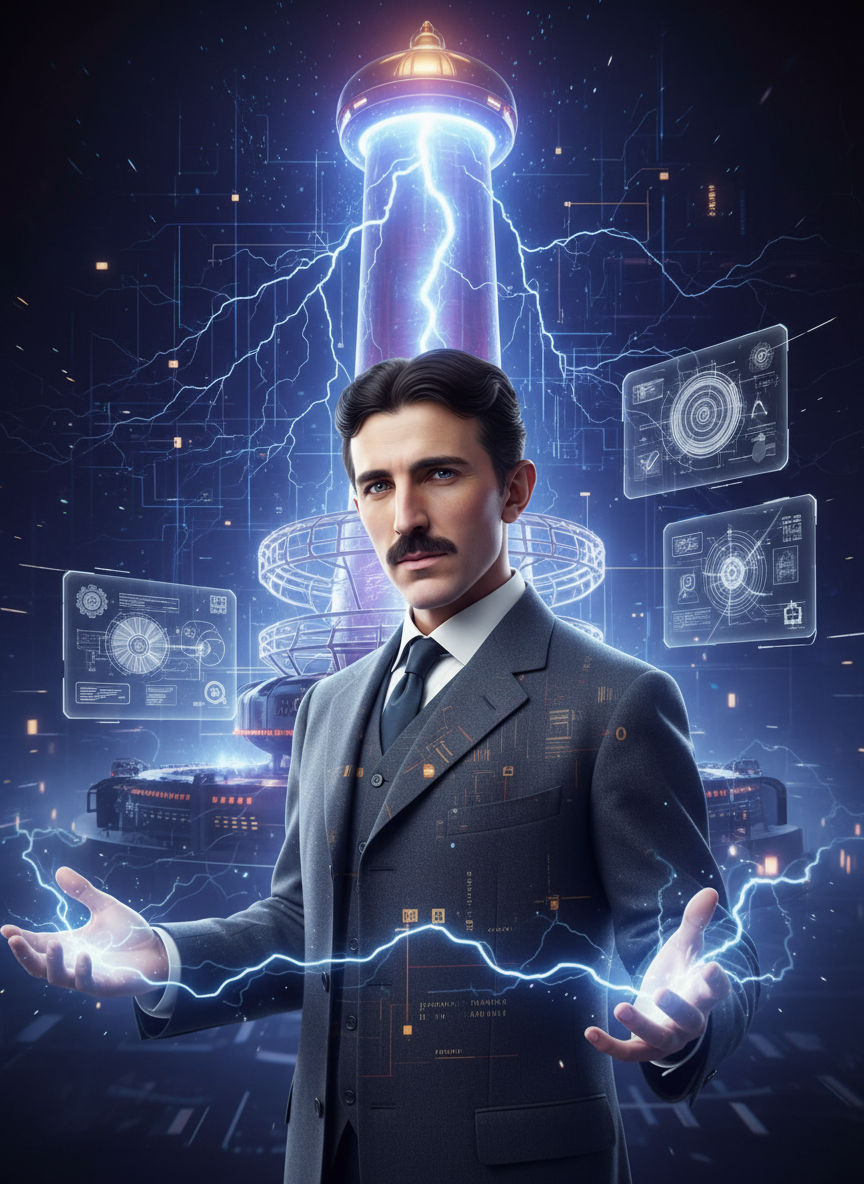
Tesla’s grandest dream was the Wardenclyffe Tower on Long Island. He envisioned a 'World Wireless System' that would provide free, clean energy and information to everyone on Earth by using the planet itself as a conductor.
Sadly, his ambition outpaced his funding. His main investor, J.P. Morgan, withdrew support when it became clear that 'free' energy would be difficult to monetize. Tesla's health and finances declined, and the tower was eventually scrapped for debt in 1917.
Tesla spent his final years as an eccentric figure in New York, living in hotels and caring for pigeons. Though he died nearly penniless in 1943, the 21st century has seen a massive revival of his legacy. Today, we recognize him not as a 'mad scientist,' but as the visionary who truly imagined our connected, electric world.
Key Takeaway
Tesla’s Wardenclyffe project failed due to a lack of funding, but it foreshadowed the modern internet and wireless charging.
Test Your Knowledge
Why was the Wardenclyffe Tower project eventually abandoned?
Track your progress, earn XP, and compete on leaderboards. Download NerdSip to start learning.