Is God a creation of the brain, or is the brain wired for God?
Prompted by A NerdSip Learner
Understand the neural mechanics of mystical experiences.
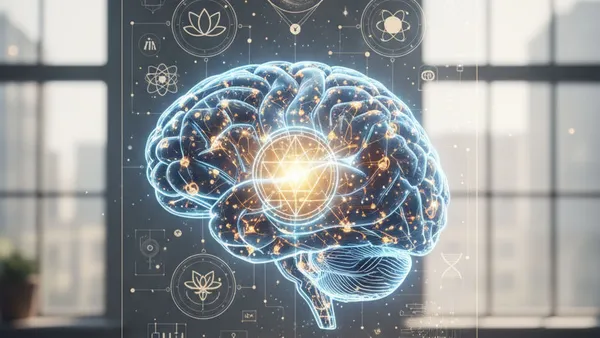
Neurotheology, or the cognitive neuroscience of religion, is a multidisciplinary field exploring the neural correlates of spiritual and religious experiences. It does not attempt to prove or disprove the existence of a higher power. Instead, it asks: what happens in the biological machinery of the brain when someone feels the presence of the divine?
For decades, scholars have debated whether the brain creates God, or if God designed the brain to communicate with humanity. Neurotheology steps out of this philosophical trap by focusing purely on phenomenology and neurobiology. By using advanced imaging tools like fMRI and SPECT, scientists can map the specific networks activated during prayer, meditation, and ritual.
Whether an individual is an atheist experiencing awe in nature, or a mystic immersed in deep prayer, the brain states share remarkable similarities. Understanding these networks offers profound insights into human consciousness, showing us that the capacity for transcendence is deeply embedded in our neural architecture.
Key Takeaway
Neurotheology maps the biological basis of spiritual experiences without validating or invalidating the reality of the divine.
Test Your Knowledge
What is the primary goal of neurotheology?
When spiritual practitioners describe a mystical experience, they frequently report a profound 'loss of self' or a feeling of boundless oneness with the universe. Neurobiologically, this sensation is heavily linked to the posterior superior parietal lobe, a region normally responsible for spatial orientation.
This part of the brain constantly draws a map, helping you distinguish where your physical body ends and the rest of the world begins. However, pioneering SPECT scans of meditating monks and praying nuns have revealed a fascinating anomaly.
During peak states of deep meditation, blood flow to this orientation center drops dramatically. This phenomenon, known as deafferentation, means the parietal lobe is deprived of normal sensory input. Without data to map the body's boundaries, the brain essentially fails to find the dividing line between the 'self' and the 'other.'
The phenomenological result is the melting away of the ego, generating an intense perception of absolute, infinite unity.
Key Takeaway
Decreased activity in the parietal lobe blurs the boundary between the self and the external world, creating a sense of cosmic unity.
Test Your Knowledge
What occurs in the parietal lobe during deep meditative states?
While the parietal lobe quiets down during deep spiritual states, the front of the brain kicks into overdrive. The prefrontal cortex is the brain's executive control center, responsible for focused attention, decision-making, and goal-directed behavior.
When a person engages in intense, directed spiritual practices—such as repeating a mantra, focusing on a mandala, or engaging in centering prayer—the prefrontal cortex demands a significant increase in blood flow. It actively filters out distracting sensory information, allowing the practitioner to achieve a state of pure, uninterrupted concentration.
Interestingly, this localized hyper-activity creates a paradox. The intense focus of the prefrontal cortex works in tandem with the sensory blockade in the parietal lobe.
You are simultaneously hyper-focused and spatially unbound. This neural tug-of-war is what transforms a simple cognitive exercise into an overwhelming, immersive spiritual event. The brain's attention center locks onto the concept of the divine, while the spatial center dissolves the physical self.
Key Takeaway
Intense spiritual focus requires heightened activity in the prefrontal cortex to block out external distractions.
Test Your Knowledge
Which cognitive function is the prefrontal cortex primarily responsible for during prayer or meditation?
Can a magnetic field make you feel the presence of God? In the 1980s, researchers attempted to answer this by creating the Koren Helmet—widely dubbed the 'God Helmet.'
The device used solenoids to apply weak, complex magnetic fields specifically targeted at the temporal lobes. The temporal lobes are deeply involved in language, memory, and emotional assignment. The hypothesis was that the left and right temporal lobes each maintain a distinct sense of self.
When the magnetic fields disrupted communication between the hemispheres, a phenomenon called inter-hemispheric intrusion supposedly occurred. The left hemisphere suddenly perceived the right hemisphere's 'self' as a distinct, external entity. Subjects in a dark, quiet room frequently reported sensing an invisible, powerful presence.
While these findings popularized neurotheology, they remain highly controversial. Independent labs have struggled to replicate the exact results, suggesting that the power of suggestion and sensory deprivation might play a significant role.
Key Takeaway
The temporal lobes are highly sensitive, and some researchers theorize their stimulation can induce the sensation of an invisible presence.
Test Your Knowledge
What is the theoretical mechanism behind the 'sensed presence' in the God Helmet experiments?
The temporal lobe's connection to religion isn't just experimental; it is deeply clinical. For over a century, neurologists have documented a link between Temporal Lobe Epilepsy (TLE) and sudden, overwhelming spiritual epiphanies.
When spontaneous electrical storms (seizures) occur in this region, patients can experience visual or auditory hallucinations, intense euphoria, and a profound sense of cosmic significance. This has led historians to speculate whether historical figures with sudden divine visions may have had TLE.
In a subset of patients, this leads to Geschwind syndrome, a behavioral phenomenon characterized by hypergraphia (compulsive writing), altered sexuality, and extreme hyperreligiosity.
The existence of Geschwind syndrome provides compelling evidence that the temporal lobes are a major neurological seat of our capacity to assign spiritual meaning. It demonstrates how a purely biological misfire can completely restructure a person's theological worldview.
Key Takeaway
Temporal lobe epilepsy can trigger extreme religious experiences, highlighting the lobe's role in spiritual processing.
Test Your Knowledge
Which of the following is a key symptom of Geschwind syndrome?
Why do classical psychedelics reliably trigger experiences identical to ancient mystical reports? The answer lies in the Default Mode Network (DMN). This interconnected web of brain regions is most active when you are daydreaming, worrying about the future, or ruminating on the past.
Essentially, the DMN is the neurological address of your 'ego'—the narrative center of 'you.' Modern fMRI studies show that deep meditation and psychedelics drastically reduce blood flow and connectivity within the DMN.
As the DMN goes offline, the rigid boundaries of the ego dissolve, a phenomenon researchers call ego dissolution or ego death.
Without the DMN acting as a rigid filter, other regions of the brain begin communicating with each other in novel, unconstrained ways. This profound neurological reset is frequently interpreted as a direct encounter with the divine, characterized by a feeling of universal interconnectedness.
Key Takeaway
Suppressing the Default Mode Network leads to a breakdown of the ego, frequently interpreted as a profound mystical state.
Test Your Knowledge
What happens to the Default Mode Network (DMN) during psychedelic-induced mystical experiences?
A spiritual experience isn't just a cold, cognitive realization; it is intensely, overwhelmingly emotional. This emotional gravity is provided by the limbic system, a deep-brain network including the amygdala and the hippocampus.
The amygdala is famous for its role in fear and threat detection, but it is more accurately described as the brain's 'significance' radar. During a spiritual state, the limbic system tags the experience with absolute, undeniable importance.
This is why mystical visions don't feel like mere dreams. The limbic system stamps them as unequivocally *real*—often described by experiencers as 'more real than everyday reality.'
Simultaneously, the hippocampus, which forms new memories, ensures that this profound emotional state is permanently burned into the psyche. This powerful limbic activation explains why a single mystical experience can radically alter a person's personality for life.
Key Takeaway
The limbic system attaches profound emotional weight and a sense of absolute reality to spiritual visions.
Test Your Knowledge
Why do mystical experiences often feel 'more real than everyday reality'?
Behind the shifting blood flows and dissolving networks is a precise neurochemical dance. Two neurotransmitters play leading roles in the theater of spiritual experience: serotonin and dopamine.
Serotonin heavily influences perception, mood, and visual processing. The 5-HT2A receptor, a specific serotonin receptor, is the primary binding site for classic psychedelics. Extreme stress, fasting, or deep meditation can also cause endogenous shifts in serotonin, opening the brain to altered perceptions.
Dopamine, the brain's reward and motivation molecule, is also highly active. Rhythmic spiritual practices—such as repetitive chanting, drumming, or ecstatic dancing—trigger massive dopamine releases.
This flood of dopamine generates the intense euphoria and bliss often associated with religious ecstasy. Together, these neurochemical shifts temporarily rewire how the brain processes reality, turning an ordinary moment into something perceived as transcendent and sacred.
Key Takeaway
Serotonin and dopamine fluctuations chemically mediate the perceptual shifts and intense euphoria of religious states.
Test Your Knowledge
Which specific neurotransmitter receptor is heavily implicated in chemically-induced mystical states and altered perception?
Despite rapid advances, neurotheology faces intense methodological challenges. The primary issue is ecological validity. It is incredibly difficult to capture a spontaneous, deeply personal mystical state while a subject is lying perfectly still inside a loud, claustrophobic fMRI tube.
Furthermore, the field wrestles with philosophical interpretations. Hard reductionists argue that because we can map spirituality to brain states, the divine is nothing more than a biological illusion.
Conversely, non-reductionists argue the opposite: just because the brain has a receiver for spiritual experiences doesn't mean the signal itself is fake. If you want to see the sunset, you need a functioning visual cortex; if you want to experience the divine, you may need a functioning temporal lobe.
This highlights the limits of neurotheology. Science can brilliantly map the *correlates* of consciousness, but the hard problem of consciousness—how physical matter generates subjective experience—remains unsolved.
Key Takeaway
Neurotheology struggles with experimental limitations and the philosophical debate over whether neural correlates reduce spirituality to mere biology.
Test Your Knowledge
What does 'ecological validity' refer to in the context of neurotheology?
If spirituality is hardwired into the brain, why did it evolve? Evolutionary psychologists propose several reasons why a brain capable of religious ideation provided a survival advantage to early humans.
First, shared religious experiences foster massive social cohesion. Rituals synchronize group behavior, allowing large tribes of humans to cooperate and survive in hostile environments.
Second, the brain features a Hyperactive Agency Detection Device (HADD). In the wild, it is safer to mistake a rustling bush for a predator (agency) than to assume it’s just the wind. This tendency to perceive intentional agents in natural phenomena likely laid the groundwork for animism and theism.
Finally, spirituality provides profound psychological resilience. The belief in a higher purpose or protective force lowers chronic stress, which directly improves immune function and survival rates. The neurological capacity for awe wasn't an accident; it was a critical tool for human survival.
Key Takeaway
The neural architecture for spirituality likely evolved because it promoted social cohesion, threat detection, and psychological resilience.
Test Your Knowledge
What is the function of the Hyperactive Agency Detection Device (HADD) in an evolutionary context?
Track your progress, earn XP, and compete on leaderboards. Download NerdSip to start learning.