Who is broadcasting from deep space?
Prompted by A NerdSip Learner
Decode the universe's most mysterious radio signals.
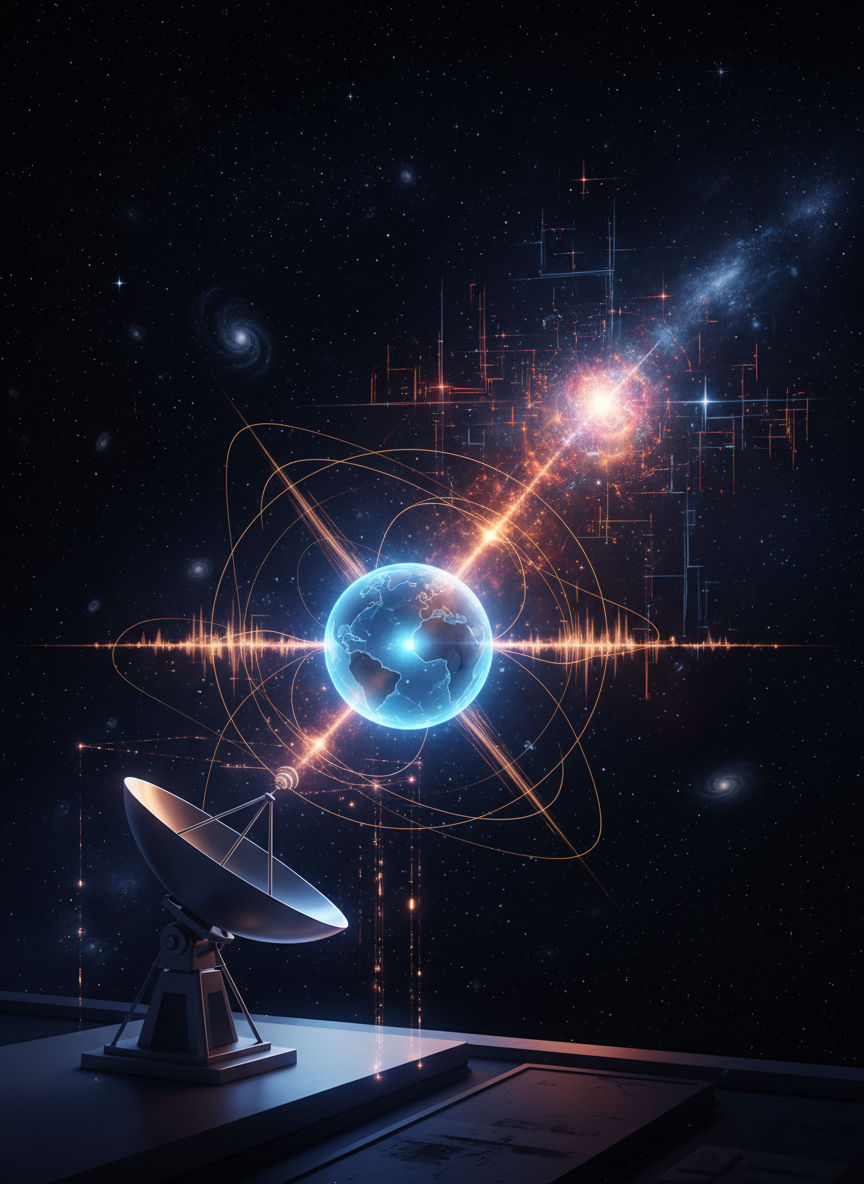
Space isn't silent—if you have the right ears! While sound can't travel through the vacuum of space, the universe is constantly shouting in electromagnetic waves, particularly radio waves.
When astronomers point massive radio telescopes at the sky, they pick up a chaotic symphony of static. This background noise is created by everything from exploding stars to the leftover radiation of the Big Bang itself.
But every once in a while, our telescopes detect something that doesn't sound like random static. They catch a sharp, powerful, or repeating signal that stands out from the cosmic noise.
These anomalous pulses are the "unexplained signals" of astronomy. Some turn out to be natural wonders we’ve never seen before, some are just interference from Earth, and others remain total mysteries that keep scientists up at night!
Key Takeaway
Space is filled with radio waves, and occasionally, we detect strange signals that stand out from the normal cosmic background noise.
Test Your Knowledge
Why do astronomers use radio telescopes to "listen" to space?
In 1967, a brilliant graduate student named Jocelyn Bell Burnell noticed a strange anomaly in her radio telescope data. It was a rapid pulse of radio waves repeating every 1.33 seconds, with the precision of a metronome.
The signal was so incredibly regular that her team half-jokingly named it LGM-1, which stood for "Little Green Men." Could this perfectly timed beacon be an artificial broadcast from an alien civilization?
After months of investigation, the truth was revealed—and it was just as mind-blowing as aliens. The signal was coming from a pulsar, a rapidly spinning, ultra-dense core of a dead star (a neutron star) sweeping beams of radiation across space like a lighthouse.
While it wasn't aliens, Bell Burnell’s discovery proved that the universe can naturally produce signals that look remarkably artificial at first glance!
Key Takeaway
The first discovered pulsar was so perfectly timed that scientists briefly wondered if it was an alien beacon.
Test Your Knowledge
What does "LGM" stand for in the context of Jocelyn Bell Burnell's 1967 discovery?
On August 15, 1977, the Big Ear radio telescope in Ohio picked up a staggering blast of radio energy from the constellation Sagittarius. It lasted for exactly 72 seconds and was incredibly powerful.
When astronomer Jerry Ehman reviewed the computer printout of the data, he was so shocked by the signal's intensity that he circled the alphanumeric code in red ink and wrote "Wow!" in the margin.
What made the Wow! Signal so special was its frequency. It was broadcast near 1420 Megahertz, the exact frequency naturally emitted by hydrogen. Scientists had long theorized that intelligent aliens might use this "universal language" of hydrogen to communicate across the stars.
Despite decades of trying, astronomers have never heard the Wow! Signal again. It remains one of the most famous, tantalizing single radio events in the history of astronomy.
Key Takeaway
In 1977, astronomers detected a powerful 72-second radio blast that looked exactly like what we'd expect an alien broadcast to be.
Test Your Knowledge
Why was the frequency of the Wow! Signal (1420 MHz) so significant?
For nearly 50 years, the Wow! Signal was treated as the ultimate potential proof of extraterrestrial life. But recently, modern science might have finally found a natural explanation for the famous blast.
In 2024, researchers analyzing archival radio telescope data proposed the astrophysical maser hypothesis. They suggest that a giant cloud of cold hydrogen gas in space suddenly became hyper-energized.
This event was likely triggered by a massive flare from a highly magnetic dead star called a magnetar. When the flare hit the hydrogen cloud, it caused the cloud to temporarily act like a giant cosmic laser, shooting a concentrated beam of radio waves directly at Earth.
While some still hold out hope for an alien origin, this new theory shows how rare, intense natural events can perfectly mimic what we thought an artificial beacon would look like.
Key Takeaway
Recent research suggests the famous Wow! Signal might have been naturally created by a hydrogen cloud hit by a stellar flare.
Test Your Knowledge
What natural object do scientists now think might have acted like a giant "cosmic laser" to create the Wow! Signal?
In 2007, astronomer Duncan Lorimer and his student David Narkevic were combing through old data from an Australian radio telescope. They were looking for pulsars, but they found something completely unprecedented.
They discovered a colossal, ultra-brief flash of radio energy. It lasted just five milliseconds, but in that fraction of a second, it unleashed as much energy as our Sun produces in an entire month!
This phenomenon became known as the Lorimer Burst, marking the very first discovery of a Fast Radio Burst (FRB). What blew scientists away was the signal's origin: it didn't come from our Milky Way galaxy, but from billions of light-years away.
Finding a flash that powerful, coming from that far away, yet lasting only milliseconds, sent shockwaves through the astronomy community. A brand new cosmic mystery was born.
Key Takeaway
The Lorimer Burst was the first discovered Fast Radio Burst (FRB)—a massive, millisecond-long flash from another galaxy.
Test Your Knowledge
How long did the original Lorimer Burst last?
Since the Lorimer Burst, astronomers have detected thousands of Fast Radio Bursts (FRBs) flashing across the sky. But instead of solving the mystery, the new data has only made it weirder.
At first, scientists thought FRBs were caused by cataclysmic, one-time events, like two neutron stars colliding and destroying each other. But then, they found FRBs that repeat. Some flash randomly, while others pulse on a predictable 16-day cycle!
Recently, astronomers even found a massive FRB coming from a "dead" elliptical galaxy—a place far too old to contain the young, highly magnetic stars (magnetars) that were thought to cause these bursts.
Are they magnetars? Black holes? Or something entirely new to physics? As telescopes get better at pinpointing their exact locations, the race to crack the FRB code is one of the most exciting fields in modern astronomy.
Key Takeaway
Fast Radio Bursts remain a major mystery because some repeat, some don't, and some come from unexpected "dead" galaxies.
Test Your Knowledge
Why did the discovery of repeating FRBs challenge early theories about what caused them?
If you wanted to send a message to another star system, what radio frequency would you use? The universe is a noisy place, so you'd need to find a quiet "channel" to broadcast on.
Astronomers refer to the quietest band of the radio spectrum as the Water Hole. This frequency range sits neatly between the natural emissions of hydrogen (H) and hydroxyl (OH)—the two components of water.
Because water is considered the essential building block of life, scientists believe that any advanced alien civilization would naturally see this quiet frequency band as the logical place to communicate.
Today, organizations like SETI (Search for Extraterrestrial Intelligence) spend the vast majority of their time tuning their massive antennas specifically to the Water Hole, listening closely for any unnatural patterns.
Key Takeaway
The "Water Hole" is a quiet band of radio frequencies where scientists believe aliens would be most likely to broadcast.
Test Your Knowledge
Why is the "Water Hole" frequency band considered a good place to look for alien signals?
In 2020, the astronomy world held its breath. The Breakthrough Listen project detected a narrow-band radio signal coming directly from Proxima Centauri, the closest star system to Earth!
Dubbed BLC1 (Breakthrough Listen Candidate 1), the signal was exactly the kind of "technosignature" scientists were looking for. It didn't look like a natural cosmic event; it looked like a piece of technology.
For months, researchers rigorously analyzed the data, hoping they had finally found our cosmic neighbors. But the conclusion was a plot twist: the signal was actually coming from Earth.
It turned out to be complex radio frequency interference—likely from broken earthly electronics—that bounced around and perfectly mimicked a signal from deep space. It was a heartbreaking false alarm, but it proved that our detection protocols actually work!
Key Takeaway
BLC1 was a highly convincing signal seemingly from our closest neighboring star, but it was ultimately identified as human-made interference.
Test Your Knowledge
What was the true source of the BLC1 signal?
We thought we understood the rules of dead stars. Neutron stars, the crushed cores of exploded suns, are supposed to spin incredibly fast—sometimes hundreds of times a second—to emit radio pulses.
If they spin too slowly, they cross a theoretical "death line" and shouldn't have enough energy to produce radio waves. But a recent discovery just shattered that rule.
Astronomers found a signal dubbed ASKAP J1935+2148, which is emitting bright radio pulses, but it takes nearly a full hour (54 minutes) to complete a single rotation!
This object is doing something that astrophysics says should be impossible. It might be a highly unusual white dwarf star, or an entirely new class of celestial object we’ve never encountered before. The universe is still full of surprises.
Key Takeaway
A recently discovered object emits radio pulses while spinning incredibly slowly, defying our current understanding of how dead stars behave.
Test Your Knowledge
Why does ASKAP J1935+2148 confuse astronomers?
For decades, finding anomalous signals was like looking for a needle in a cosmic haystack. Astronomers had to manually sift through charts and graphs, hoping to spot something weird.
Today, the game has changed. Projects like Breakthrough Listen are using vast networks of global telescopes to monitor millions of stars simultaneously. They are generating petabytes of data every single day.
To handle this overwhelming flood of information, scientists are deploying Artificial Intelligence. AI algorithms can listen to millions of radio channels at once, instantly filtering out Earth's interference and flagging true cosmic anomalies.
We haven't found a confirmed message from E.T. yet, but our tools are getting exponentially sharper. The next unexplained signal we catch might just be the one that changes humanity forever!
Key Takeaway
Artificial Intelligence and global telescope networks are revolutionizing our ability to filter cosmic noise and search for true space anomalies.
Test Your Knowledge
How is Artificial Intelligence currently helping astronomers search for signals from space?
Track your progress, earn XP, and compete on leaderboards. Download NerdSip to start learning.