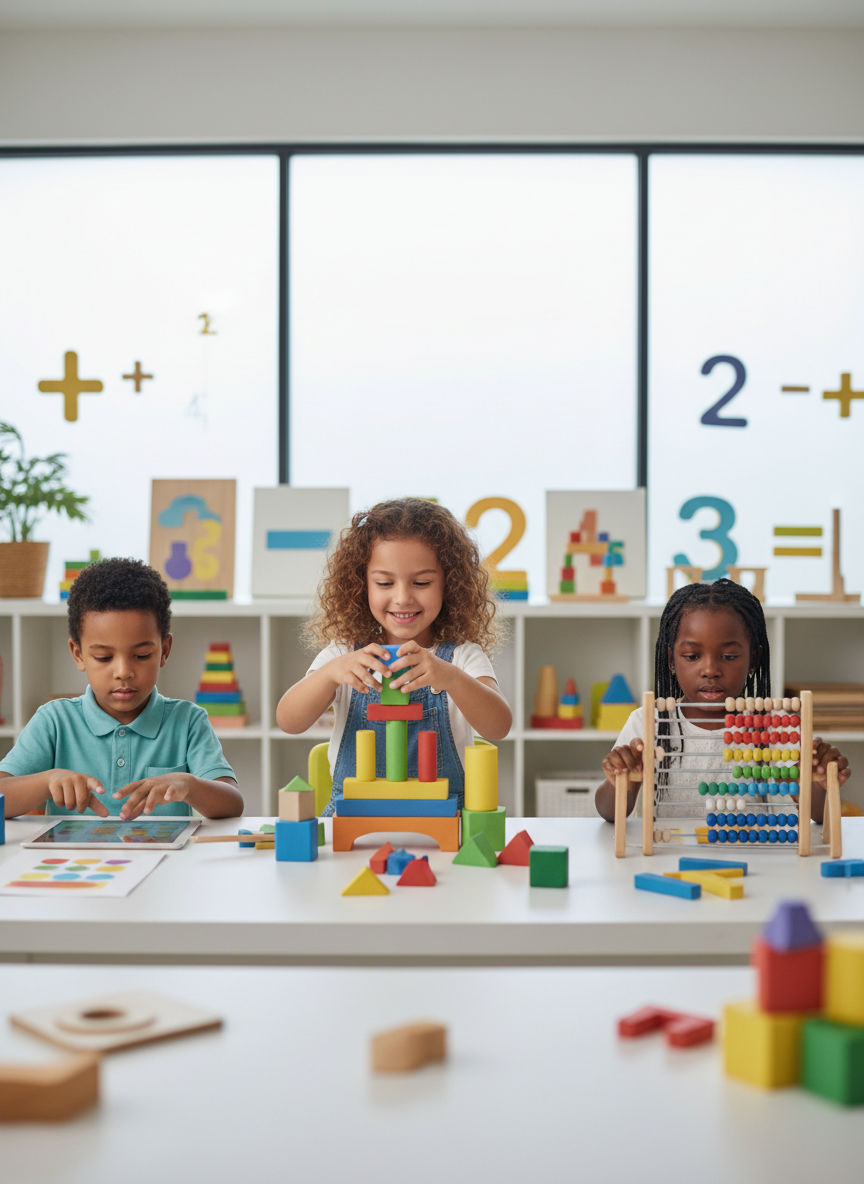
Ever feel like math is a secret language you missed out on?
Prompted by A NerdSip Learner
Master the foundations of everyday math with confidence.
Start with the absolute basics. Math isn't about memorization; it's a language used to describe the real world. Think of our everyday number system, known as the base-10 system. It is built on a very simple, human premise: we have ten fingers!
Every single time we count past nine, we bundle those ten items together and move them over to a new column. That is exactly why the number 14 isn't just a random symbol—it literally means "one bundle of ten, plus four leftovers."
By seeing numbers as physical bundles rather than abstract squiggles on a page, you instantly take the pressure off your brain. If you want to add 14 and 12, you aren't doing complex calculations. You are just combining one bundle of ten with another bundle of ten (making two tens, or 20), and adding the 4 and 2 leftovers (making 6). The result is effortlessly 26!
This foundational idea is called number sense. It is the secret to all mental math and helps you feel confident when looking at prices, clocks, or recipes.
Key Takeaway
The base-10 system simply groups numbers into bundles of ten, making math easier to visualize.
Test Your Knowledge
What does the '1' in the number 14 physically represent?
Many adults feel anxious about math, but you actually do addition and subtraction all day long without even realizing it! At its core, math is just storytelling with numbers.
Addition is simply the story of things coming together. If you have two apples and your friend gives you three more, you aren't doing complex equations. You are just combining two small groups into one larger group of five.
Subtraction is the exact opposite—it is the story of taking things away or finding the difference. If you have five dollars and spend two on a coffee, subtraction simply tells you how much money is left in your pocket.
One brilliant, stress-free trick for subtraction is to think of it as "finding the distance" between two numbers. If a shirt costs $18 and you have a $20 bill, don't try to subtract backwards in your head. Just count *up* from 18 to 20. It takes 2 steps, so the difference is $2. By connecting math to physical objects, the rules finally make logical sense!
Key Takeaway
Subtraction can be easily solved by counting up to find the distance between two numbers.
Test Your Knowledge
Which is a practical, stress-free way to solve a subtraction problem like 20 minus 18?
The word "multiplication" often sounds intimidating, but it is actually a fantastic mathematical shortcut for laziness! If you want to buy 4 coffees for your coworkers and they cost $3 each, you *could* use basic addition to find the total: 3 + 3 + 3 + 3.
But let's be honest, that takes way too long. Multiplication is just a lightning-fast way to do repeated addition. It is the mathematical equivalent of using the "copy and paste" function on a computer. Saying "4 times 3" just means "give me four exact copies of the number three."
A great way to visualize this concept is by thinking of a grid, like a carton of eggs. A standard egg carton has 2 rows of 6 eggs. Instead of pointing and counting every single egg, you can just see "two copies of six" to instantly know there are 12 eggs total.
Next time you are at the grocery store, look at how cans are arranged on shelves. That's multiplication happening right in front of you!
Key Takeaway
Multiplication is simply a shortcut for adding the same number together multiple times.
Test Your Knowledge
How can you best describe multiplication in simple terms?
Division often triggers intense math anxiety, complete with flashbacks to confusing long division tests in school. Let's wipe the slate clean and start fresh. Division is simply the physical act of fair sharing.
Imagine you and three friends order a delicious pizza that has exactly 8 slices. You want to make sure everyone gets an equal amount so nobody is left hungry. How do you divide it? You deal the slices out, one by one, until they are all gone. Each of the 4 people gets 2 slices. Congratulations, you just successfully solved "8 divided by 4 equals 2."
Division is exactly the opposite of multiplication. While multiplication builds larger groups, division breaks them apart into equal, smaller chunks.
This is the exact same skill you intuitively use when splitting a restaurant bill or figuring out how many days a bag of dog food will last. When you focus solely on the concept of "fair sharing," the scary symbols fade away.
Key Takeaway
Division is simply the process of breaking a larger group into equal, fair shares.
Test Your Knowledge
If you have 12 cookies and 3 friends, how do you use the concept of division?
If there is one overarching secret to understanding how math works, it is this: Math is simply the science of patterns. It is a tool we use to make sense of the universe by spotting things that repeat themselves.
Think about the beautiful tiles on a bathroom floor, the driving rhythm of your favorite song, or the way the days of the week cycle over and over again. These are all patterns! In numbers, patterns let us predict the future without doing any hard work.
Take the number 5, for example. If you count by fives (5, 10, 15, 20), you instantly notice a striking pattern: the numbers always end in either 5 or 0. Because you noticed that simple rule, you immediately know that 134 is *not* a multiple of 5, all without having to do any actual division!
When you start looking for patterns, math completely stops being a boring list of rules to memorize. Instead, it becomes a fun puzzle to solve every day.
Key Takeaway
Math is fundamentally the study of patterns, which allows us to make quick predictions.
Test Your Knowledge
How do patterns actually help us in everyday math?
Track your progress, earn XP, and compete on leaderboards. Download NerdSip to start learning.