How do you print circuits using light that shouldn't exist?
Prompted by A NerdSip Learner
Understand the core mechanics of EUV lithography tools confidently.
Welcome to the cutting edge of technology! EUV stands for Extreme Ultraviolet lithography, and it is the secret sauce behind the world's most powerful microchips. Think of lithography like a high-tech stencil. For years, we used Deep Ultraviolet (DUV) light with a wavelength of 193 nanometers. But as we want to pack more power into our pockets, we need a much finer 'pen.'
EUV uses a wavelength of just 13.5 nanometers—nearly 15 times smaller than its predecessor! This incredible leap allows engineers to 'print' patterns on silicon that are so small, they are measured in atoms. By shrinking these features, we can fit billions more transistors on a single chip, making your smartphone faster and your gadgets smarter than ever before.
Key Takeaway
EUV uses a much shorter wavelength of light to print incredibly small patterns on microchips.
Test Your Knowledge
What is the wavelength of light used in EUV lithography?
Here is a mind-blowing fact: EUV light is so fragile that it is absorbed by almost everything, including standard glass lenses. If you tried to use a normal camera lens, the EUV light would simply soak into the glass and disappear! To solve this, scientists had to throw out the traditional playbook. Instead of lenses that light passes through, EUV machines use a series of ultra-precise mirrors.
These are not your typical bathroom mirrors. They are coated with dozens of alternating layers of molybdenum and silicon, designed to reflect the EUV light with surgical precision. These mirrors are so smooth that if they were the size of the United States, the largest bump would be less than a millimeter high! This extreme smoothness is required to guide the light toward the silicon wafer without losing its focus.
Key Takeaway
EUV machines use specialized mirrors instead of glass lenses because EUV light is absorbed by glass.
Test Your Knowledge
Why don't EUV lithography tools use traditional glass lenses?
How do we even create EUV light? It doesn't occur naturally on Earth in a way we can use. To generate it, the machine performs a feat of high-speed physics. It drops a tiny droplet of molten tin, about 30 microns wide, and hits it with a high-powered CO2 laser. But wait, it actually hits it twice! The first 'pre-pulse' flattens the droplet into a pancake shape, and the second 'main pulse' vaporizes it into a scorching plasma.
This plasma reaches temperatures of hundreds of thousands of degrees—hotter than the surface of the sun! In this state, the tin atoms emit the 13.5nm EUV light we need. This process happens a staggering 50,000 times every single second to create a continuous beam of light. It is one of the most complex light sources ever engineered by humanity.
Key Takeaway
EUV light is created by hitting molten tin droplets with powerful lasers to create a light-emitting plasma.
Test Your Knowledge
What material is vaporized by a laser to create EUV light?
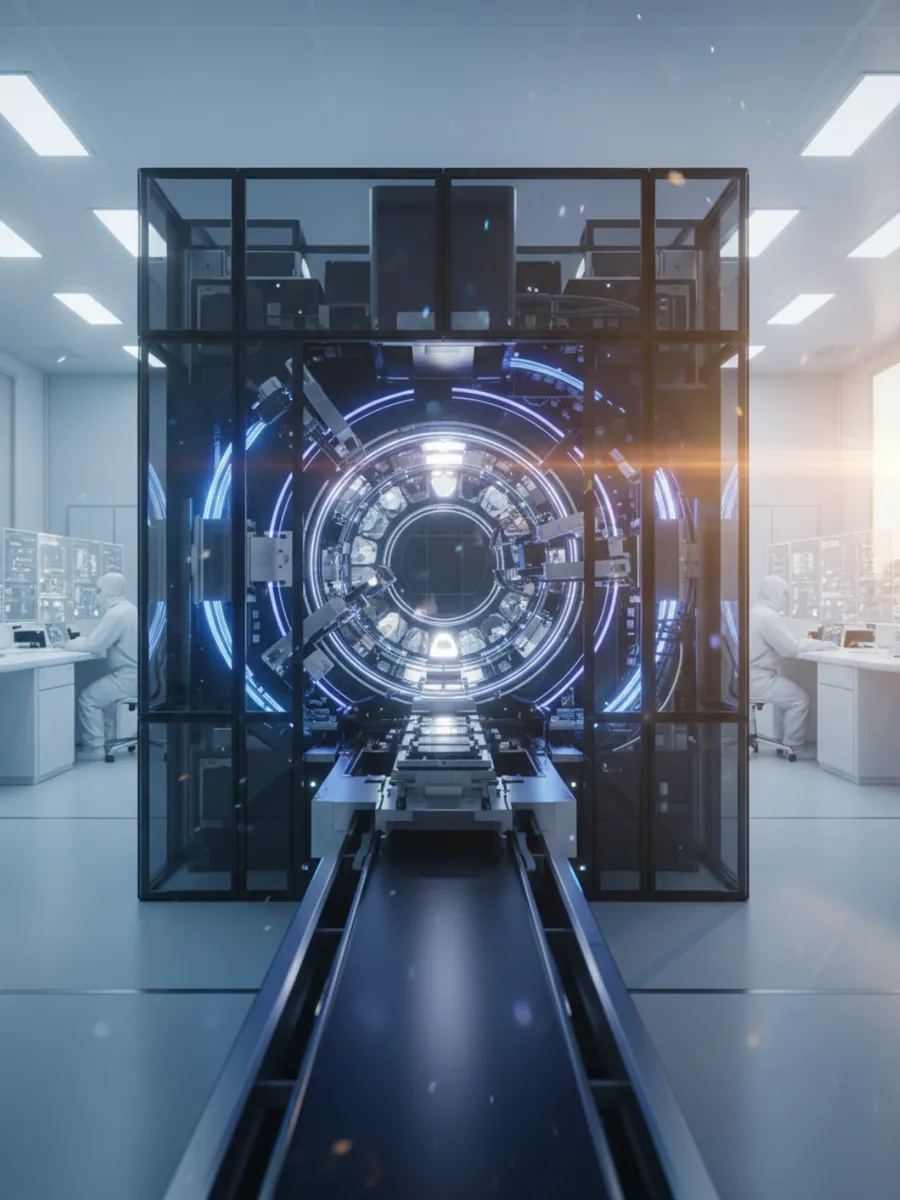
Because EUV light is so easily absorbed, even the air we breathe is a barrier. If the light beam encountered oxygen or nitrogen molecules on its way to the silicon wafer, it would be blocked instantly. To prevent this, the entire 'optical train' of an EUV machine—where the light is reflected by mirrors and projected onto the chip—must be kept in a near-perfect vacuum.
This requirement makes the machines massive and incredibly expensive. Every single component inside must be perfectly clean; even a single speck of dust or a fingerprint could ruin the vacuum or damage the mirrors. The vacuum system ensures that the EUV light has a clear, unobstructed path from the plasma source all the way to the wafer, ensuring the tiny transistor patterns are printed with absolute perfection.
Key Takeaway
EUV lithography must happen in a vacuum because air molecules absorb the light.
Test Your Knowledge
Why is a vacuum necessary inside an EUV tool?
You might wonder why we spend hundreds of millions of dollars on a single machine. The answer is Moore’s Law—the idea that computing power should double every couple of years. EUV is the 'hero' technology that allows this to continue. Without it, we would have reached a physical limit where transistors simply couldn't get any smaller using older light sources.
By using EUV, we can create chips for AI, 5G, and advanced medical devices that are more powerful and consume less energy. These chips contain tens of billions of transistors, all working together to process data at lightning speed. Every time you use a modern high-end smartphone, you are holding the result of this incredible light-bending science. EUV isn't just a tool; it's the foundation of our digital future!
Key Takeaway
EUV lithography is essential for continuing the advancement of computing power and energy efficiency.
Test Your Knowledge
What is the primary benefit of using EUV for microchips?
Track your progress, earn XP, and compete on leaderboards. Download NerdSip to start learning.