Could a car-sized robot find signs of ancient alien life on the Red Planet?
Prompted by A NerdSip Learner
Master the goals and tech of NASA's Mars rover.
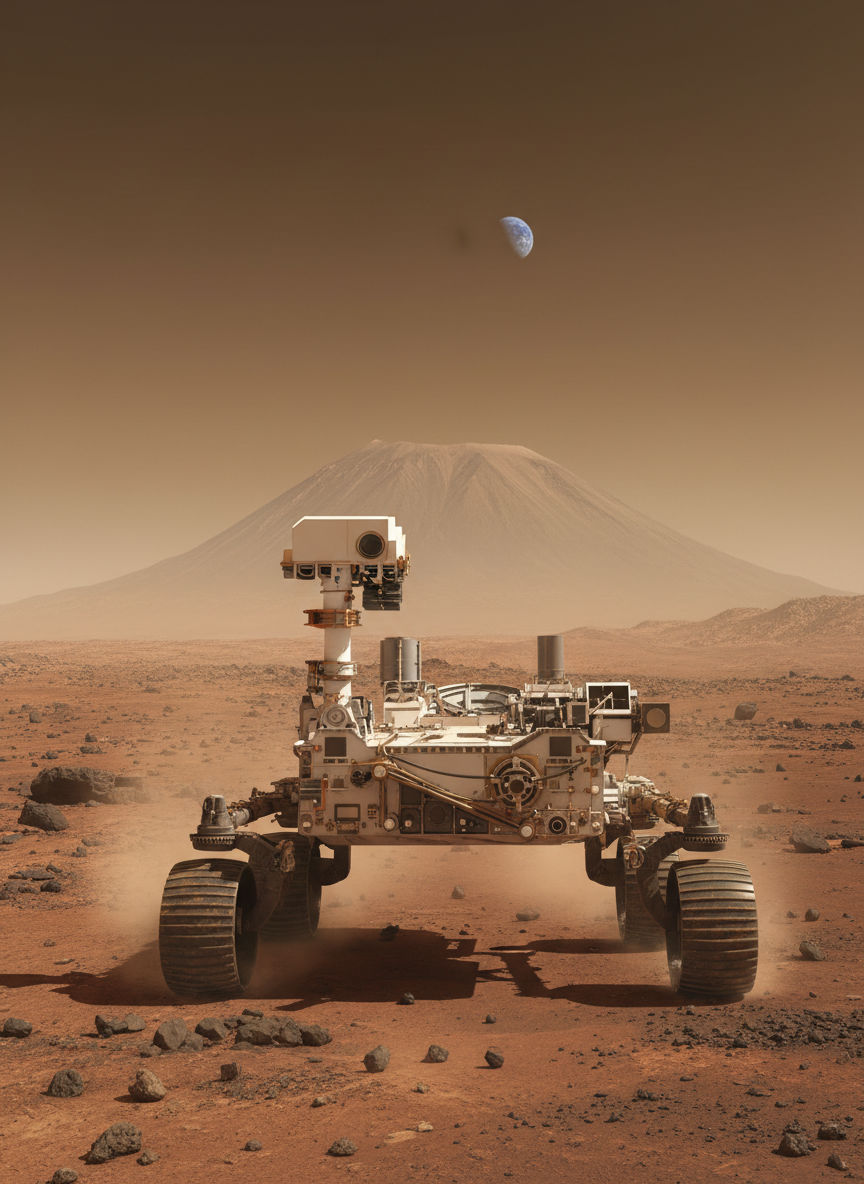
Imagine a SUV-sized robot hurtling toward a foreign planet at 12,000 miles per hour. This was the start of the Perseverance mission in February 2021. To land safely, the rover used a complex 'Sky Crane' maneuver, slowing down from supersonic speeds to a gentle hover before being lowered by nylon cords. This high-stakes sequence is famously known as the Seven Minutes of Terror because the delay in communication meant the rover had to land itself entirely via automation.
Why go through all that stress? The destination was Jezero Crater, a 28-mile wide impact basin. Scientists chose this spot because it was once a primordial lake fed by a river delta billions of years ago. On Earth, river deltas are incredible at preserving organic molecules, making this the perfect place to hunt for biosignatures—ancient signs of microbial life.
Perseverance, or 'Percy,' isn't just a photographer; it’s a sophisticated mobile laboratory. It carries 23 cameras and two microphones, allowing us to actually hear the Martian wind for the first time. It is the most complex machine we have ever sent to another world, built to endure the freezing, radiation-soaked Martian environment while searching for our cosmic neighbors.
Key Takeaway
Perseverance landed in Jezero Crater using an automated 'Sky Crane' to search for ancient microbial life in an old lake bed.
Test Your Knowledge
Why did NASA choose Jezero Crater as the landing site for Perseverance?
Perseverance has two main jobs: hunting for history and preparing for the future. As a robotic geologist, it uses a massive drill to collect core samples of Martian rock and soil. These aren't just analyzed on the spot; they are sealed in hermetically-sealed tubes and left on the surface. A future mission, known as Mars Sample Return, will eventually retrieve these tubes and bring them back to Earth for the most detailed study in human history.
One of the most 'Sci-Fi' tools on board is MOXIE (Mars Oxygen In-Situ Resource Utilization Experiment). Mars has an atmosphere that is 95% carbon dioxide, which is unbreathable for humans. MOXIE works like a tree, 'breathing in' the CO2 and using an electrochemical process to generate oxygen. This technology is a proof-of-concept for future astronauts who will need oxygen for breathing and for rocket fuel to get back home.
By proving we can manufacture resources on-site, Percy is paving the way for the first human footsteps on Mars. It transforms the planet from a hostile wasteland into a place where we might one day survive using the local 'air' as raw material.
Key Takeaway
The rover caches rock samples for future return to Earth and uses the MOXIE instrument to produce oxygen from the Martian atmosphere.
Test Your Knowledge
What is the primary purpose of the MOXIE instrument?
Did you know Perseverance didn't travel alone? Tucked inside its belly was a small, 4-pound helicopter named Ingenuity. This 'technology demonstration' had one goal: to prove that powered, controlled flight is possible on another planet. This is incredibly difficult because the Martian atmosphere is less than 1% as dense as Earth's. It's like trying to fly a helicopter in the thin air 100,000 feet above the ground on Earth.
To generate enough lift, Ingenuity's blades had to spin at over 2,400 rotations per minute—about five times faster than a standard helicopter. On April 19, 2021, Ingenuity made history by performing the first flight, often compared to the Wright Brothers' first flight in 1903. In a touching tribute, a small piece of fabric from the original Wright Flyer was actually attached to the helicopter.
What started as a 30-day test turned into a multi-year mission. Ingenuity became a scout for Perseverance, flying ahead to photograph terrain and help scientists plan the safest paths for the rover. This success has changed space exploration forever, proving that aerial drones will be essential tools for exploring the mountains, craters, and caves of distant worlds.
Key Takeaway
The Ingenuity helicopter proved flight is possible in Mars' thin atmosphere, serving as a scout for the rover.
Test Your Knowledge
Why is it much harder to fly a helicopter on Mars than on Earth?
Track your progress, earn XP, and compete on leaderboards. Download NerdSip to start learning.