What if a single star could outshine a million Suns while literally tearing itself apart?
Prompted by A NerdSip Learner
Identify the universe's most unstable and massive stars.
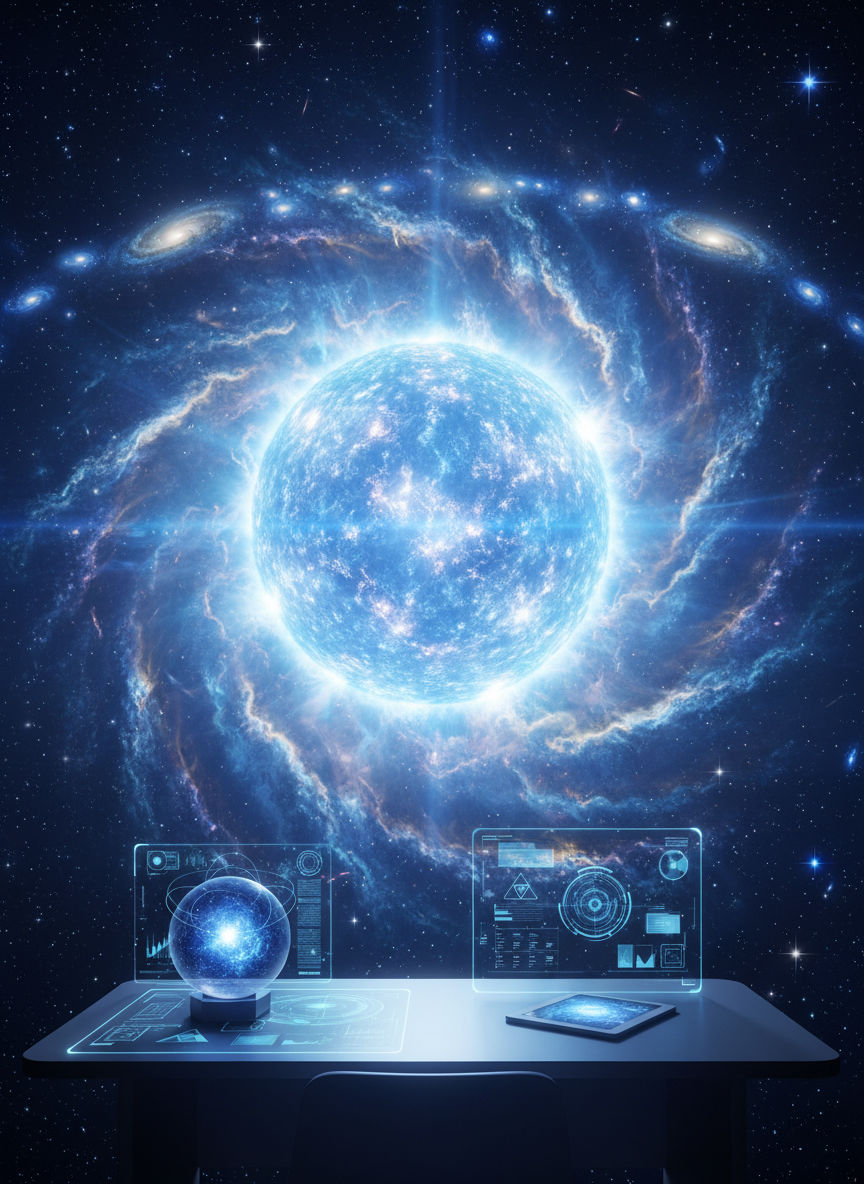
Imagine a star so massive it makes our Sun look like a grain of sand. Luminous Blue Variables (LBVs) are among the rarest and most massive stars in the universe. They aren't just big; they are exceptionally luminous, often shining millions of times brighter than our own star.
These stars are in a very brief, frantic stage of their lives. Because they are so massive—often starting at over 50 times the mass of the Sun—they burn through their nuclear fuel at a terrifying rate. This makes them incredibly hot, giving them their signature blue glow.
However, being this big comes with a price: instability. LBVs are like cosmic pressure cookers that are constantly on the verge of exploding. They don't just sit there shining; they fluctuate wildly in brightness and size over years or decades, which is why we call them variables.
Key Takeaway
LBVs are massive, ultra-bright stars in a short-lived and highly unstable stage of stellar evolution.
Test Your Knowledge
Why are these stars called 'Variables'?
Why can't a star just keep getting bigger forever? The answer lies in a delicate balance called the Eddington Limit. In a normal star, the inward pull of gravity is perfectly balanced by the outward pressure of the energy being created in the core.
In an LBV, the star is so bright that the radiation pressure (the physical push of light itself) becomes stronger than gravity. Imagine trying to hold down a tarp in a hurricane; the wind is the light, and your hands are gravity. Eventually, the wind is just too strong.
When an LBV hits this limit, it begins to shed its outer layers. It isn't a smooth process; the star literally starts to blow itself away into space. This creates massive clouds of gas and dust around the star, often hiding the titan within a shimmering nebula.
Key Takeaway
LBVs are unstable because their intense light pressure actually overcomes the force of gravity holding them together.
Test Your Knowledge
What happens when a star exceeds the Eddington Limit?
Sometimes, an LBV has a literal 'meltdown.' These are called giant eruptions. During these events, the star becomes significantly brighter, sometimes rivaling a supernova—the explosion that marks the death of a star. However, in these cases, the star actually survives the event.
Astronomers often call these events Supernova Impostors. The star throws off a massive amount of material—sometimes several times the mass of our entire Sun—in just a few years. It’s like the star is having a violent temper tantrum, casting off its outer 'skin' to try and regain stability.
These eruptions are among the most energetic events in the universe short of a final explosion. They leave behind beautiful, complex shells of gas that we can see through powerful telescopes like Hubble, serving as a warning of the star's eventual fate.
Key Takeaway
Supernova Impostors are massive eruptions where an LBV loses huge amounts of mass but remains intact.
Test Your Knowledge
How does a 'Supernova Impostor' event differ from a real Supernova?
The most famous Luminous Blue Variable is Eta Carinae, located about 7,500 light-years away. In the 1840s, it underwent a 'Great Eruption' and became the second-brightest star in the night sky, even though it is much further away than its neighbors.
During this event, it ejected a massive cloud of dust and gas now known as the Homunculus Nebula. This nebula looks like two glowing lobes or bubbles expanding away from the central star. It is one of the most studied objects in the sky because it gives us a front-row seat to stellar instability.
Today, Eta Carinae is actually a binary system, meaning there are two stars orbiting each other. The primary star is a massive LBV, and its interaction with its companion might be part of the reason it is so prone to these spectacular, violent outbursts.
Key Takeaway
Eta Carinae is the most famous LBV, known for its 19th-century 'Great Eruption' and the stunning Homunculus Nebula.
Test Your Knowledge
What is the name of the nebula created by Eta Carinae's Great Eruption?
The LBV phase is just a brief 'mid-life crisis' for the universe's most massive stars, lasting perhaps only a few hundred thousand years. As the star continues to lose its outer hydrogen layers through eruptions and solar winds, it eventually reveals its hot, helium-rich core.
At this point, the star may transition into a Wolf-Rayet star, another type of extreme, hot star. But the clock is ticking. Because it is so massive, it will eventually run out of elements to fuse in its core. Unlike our Sun, which will die quietly, an LBV's life always ends in a Supernova.
Because they are so big, they might even skip the standard supernova and undergo a Hypernova, an even more powerful explosion that can release a Gamma-Ray Burst. Whether it collapses into a neutron star or a black hole, the LBV stage is the final, chaotic warning before the big finish.
Key Takeaway
The LBV stage is a short-lived transition that inevitably leads to a massive supernova explosion.
Test Your Knowledge
What is the likely final fate of a Luminous Blue Variable?
Track your progress, earn XP, and compete on leaderboards. Download NerdSip to start learning.