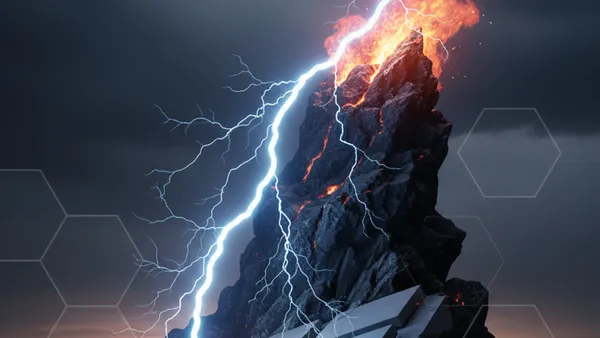
Did you know a single bolt of lightning is five times hotter than the surface of the sun?
Prompted by A NerdSip Learner
Master the basics
Have you ever watched a thunderstorm and wondered exactly what you were looking at? Lightning is one of nature's most spectacular displays of raw energy. At its core, lightning is a massive electrostatic discharge—a giant spark of electricity flowing through the atmosphere.
When we see that blinding flash, we are actually witnessing air turning into plasma. The electrical current is so powerful that it strips electrons from the air molecules, creating a glowing, superheated channel.
Here is the most staggering fact: that narrow channel of plasma is roughly five times hotter than the surface of the sun! While the sun's visible surface sits at about 5,500°C (10,000°F), a lightning bolt can heat the air around it to an astonishing 30,000°C (54,000°F).
Despite this astronomical heat, lightning doesn't usually incinerate everything it touches because the extreme temperature lasts for only a few microseconds. It is a brilliant, fleeting burst of energy that vanishes almost as quickly as it appears.
Key Takeaway
Lightning is a massive electrical discharge that turns air into plasma, briefly reaching temperatures around five times hotter than the sun's surface.
Test Your Knowledge
Why doesn't lightning usually incinerate everything it touches, despite its extreme heat?
Before lightning can strike, a thunderstorm has to build up a massive electrical charge. Think of a storm cloud as a colossal, turbulent battery hovering in the sky.
According to leading atmospheric models, this charging process relies heavily on ice. Inside a towering cumulonimbus cloud, violent updrafts of warm air collide with downdrafts of freezing air. As moisture rises into the freezing upper levels of the storm, it forms tiny ice crystals.
At the same time, heavier, slushy hail called "graupel" falls downward. When the rising ice crystals crash into the falling graupel, a critical transfer of energy occurs. The collision strips electrons (which carry a negative charge) from the rising ice and leaves them on the falling graupel.
As a result, the top of the storm cloud becomes positively charged, while the bottom of the cloud fills up with a strong negative charge. Once this separation of charges becomes extreme enough, the stage is set for a lightning strike!
Key Takeaway
Storm clouds build electrical charge when rising ice crystals collide with falling graupel, creating a positively charged cloud top and a negatively charged base.
Test Your Knowledge
What is the primary mechanism believed to cause charge separation in a thundercloud?
Once the bottom of a storm cloud is heavily loaded with negative charge, it begins to seek a path to the positively charged ground. However, air is an excellent insulator, making it difficult for electricity to flow.
To overcome this resistance, the cloud sends down an invisible, jagged channel of negative charge called a "stepped leader." This leader moves downward in incredibly fast, segmented steps, branching out as it searches for the path of least electrical resistance.
As the stepped leader gets closer to the earth, the strong negative charge repels electrons in the ground, causing positive charge to gather in high places like trees, skyscrapers, and even people.
These grounded objects then send up their own invisible electrical channels, known as "streamers." It is a frantic race as multiple streamers reach upward, trying to be the first to connect with the descending stepped leader.
Key Takeaway
Lightning finds its path to the ground when an invisible "stepped leader" from the cloud connects with an upward-reaching "streamer" from the earth.
Test Your Knowledge
What is the name of the upward-reaching electrical channel sent from objects on the ground?
The moment a downward stepped leader meets an upward streamer, a continuous path is formed between the cloud and the ground. This completed circuit sets off the spectacular main event of a lightning strike.
With the path now open, a massive wave of electrical current surges through the newly created channel. This brilliant pulse of energy is known as the "return stroke." It is the blindingly bright flash of light that we visually identify as a lightning bolt.
Here is a mind-bending illusion: because the stepped leader moves downward invisibly, and the bright return stroke surges upward from the ground to the cloud, the visible flash of lightning actually travels *up*! It moves so incredibly fast—roughly one-third the speed of light—that our human eyes cannot process the direction, making it look like a downward strike.
Often, a single lightning flash flickers. This happens when multiple return strokes use the exact same plasma channel in rapid succession.
Key Takeaway
The visible, bright flash of lightning we see is called the return stroke, and it actually travels upward from the ground to the cloud.
Test Your Knowledge
Why does a single lightning bolt sometimes appear to flicker?
You can't have thunder without lightning. Thunder is entirely a byproduct of the incredible heat generated by the lightning's return stroke.
Remember that lightning heats the air in its plasma channel to roughly 30,000°C (54,000°F) in a fraction of a millisecond. When air is heated this drastically and suddenly, it has no time to expand gently. Instead, it explodes outward violently.
This explosive expansion of superheated air compresses the surrounding atmosphere, creating a massive shockwave. As this shockwave travels outward and slows down, it decays into the acoustic sound wave we recognize as thunder.
Because light travels much faster than sound, you always see the lightning before you hear the thunder. By counting the seconds between the flash and the boom, you can roughly estimate how far away the strike was—every three seconds roughly equals one kilometer (or five seconds for a mile)!
Key Takeaway
Thunder is a sonic shockwave caused by the rapid, explosive expansion of superheated air surrounding a lightning bolt.
Test Your Knowledge
What directly causes the sound of thunder?
While cloud-to-ground lightning is the most famous type, it actually makes up only about 20% to 30% of all lightning strikes! The vast majority of lightning happens entirely up in the sky.
"Intra-cloud" lightning occurs when charges balance themselves out within the exact same storm cloud, leaping between the positive top and negative base. Sometimes, lightning will even travel between two entirely different storm clouds, known as "cloud-to-cloud" lightning. These strikes illuminate the clouds from within, creating beautiful sheets of light.
There is also a rare and incredibly dangerous phenomenon called "positive lightning." Instead of originating from the negatively charged bottom of the cloud, these strikes shoot out from the positively charged anvil at the very top of the storm. Because they have to travel much further to reach the ground, positive lightning bolts can carry up to ten times the electrical current of a standard strike and strike miles away from the main storm!
Key Takeaway
Most lightning never touches the earth, occurring within or between clouds. Positive lightning, however, originates from the cloud tops and is exceptionally powerful.
Test Your Knowledge
What makes positive lightning particularly dangerous compared to standard cloud-to-ground strikes?
When lightning finally reaches the earth, it doesn't just disappear; its intense energy has to go somewhere. If lightning happens to strike a sandy beach or a desert, it can leave behind a fascinating geological souvenir.
Sand is primarily made of silica (quartz). When lightning strikes sand, the 30,000°C temperatures easily surpass the melting point of silica, which is around 1,800°C. In a fraction of a second, the electrical current melts the sand along its path deep into the ground.
As the surrounding earth quickly cools the melted sand, it hardens into a hollow, branching glass tube called a "fulgurite." These delicate, crusty glass structures are sometimes referred to as "fossilized lightning."
Fulgurites perfectly map the exact path the lightning bolt took as it dispersed its energy into the soil. Finding one is incredibly rare, but it serves as a beautiful, physical reminder of the friction, fire, and power of a thunderstorm.
Key Takeaway
When lightning strikes sand, its extreme heat instantly melts the silica, creating branching, hollow glass tubes known as fulgurites.
Test Your Knowledge
What is a fulgurite?
Track your progress, earn XP, and compete on leaderboards. Download NerdSip to start learning.