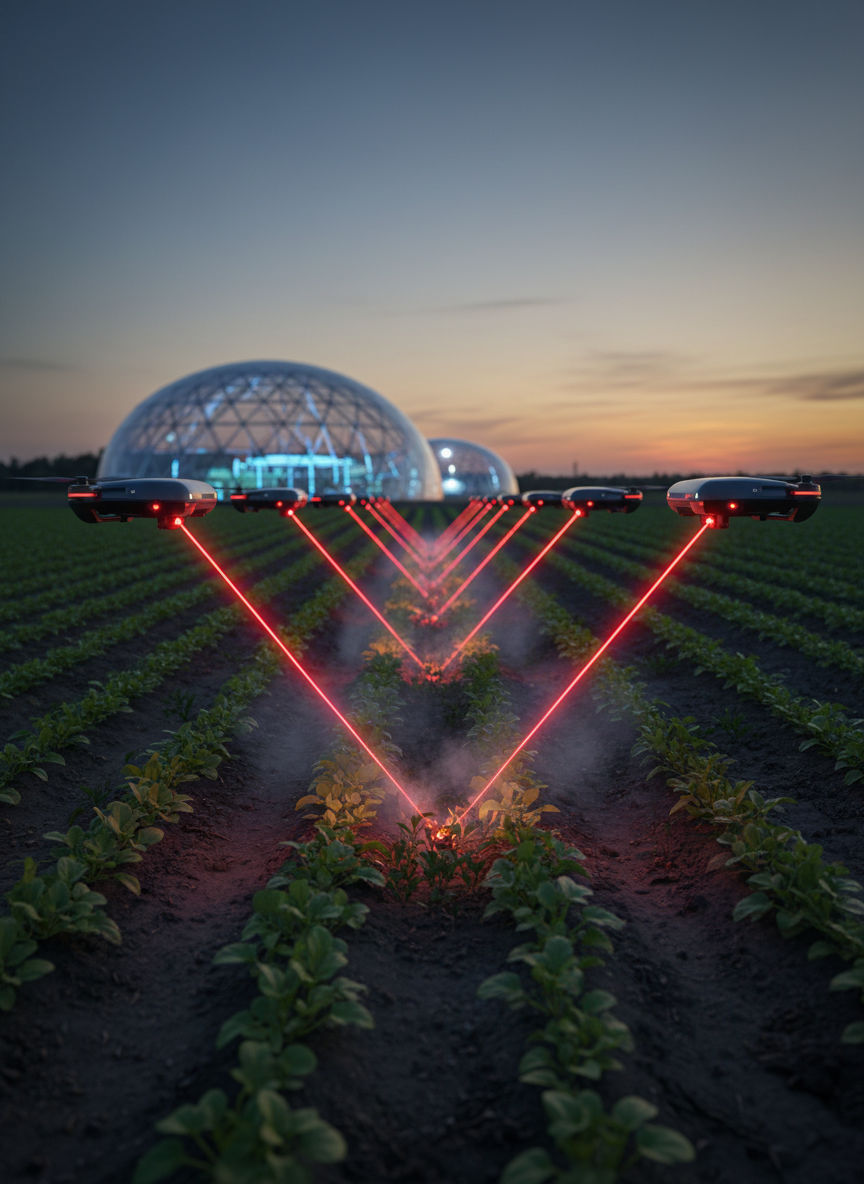
Could farmers trade their chemical sprayers for laser cannons?
Prompted by A NerdSip Learner
Grasp the basics of laser weeding.
Welcome to the farm! For centuries, farmers have fought a relentless battle against weeds. These unwelcome plants are more than just an eyesore; they're fierce competitors. They steal precious water, sunlight, and nutrients from the crops we need to survive, which can drastically reduce the amount of food a farm can produce.
To fight back, the most common weapon has been chemical herbicides. These are sprayed across entire fields to kill weeds. While often effective, this approach comes with growing concerns. Herbicides can sometimes harm beneficial insects, impact soil health over time, and traces can remain in our environment.
Another major issue is herbicide resistance. Just like bacteria can become resistant to antibiotics, weeds are evolving to survive the chemicals designed to kill them. This forces farmers to use stronger or more varied chemicals, creating a cycle that is difficult and costly to break. It's clear that we need a smarter, more sustainable solution.
Key Takeaway
Traditional weeding with chemicals is facing major challenges like environmental impact and weed resistance, creating a need for new solutions.
Test Your Knowledge
What is the primary problem with relying on chemical herbicides for weeding?
Imagine a robot rolling through a field, not with a sprayer, but with a high-tech laser cannon! That's the core idea behind laser farming. These aren't science fiction props; they are real, intelligent machines designed for a very specific task: seek and destroy weeds.
Here's how it works in a nutshell. A tractor or an autonomous robot carries the laser system. High-resolution cameras constantly scan the ground, taking thousands of pictures per minute. An onboard computer, powered by Artificial Intelligence (AI), analyzes these images instantly.
When the AI identifies a plant as a weed, it locks on. In a fraction of a second, it aims and fires a concentrated beam of light—a high-powered laser—directly at the weed's growth point. The intense energy boils the water inside the plant's cells, causing them to explode and killing the weed instantly, without disturbing the soil or the crops nearby.
Key Takeaway
Laser weeders use a combination of cameras, AI to identify weeds, and high-powered lasers to eliminate them with pinpoint accuracy.
Test Your Knowledge
What are the three core components of a laser weeding system?
The real magic of laser farming isn't just the laser; it's the incredible 'brain' that tells it where to fire. This brain uses a technology called computer vision, a type of AI that trains computers to interpret and understand the visual world. Think of it like teaching a robot to be an expert botanist.
To start, developers 'feed' the AI millions of images of both crops and weeds at every stage of growth—from tiny sprouts to mature plants. The AI learns to spot the subtle differences in leaf shape, color, and texture that distinguish a valuable carrot from a pesky thistle.
This process, known as machine learning, makes the system incredibly smart and precise. It can operate day or night, in different lighting conditions, and gets better over time as it sees more examples. This precision is what allows the laser to zap a weed that's less than an inch away from a crop without causing any harm to the valuable plant.
Key Takeaway
Computer vision and machine learning are the 'brains' that allow the system to accurately distinguish between crops and weeds.
Test Your Knowledge
How does the AI in a laser weeder learn to identify weeds?
So, is laser weeding the ultimate champion? Let's look at the pros and cons. The biggest advantage is that it's completely chemical-free. This is a massive win for organic farming, soil health, and reducing chemical runoff into our water systems. It also eliminates the problem of herbicide-resistant 'superweeds'.
Another benefit is improved soil health. Traditional methods can disturb the soil, but lasers only target the plant, leaving the delicate ecosystem of microorganisms in the soil untouched. This can lead to healthier, more resilient crops in the long run.
However, the technology faces challenges. The primary hurdle is cost. These high-tech machines represent a significant upfront investment compared to a traditional sprayer. They can also be slower than broadcast spraying a whole field, though their efficiency is constantly improving. Finally, performance might be affected by weather, such as heavy rain or dense fog, which can interfere with the cameras and lasers.
Key Takeaway
Laser weeding offers huge environmental benefits but currently faces challenges related to high initial cost and operational speed.
Test Your Knowledge
What is the main disadvantage of current laser weeding technology?
Laser weeding isn't just a cool gadget; it's a key part of a bigger movement called precision agriculture. This is the idea of using technology to manage farms on a plant-by-plant basis, rather than a field-by-field basis. It's about being incredibly efficient and sustainable.
What's next for this technology? Companies are working on making the systems faster, lighter, and more affordable. We can expect to see swarms of smaller, autonomous laser-weeding robots working together to manage large farms 24/7. This could revolutionize how we produce food, especially for high-value vegetable crops.
The technology also has potential beyond just killing weeds. The same AI and targeting systems could be adapted to perform other tasks. Imagine a machine that can precisely thin out a row of lettuce to give the strongest plants room to grow, or one that could spot and eliminate a specific insect pest. The future of farming is precise, intelligent, and a whole lot greener.
Key Takeaway
Laser farming is a cornerstone of precision agriculture, with a future that includes faster, more affordable robots performing multiple farm tasks.
Test Your Knowledge
Precision agriculture, which includes laser weeding, aims to manage farms on what level?
Track your progress, earn XP, and compete on leaderboards. Download NerdSip to start learning.