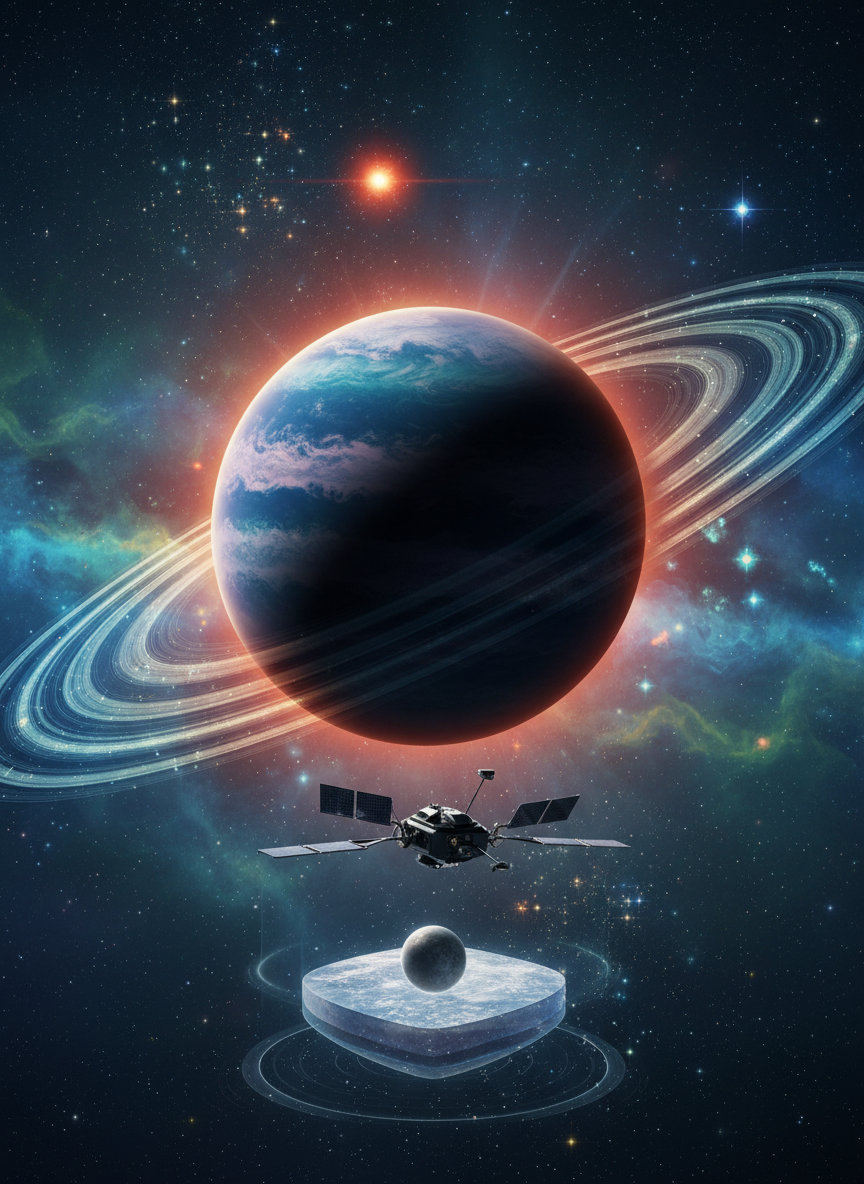
124 light-years away, an ocean world awaits. Could life be swimming there?
Prompted by A NerdSip Learner
Identify the signs of life on a distant water world.
Welcome aboard! Today, we are traveling 124 light-years away to the constellation Leo. Here lies K2-18b, a planet that has captured the imagination of astronomers everywhere. Discovered by the Kepler Space Telescope, this world is what we call a Super-Earth.
It isn't a gas giant like Jupiter, but it is significantly larger than our home planet—about 2.6 times the radius of Earth and 8.6 times as massive! For a long time, we didn't know much about these intermediate-sized planets because we don't have any in our own Solar System.
K2-18b gives us a rare glimpse into this mysterious category. It orbits a cool, reddish star known as a Red Dwarf. Because this star is much smaller and dimmer than our Sun, K2-18b has to orbit very close to it to get enough warmth, completing a full 'year' in just 33 days!
Key Takeaway
K2-18b is a massive 'Super-Earth' located 124 light-years away, orbiting a Red Dwarf star.
Test Your Knowledge
How does the size of K2-18b compare to Earth?
Why is everyone so excited about K2-18b? It's all about location, location, location! This planet sits comfortably within its star's Habitable Zone (often called the Goldilocks Zone). This is the specific distance from a star where it is not too hot and not too cold, allowing for the potential existence of liquid water on the surface.
Being in the habitable zone doesn't guarantee life—Mars is technically in ours! However, it is the first step in finding an Earth-like environment. Because K2-18b orbits a Red Dwarf, it faces unique challenges. These stars can be quite active, blasting their planets with high-energy flares.
Despite the radiation risks, the temperature on K2-18b is estimated to be somewhat similar to Earth's, possibly allowing for clouds and rain. But don't pack your bags just yet; the gravity there would feel much heavier than what you're used to!
Key Takeaway
K2-18b resides in the Habitable Zone, meaning temperatures could theoretically support liquid water.
Test Your Knowledge
What defines the 'Habitable Zone' of a star?
In 2019, K2-18b made headlines globally. Astronomers analyzing data from the Hubble Space Telescope detected something incredible: Water Vapor. This was a historic moment—it was the first time we found water in the atmosphere of a planet orbiting within the habitable zone of a distant star!
The signature of water was clear, but that wasn't all. The data suggested the planet has a thick, hydrogen-rich atmosphere. This combination of hydrogen and water vapor creates a chaotic, high-pressure environment.
While the presence of water is promising, the thick hydrogen atmosphere acts like a heavy blanket. This suggests that beneath the clouds, the surface pressure might be too intense for life as we know it on Earth to survive easily. It’s a watery world, but perhaps more like a high-pressure steam room than a tropical vacation spot.
Key Takeaway
K2-18b was the first habitable-zone planet found to have water vapor in its atmosphere.
Test Your Knowledge
What major discovery did the Hubble Space Telescope make about K2-18b in 2019?
Recent studies have led scientists to propose a brand new classification for planets like K2-18b: Hycean Worlds. The name comes from combining 'Hydrogen' and 'Ocean.'
A Hycean planet is hot, covered entirely by a global ocean, and wrapped in a thick hydrogen atmosphere. Unlike Earth, which has continents and a nitrogen-heavy sky, a Hycean world is a vast, planet-wide sea.
This theory changes the game for hunting aliens. Previously, we only looked for Earth-twins. But life—specifically microbial life—could potentially survive in these warm, high-pressure oceans. By expanding our search to Hycean worlds, we significantly increase our chances of finding biological activity elsewhere in the universe. K2-18b is now the poster child for this exciting new planetary class!
Key Takeaway
K2-18b is likely a 'Hycean' world: a planet with a global ocean and a hydrogen atmosphere.
Test Your Knowledge
What two words are combined to create the term 'Hycean'?
Here is where things get truly thrilling. The James Webb Space Telescope (JWST) recently took a deeper look at K2-18b. It confirmed the presence of methane and carbon dioxide, which supports the Hycean ocean theory.
But the real shocker? JWST detected a potential hint of a molecule called Dimethyl Sulfide (DMS). On Earth, DMS is only produced by life—specifically, by phytoplankton in our oceans.
Caution is key here. The detection is not yet confirmed and needs more observation to be sure it isn't a data error. However, if confirmed, it would be the strongest evidence yet of biological activity on an exoplanet. K2-18b has gone from just another dot in the sky to our most promising lead in the search for extraterrestrial life!
Key Takeaway
JWST detected potential traces of DMS, a molecule that, on Earth, is only produced by living organisms.
Test Your Knowledge
Why is the detection of Dimethyl Sulfide (DMS) significant?
Track your progress, earn XP, and compete on leaderboards. Download NerdSip to start learning.