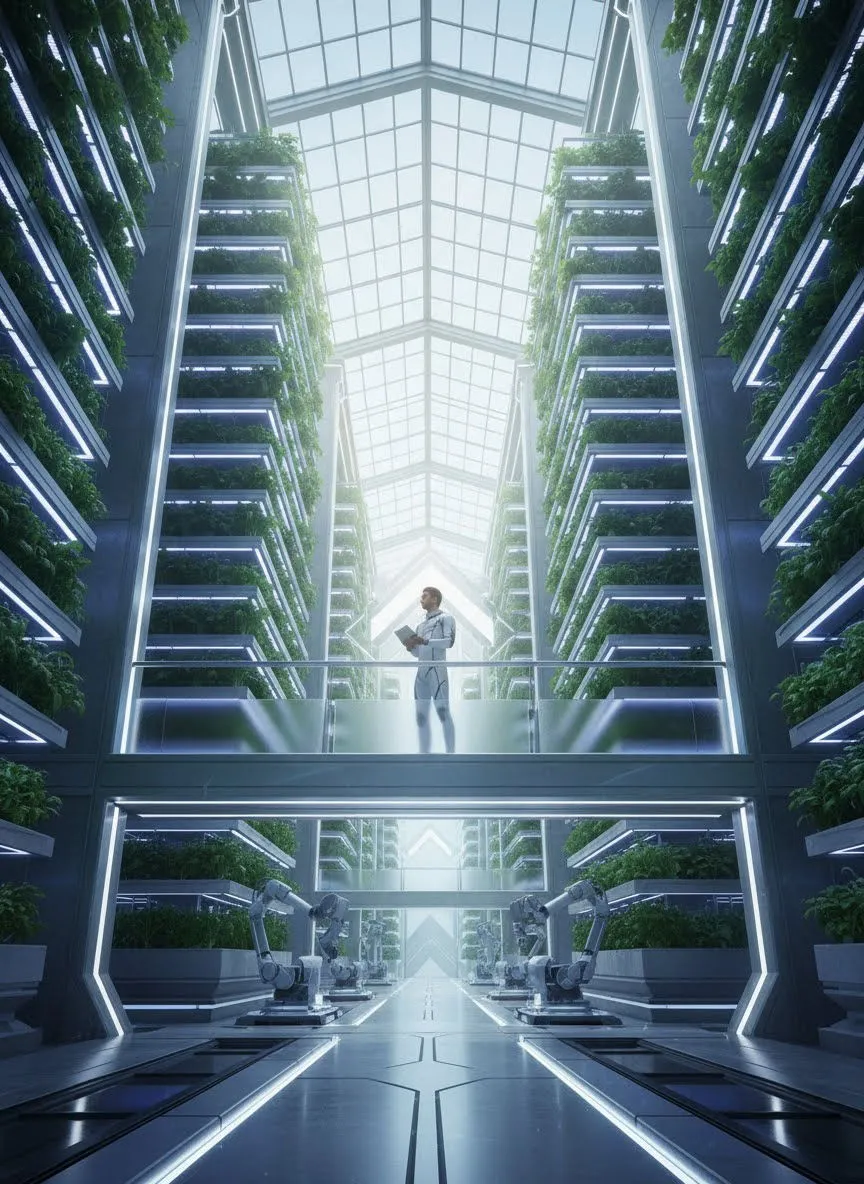
Can we feed a city using skyscrapers instead of fields?
Prompted by A NerdSip Learner
Understand the future of high-tech sustainable agriculture.
Imagine a farm that looks less like a muddy field and more like a high-tech server room. That's vertical farming. Instead of needing massive acres of flat land, we stack crops in layers, going up towards the ceiling—think of it as a skyscraper for salad!
Here’s the wild part: we usually ditch the soil entirely. Most vertical farms use hydroponics (roots soaking in nutrient water) or aeroponics (roots sprayed with nutrient mist). This creates a sterile, controlled environment where bugs aren't welcome, meaning we can say goodbye to harmful pesticides.
By moving indoors, we aren't at the mercy of droughts or storms. We control the weather. This allows us to grow massive amounts of food right in the middle of a concrete jungle, using a fraction of the space traditional farming requires.
Key Takeaway
Vertical farming stacks crops indoors without soil, saving space and eliminating weather risks.
Test Your Knowledge
What is the main difference between vertical farming and traditional farming?
Have you ever seen pictures of vertical farms glowing with a sci-fi pink or purple light? That isn't just for aesthetics. Plants don't actually need white sunlight to grow; they crave specific wavelengths, mostly red and blue, to power photosynthesis. By using specialized LEDs, farmers can give plants exactly the light recipe they need to grow faster and tastier.
But it’s not just lights; it’s data. These farms are run by smart sensors and AI. They monitor humidity, temperature, and CO2 levels every second. If a basil plant is thirsty, the computer knows instantly and adjusts the water flow.
This precision engineering means vertical farms use up to 95% less water than regular field farming. We are essentially coding nature to be as efficient as possible, recycling every drop of water that the plants don't absorb.
Key Takeaway
LEDs provide specific light spectrums for growth, while AI optimizes water and climate for extreme efficiency.
Test Your Knowledge
Why do many vertical farms appear pink or purple?
Why go through all this trouble? Here is the reality check: by the year 2050, there will be nearly 10 billion people on Earth. We are running out of farmable land, and climate change is making traditional weather patterns unpredictable. We need a backup plan.
Vertical farming solves the problem of 'food miles.' Right now, your lettuce might travel 2,000 miles in a truck to get to your plate, losing nutrients and burning fossil fuels along the way. A vertical farm can be built in an abandoned warehouse down the street from the grocery store.
While it currently uses a lot of electricity, the goal is to pair these farms with renewable energy like solar or wind. It’s about food security—ensuring that no matter what happens to the climate outside, we can still harvest fresh, healthy food inside our cities 365 days a year.
Key Takeaway
Vertical farming reduces food transport distance and provides a reliable food source for a growing population.
Test Your Knowledge
What is meant by reducing 'food miles' in the context of vertical farming?
Track your progress, earn XP, and compete on leaderboards. Download NerdSip to start learning.