Ditch the simple myths—master real aerodynamics from circulation to Mach speed.
Prompted by A NerdSip Learner
Master the high-level principles of complex aerodynamics and fluid mechanics.
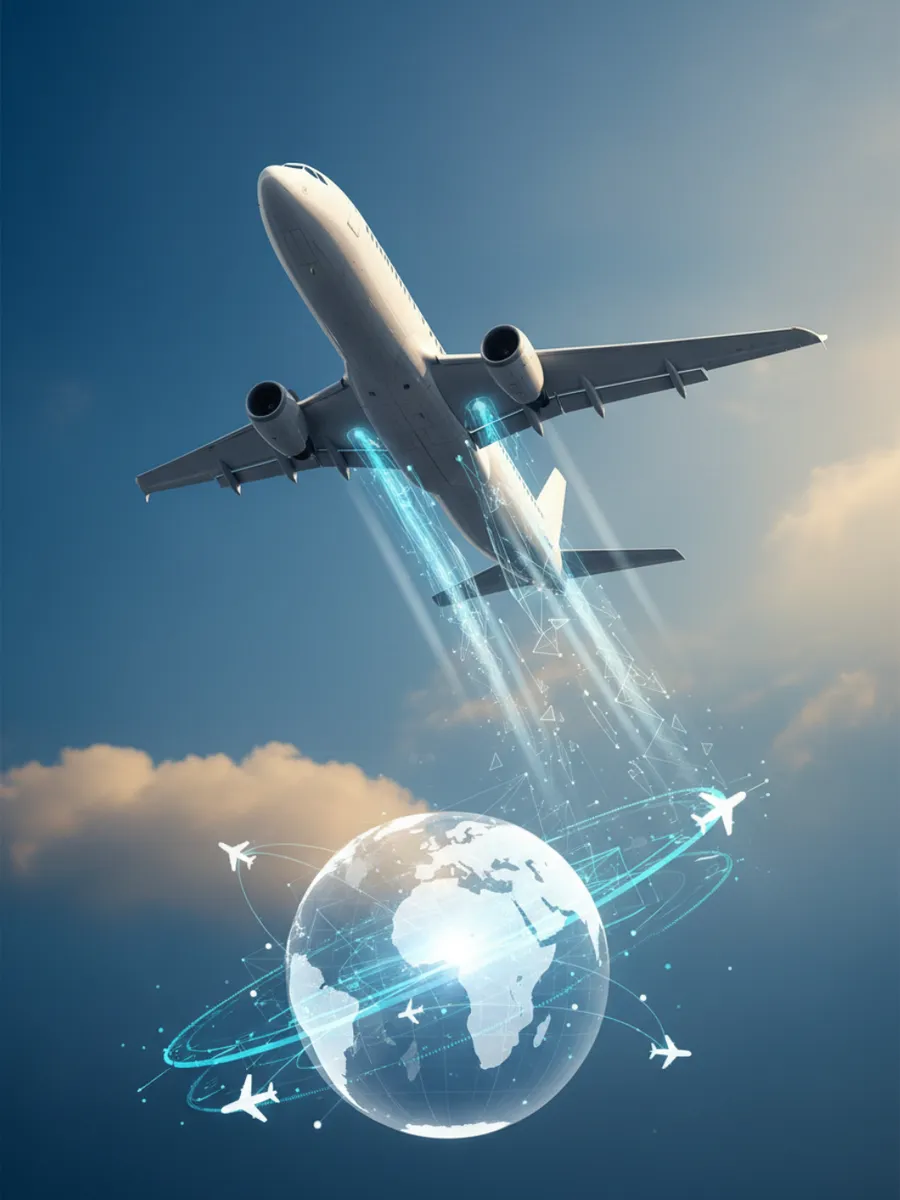
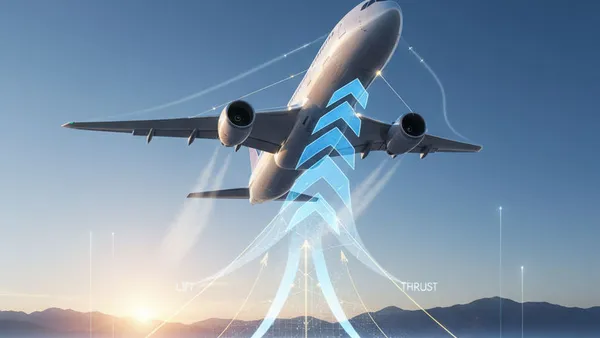
Most people know Bernoulli, but elite aerodynamics describes lift through the concept of circulation. According to the Kutta-Joukowski theorem, lift is exactly proportional to the circulation of air around the airfoil, air density, and the flow velocity.
Instead of tracking individual molecules, this theory models a bound vortex wrapping around the wing. This circulation is triggered by the Kutta condition: because air is viscous, it must leave the sharp trailing edge smoothly without reaching impossible, infinite speeds.
As a plane starts its takeoff roll, a starting vortex sheds off the back and stays on the runway. To conserve total angular momentum, an equal and opposite bound vortex forms around the wing. This accelerates air on the top and slows it down below.
This elegant model explains pressure differences far more precisely than the debunked "equal transit time" myth, which wrongly claims air molecules must reunite at the trailing edge simultaneously.
Key Takeaway
Lift is modeled via circulation and the conservation of angular momentum through vortex formation.
Test Your Knowledge
What does the "Kutta condition" force at the wing's trailing edge?
In a 2D theoretical model, lift seems perfectly efficient. In reality, wings have physical ends. High pressure under the wing escapes around the tips to the low-pressure top, creating massive, spiraling tubes of air: the famous wingtip vortices.
These vortices, often visible as vapor trails on humid days, distort the entire flow field. They generate a permanent downward flow behind the wing known as downwash. This downwash tilts the resulting lift vector slightly backward.
This rearward component of lift acts as a brake and is known as induced drag. Paradoxically, it is strongest when flying slowly (like during takeoff) because the angle of attack is much higher, forcing more air around the tips.
Modern winglets are designed to physically block this pressure bleed. By disrupting the vortex formation, they minimize drag and boost efficiency in the high-stakes game of long-haul flight.
Key Takeaway
Wingtip vortices tilt the lift vector backward, creating a retarding force known as induced drag.
Test Your Knowledge
In which flight phase is induced drag typically at its strongest?
Air seems weightless, but for aerodynamicists, it has a critical property: viscosity. A microscopic layer of air sticks directly to the wing's metal surface, with a velocity of zero. This is the legendary boundary layer.
Within millimeters, air accelerates from zero to full speed. Initially, this flow is laminar—smooth and parallel. While it has low friction, it is fragile. Tiny imperfections or even insects can flip it into a chaotic turbulent state.
Surprisingly, a turbulent boundary layer is often a lifesaver. Because it is highly mixed, it has much more kinetic energy. This energy helps it fight against the rising pressure found at the back of the wing.
If the boundary layer lacks the energy to push through this pressure, it separates violently from the surface. This causes a stall, leading to a sudden, catastrophic loss of lift.
Key Takeaway
Air viscosity creates a boundary layer that destroys lift if it loses kinetic energy and separates.
Test Your Knowledge
Why are tiny vortex generators often intentionally placed on aircraft wings?
Below 400 km/h, air behaves like water. But near the speed of sound (Mach 1), physics shifts: air becomes rigid and compressible. This creates a high-stakes environment where the air can no longer get out of its own way.
Because wing curvature accelerates local flow, air on top often breaks the sound barrier while the plane is still subsonic. This complex mix of speeds is known as the transonic regime.
When this local supersonic flow inevitably slows back down, it creates a brutal shockwave. This wall of pressure generates massive wave drag and can rip the sensitive boundary layer right off the wing.
This is why modern jets have swept wings. By angling the wings back, the profile "feels" only the slower component of air perpendicular to the edge. This allows cruising at Mach 0.85 without triggering destructive shocks.
Key Takeaway
Transonic flight creates shockwaves; swept wings delay these effects by reducing effective flow speed.
Test Your Knowledge
What is the primary aerodynamic purpose of swept-back wings on airliners?
Producing lift isn't enough; a plane must be self-stabilizing. If a gust kicks the nose up, the design must naturally push it back down. This is longitudinal stability, the key to a safe, hands-off flight.
The secret lies in the relationship between the center of gravity (CG) and the center of pressure. For safety, the CG in conventional planes is positioned slightly *ahead* of the main lift point.
This creates a constant nose-down torque, like an uneven seesaw. To balance this, the horizontal stabilizer at the tail doesn't create lift. Paradoxically, it produces constant downforce, pulling the tail down.
This setup is a brilliant failsafe. If the plane slows, the tail's downforce drops. The heavy nose then dips, the plane gains speed, and flight stability restores itself automatically without pilot input.
Key Takeaway
For stability, the center of gravity is forward, meaning the tail must provide constant downforce.
Test Your Knowledge
Why does the horizontal stabilizer at the tail usually generate downforce in flight?
Track your progress, earn XP, and compete on leaderboards. Download NerdSip to start learning.