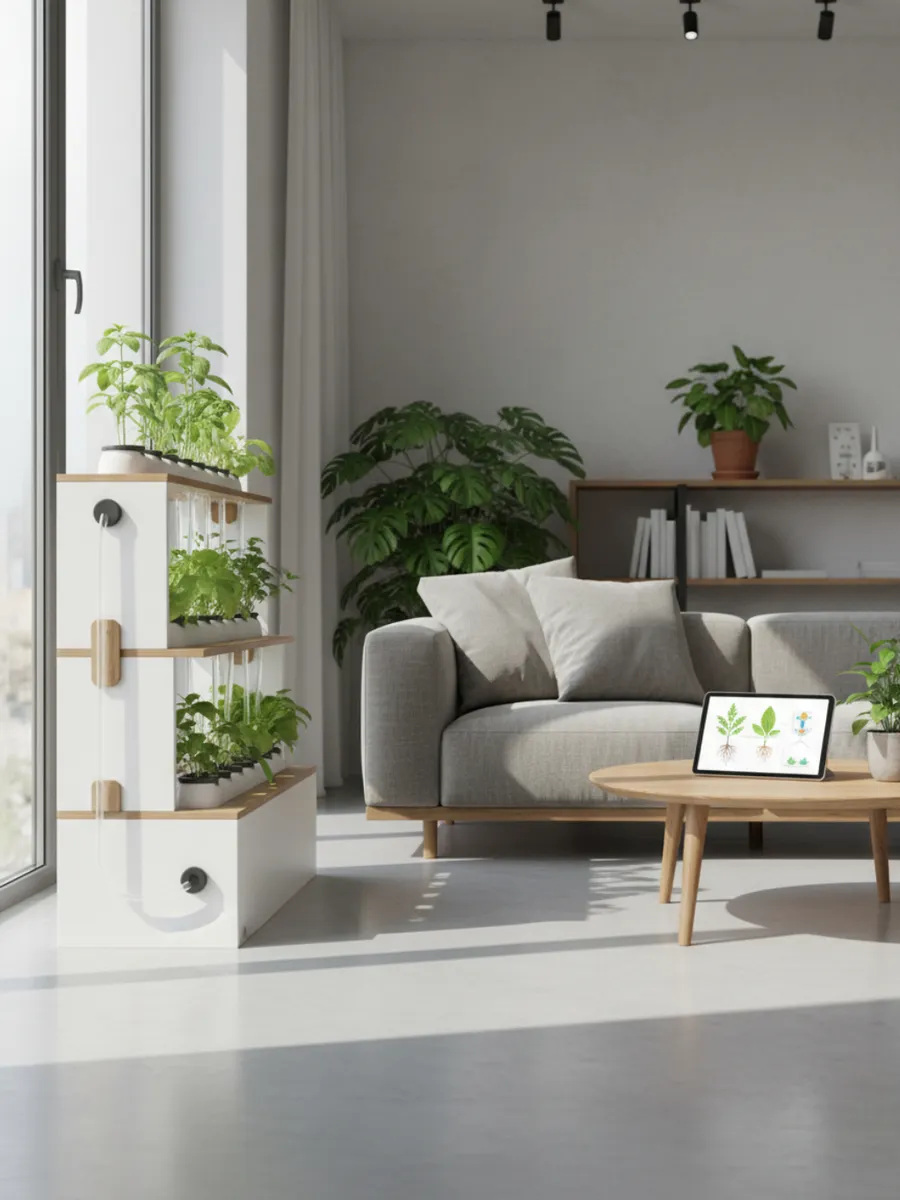
Did you know plants grow up to 30% faster in water than in dirt?
Prompted by A NerdSip Learner
Learn to grow fresh salads and herbs indoors using only water and nutrients.
Welcome to the world of hydroponics! The concept is simple yet brilliant: plants don't actually need soil to grow; they only use it for physical support. In nature, roots have to work hard to find minerals hidden in the dirt. In hydroponics, we remove the middleman and deliver nutrients directly to the roots via water.
By saving energy usually spent searching for food, the plant can focus entirely on growing lush leaves and juicy fruit. This efficiency is why your indoor herbs often grow 30% faster than they would in a traditional garden. It is essentially turbo-charging your greenery.
Beyond speed, it is the cleanest way to garden. Say goodbye to messy soil on your floors and pesky fungus gnats. Plus, because the water stays in a closed system with minimal evaporation, you will use up to 90% less water than traditional farming. It is the perfect high-tech solution for your living room.
Key Takeaway
Hydroponics uses water instead of soil to deliver nutrients efficiently, leading to faster growth and less water waste.
Test Your Knowledge
Why do plants often grow faster in hydroponic systems?
The easiest way to start is the 'Kratky Method.' It is a passive system, meaning you don't need pumps, electricity, or fancy tech. All you need is a light-proof container, a lid with a hole, and a small mesh net pot.
Your plant sits in a soil-less medium like rockwool within the net pot, while its roots hang down into the nutrient solution. The secret lies in the falling water level. As the plant drinks, the water line drops, creating a gap of moist air between the plant and the liquid.
In this gap, the plant develops special 'air roots' that breathe in essential oxygen. You simply fill the container once and watch your lettuce grow to maturity. It is the ultimate 'set-and-forget' system for beginners who want big results with zero maintenance.
Key Takeaway
The Kratky Method is a passive, electricity-free system where a dropping water level provides essential oxygen to the roots.
Test Your Knowledge
What happens in a Kratky system as the plant consumes the water?
Since we aren't using soil, we have to provide the food ourselves. You will need a specialized hydroponic fertilizer (usually an 'A+B' solution) containing all necessary micronutrients. Regular houseplant fertilizer won't work because it lacks the specific minerals needed for water-based growth.
Two numbers determine your success: pH and EC. For most leafy greens, the pH should stay between 5.5 and 6.5. If it drifts too high or too low, the plant's 'mouth' effectively stays shut, and it cannot absorb nutrients even if they are plentiful in the water.
The EC value measures electrical conductivity, telling you how concentrated your nutrient mix is. To get started, a simple pH test strip or a cheap digital meter is all you need to ensure your plants are neither 'starving' nor 'burning' from over-fertilization.
Key Takeaway
A pH level between 5.5 and 6.5 is essential for plants to successfully absorb the nutrients dissolved in the water.
Test Your Knowledge
What happens if the pH level in your system stays at 8.5?
Light is the fuel for your plants. Unfortunately, window light—especially in winter—is rarely enough for indoor farming. Without enough light, plants become 'leggy,' growing thin, weak, and pale as they stretch desperately toward the sun.
Modern LED grow lights are the game-changer. They use very little power and provide the exact spectrum of light that plants crave. For simple salads and herbs, affordable full-spectrum LEDs are more than enough to get professional results at home.
Aim for about 14 to 16 hours of light per day. Use a simple plug-in timer to keep the rhythm consistent. Remember, plants also need a dark phase to 'rest' and process their energy—keeping the lights on 24/7 is actually counterproductive for most species.
Key Takeaway
LED grow lights for 14-16 hours a day replace missing sunlight and prevent weak, leggy growth.
Test Your Knowledge
Why is a timer recommended for your grow lights?
How do you actually start? You cannot simply move a plant from a dirt pot into your system. Dirt would clog the fine channels and introduce bacteria or pests. To succeed in hydroponics, we have to start 'clean.'
Use soil-less starting media like rockwool cubes, coco coir plugs, or specialized sponges. Place your seed in the moist cube and keep it warm and dark until the first sprout appears. Once you see the first set of 'true leaves,' move the whole cube into your net pot.
Initially, ensure the bottom of the cube touches the nutrient solution to stay moist. Once the roots grow out of the basket and into the reservoir, gravity and thirst will take over, and the roots will find their own way deep into the water.
Key Takeaway
Always use soil-less growing media in hydroponics to keep the system clean and avoid root diseases.
Test Your Knowledge
Why shouldn't you move plants directly from traditional soil into a hydro-system?
Your biggest enemy indoors is algae. Algae loves two things: light and nutrients. If light reaches your water reservoir, your water will turn green. This isn't just an eyesore; algae will actively steal oxygen and nutrients meant for your plants.
The solution is simple: your container must be 100% light-proof. Use dark-colored buckets or wrap transparent jars in foil or paint. If the light can't get in, the algae can't grow. It is the easiest way to keep your system healthy.
Once a week, do a quick check. The water should smell fresh, and the roots should be bright white. If the roots look brown or feel slimy, it usually means there is a lack of oxygen or rot is setting in—time for a quick water change!
Key Takeaway
Light-proof containers prevent algae growth; healthy roots should be white and smell fresh.
Test Your Knowledge
What is the most effective way to prevent green algae in your system?
After about 4 to 6 weeks, your lettuce should be ready for the plate! For leafy greens, you have two choices: harvest the whole plant at once or use the 'cut-and-come-again' method. This involves picking only the outer leaves and leaving the center intact.
By leaving the 'heart' of the plant, it will continue to produce new leaves for weeks. Once you eventually finish a crop, give your system a thorough cleaning with warm water and a bit of vinegar before starting the next round to keep everything sterile.
As you gain confidence, you can upgrade to active systems with air pumps to grow heavier feeders like tomatoes or chilies. The core principles remain the same—just with more light and food. Enjoy your first successful indoor harvest!
Key Takeaway
Leafy greens can be harvested whole or leaf-by-leaf; keeping the system clean between cycles is the key to long-term success.
Test Your Knowledge
What is the main benefit of the 'cut-and-come-again' harvest method?
Track your progress, earn XP, and compete on leaderboards. Download NerdSip to start learning.