What if a tiny hull change saved millions in fuel costs?
Prompted by A NerdSip Learner
Design elite-level energy saving devices for modern hulls.
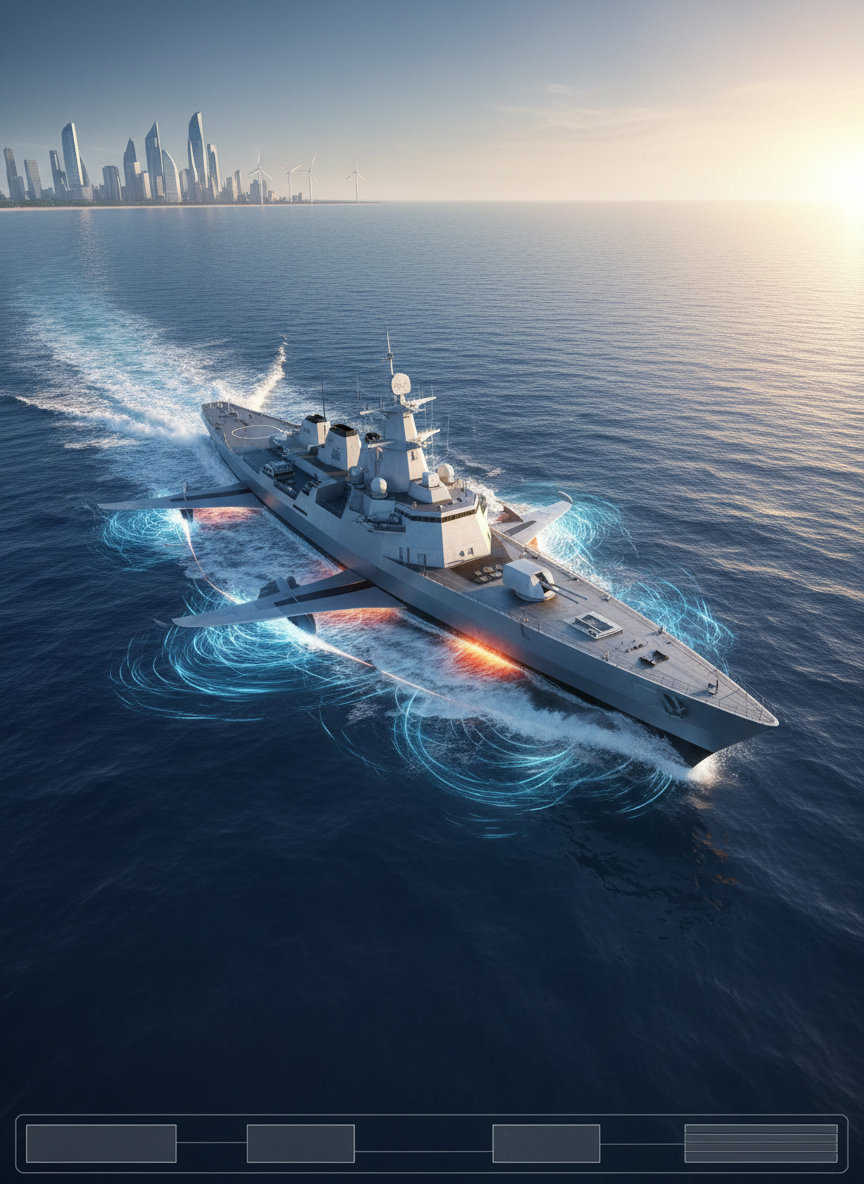
Welcome to the deep end of naval architecture! We know that the propeller efficiency, $\eta_O$, is heavily dependent on the quality of the inflow. At an expert level, we aren't just looking at the nominal wake fraction; we are obsessively focused on modifying the tangential velocity components of the flow before it reaches the propeller plane. Enter Pre-Swirl Stators (PSS).
These asymmetric fins, mounted upstream of the propeller on the stern boss, generate a pre-swirl counter to the propeller's rotation. This increases the effective angle of attack for the blade sections, essentially recovering rotational energy losses before they even happen.
Crucially, PSS application isn't just about efficiency (typical gains of 2-4%); it's a vital tool for vibration mitigation. By homogenizing the wake field into the upper part of the propeller disc, we significantly reduce unsteady cavitation and pressure pulses against the hull. It’s all about conditioning that boundary layer for optimal propulsion interaction!
Key Takeaway
Pre-Swirl Stators recover rotational energy upstream and homogenize the wake field to reduce cavitation and pressure pulses.
Test Your Knowledge
In the context of Pre-Swirl Stators (PSS), which hydrodynamic mechanism is primarily responsible for the efficiency gain?
Let's move downstream to the propeller hub. You are well aware that a standard propeller generates a low-pressure core known as the hub vortex. This isn't just a flow visualization nuisance; it represents a tangible loss of kinetic energy and a source of significant induced drag.
Propeller Boss Cap Fins (PBCF) address this by rectifying the flow. The small fins attached to the cap generate a strong downwash that breaks up the hub vortex structure. By mitigating this low-pressure zone, we see a reduction in the propeller torque required for a given thrust.
From a structural longevity perspective, eliminating the hub vortex prevents cavitation erosion on the rudder horn, a common plague in high-powered container ships. While the efficiency gain is modest (roughly 2-5%), the reduction in torque and vibration makes the PBCF a standard for holistic hydrodynamic optimization. It effectively essentially cancels out the root vortex caused by the pressure difference between the blade face and back.
Key Takeaway
PBCFs break up the hub vortex, reducing induced drag, lowering torque requirements, and preventing rudder erosion.
Test Your Knowledge
What is the primary physical effect of a PBCF on the propeller's performance characteristics?
Finally, let's analyze the Becker Mewis Duct and similar integrated systems. These are particularly potent for full-form vessels with high block coefficients ($C_B$). The device combines a wake-equalizing duct with an integrated pre-swirl fin system. The duct generates a forward thrust component via an airfoil cross-section (similar to a Kort nozzle effect), while the fins correct the inflow rotation.
The engineering challenge here lies in scale effects. When relying on model tests, the Reynolds number ($Re$) disparity between model and full scale can lead to inaccurate predictions of flow separation around the duct. Advanced CFD (RANS/DES) simulations are mandatory to predict the viscous resistance accurately.
The goal is to minimize flow separation at the aft-body while maximizing the thrust deduction factor ($t$) benefits. By straightening the flow, we are essentially converting the hull's viscous wake into useful thrust, pushing the boundaries of the quasi-propulsive coefficient (QPC).
Key Takeaway
Integrated ducts combine airfoil-generated thrust with pre-swirl fins, ideal for high block coefficient vessels to maximize the quasi-propulsive coefficient.
Test Your Knowledge
Why are integrated duct systems like the Mewis Duct most effective on vessels with a high block coefficient ($C_B$)?
Track your progress, earn XP, and compete on leaderboards. Download NerdSip to start learning.