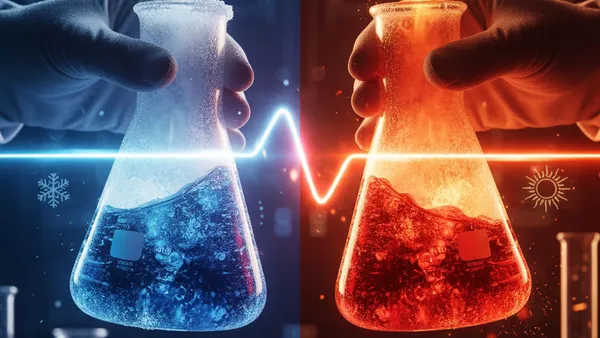
Why does a melting ice cube actually absorb heat?
Prompted by NerdSip Explorer #6116
Master the basics of heat energy.
Everything around us is moving, even if we can't see it. In the microscopic world, molecules are constantly wiggling, vibrating, and bumping into each other. This movement is what we feel as heat. Think of heat as an invisible currency of energy that the universe is constantly trading.
Whenever a change happens in nature—like a piece of paper burning or ice melting—energy is exchanging hands. It has to go somewhere! Nature has a strict accounting system, meaning energy cannot simply disappear. It just moves from one place to another.
To understand how the world works, we just need to follow the money—or in this case, follow the heat! Sometimes an object gives its heat away to the world around it, and sometimes it steals heat from its surroundings.
This simple exchange of heat energy is the foundation for almost everything that happens in our daily lives, from how our cars run to how our food cooks. Getting comfortable with this idea unlocks the secret to both endothermic and exothermic processes!
Key Takeaway
Heat is a form of energy that constantly moves and exchanges between objects.
Test Your Knowledge
What is heat best described as in the microscopic world?
Science words can sound intimidating, but they are usually just simple concepts wearing a fancy Greek or Latin disguise. Let's unmask the words "endothermic" and "exothermic" by breaking them into pieces!
First, let's look at the ending: -thermic. You might recognize this from words like "thermostat" or "thermal underwear." It simply means heat. So, both of our mystery words are all about heat.
Now for the prefixes. Exo- means "outside" or "external." Think of an exit sign or an exoskeleton (a skeleton on the outside of a bug). Put it together, and exothermic literally means "heat going outside."
On the flip side, Endo- means "inside." Think of an endoscopy (looking inside the body) or entering a door. Therefore, endothermic means "heat going inside."
By just remembering "exit" and "enter," you've already mastered the hardest part of this entire topic! Exothermic pushes heat out, and endothermic pulls heat in. It really is that simple.
Key Takeaway
"Exo" means outside (heat exiting) and "Endo" means inside (heat entering).
Test Your Knowledge
If "thermic" means heat, what does the prefix "Exo-" mean?
Imagine you are standing next to a crackling campfire on a chilly autumn evening. As you hold your hands out, you feel a wonderful, comforting warmth hitting your skin. This is the perfect example of an exothermic process in action!
Remember our vocabulary: "Exo" means outside, and "thermic" means heat. The burning wood is literally throwing its heat energy out into the surrounding world. Because the heat is escaping *from* the fire and traveling *into* your hands, your hands feel warm.
In an exothermic process, the main event (the fire) has more energy than it needs, so it dumps the leftovers into the environment. This is why things that are exothermic feel hot to the touch!
It's not just fires, either. When your body breaks down the food you eat, it releases heat, which is exactly why humans have a warm body temperature! The environment gets warmer because the reaction is giving away its energy for free.
Key Takeaway
Exothermic processes release heat into their surroundings, making things feel warm.
Test Your Knowledge
Why does an exothermic process feel hot to you?
Now, imagine you sprained your ankle and you place an instant cold pack right on the swelling. As soon as you snap the pack, it feels freezing cold against your skin. This is the magic of an endothermic process!
Let's check our vocabulary again: "Endo" means inside, and "thermic" means heat. The chemicals inside that cold pack are incredibly greedy. To do their job, they desperately need energy, so they start stealing heat from the outside world.
Where do they steal it from? From the closest thing available—your warm skin! Because heat is literally being sucked *out* of your leg and *into* the plastic pack, your brain registers the loss of heat as a sensation of cold.
An endothermic reaction acts like a sponge for energy. It soaks up the heat from its environment. So, whenever you touch something and it feels suspiciously cold, you are likely feeling a tiny heat thief in action!
Key Takeaway
Endothermic processes absorb heat from their surroundings, which we feel as cold.
Test Your Knowledge
Why does an instant cold pack feel freezing against your skin?
To really understand these processes, it helps to imagine a game of energetic tug-of-war. In every physical change or chemical reaction, there is a battle between breaking old connections and forming new ones.
Here is the golden rule: Breaking things apart always costs energy, while building new things always releases energy. Think of snapping a tough stick in half—you have to put effort (energy) into it. But when things snap together, like powerful magnets, they release a burst of energy!
Every reaction does both: it breaks old bonds and makes new ones. The winner of this tug-of-war determines what we feel!
If it takes *more* energy to break the old stuff apart than is released by making the new stuff, the reaction is in energy debt. It has to steal heat from the room to pay the difference (endothermic). If building the new stuff releases a massive amount of excess energy, it dumps that extra heat into the room (exothermic).
Key Takeaway
Breaking bonds requires energy, while forming new bonds releases energy.
Test Your Knowledge
What happens to energy when you break chemical connections apart, like snapping a stick?
We usually think of chemistry as bubbling test tubes, but these heat concepts apply to everyday things like water. Let's look at an ice cube sitting on a kitchen counter. What happens? It melts!
Believe it or not, melting is an endothermic process. To turn from a rigid, frozen solid into a flowing liquid, the ice needs to loosen up its molecules. Remember our tug-of-war? Breaking apart that frozen structure costs energy!
To get that energy, the ice cube acts like a heat sponge. It silently absorbs the invisible heat from the warm air in your kitchen. As the ice sucks the heat *inward* (endo), it finally gains enough energy to break its solid bonds and turn into liquid water.
This is exactly why ice cools down your drink! The ice isn't actually "giving off coldness." Instead, it is actively stealing the heat out of your warm soda to melt itself. Your drink loses heat, so it gets colder!
Key Takeaway
Melting is endothermic because it must absorb heat from its surroundings to turn into a liquid.
Test Your Knowledge
Why does an ice cube cool down a warm glass of soda?
If melting an ice cube absorbs heat, what happens when we put water into the freezer to make ice? We experience the exact opposite: an exothermic process!
To turn free-flowing liquid water into a rock-hard ice cube, the water molecules have to slow down and lock together. But water molecules love to wiggle! To force them to stop wiggling, the water must give away its extra energetic heat.
The liquid water pushes its internal heat *outward* into the surrounding air. This is the literal definition of exothermic—heat exiting! Your freezer's entire job is to constantly pump this discarded heat out of the box, allowing the water to finally calm down and freeze.
The same thing happens when water vapor turns into rain (condensation). The clouds are releasing heat into the atmosphere to form those raindrops! So next time you make ice, remember that your water is actually throwing its heat away.
Key Takeaway
Freezing is exothermic because liquid water must release its heat outward to become a solid.
Test Your Knowledge
Why is freezing considered an exothermic process?
You might not realize it, but if you enjoy cooking or baking, you are regularly conducting endothermic chemistry experiments! Your kitchen oven is actually the ultimate tool for pushing energy into things.
Think about baking a cake. You mix raw eggs, flour, and sugar into a gooey batter. If you leave that batter on the counter, nothing will happen. The ingredients need a massive influx of heat energy to transform into a fluffy cake.
When you put the pan in the oven, the batter absorbs the intense heat from the air. This absorbed energy forces the proteins in the eggs to unfold and the baking powder to create air bubbles.
Because the batter is continuously taking heat *in* from its environment to make these changes happen, baking is fundamentally endothermic. Frying an egg, boiling pasta, and making toast all require an external heat source to work! You are a master of endothermic science.
Key Takeaway
Cooking often requires food to absorb heat from its environment, making it an endothermic process.
Test Your Knowledge
Why is baking a cake an example of an endothermic process?
Let's step out of the kitchen and into a snowy winter day. Your hands are freezing, so you tear open a plastic packet, shake up the little paper pouch inside, and slip it into your gloves. Almost instantly, it gets wonderfully warm.
Those disposable hand warmers are a beautiful piece of exothermic engineering! Inside that little pouch is mostly iron powder. When you open the plastic package, you let oxygen from the air rush inside.
The oxygen and the iron quickly start to combine, creating iron oxide (which is just a fancy word for rust!). As these chemicals build new bonds with each other, they release a tremendous amount of leftover energy.
Remember our golden rule: building new things releases energy. Because the reaction is pushing its extra heat *outward*, it warms up your cold hands. You are basically using a highly controlled, heat-exiting chemical reaction to survive the winter!
Key Takeaway
Hand warmers use an exothermic chemical reaction to push extra heat into your hands.
Test Your Knowledge
How do disposable hand warmers generate heat for your gloves?
You have officially mastered the basics of how energy moves! It all boils down to whether heat is moving into the system or exiting the system. By simply paying attention to temperature changes, you can usually guess what is happening.
Let's summarize the cheat sheet. If you mix two things together and the container gets incredibly hot, the reaction is throwing away its extra energy. Heat is exiting, which means it is exothermic.
If you mix two things together and the container becomes surprisingly cold, the reaction is greedy. It is stealing energy from the room (and your fingers) to survive. Heat is entering, which means it is endothermic.
Whether it is the sun warming the earth, a campfire burning logs, or an ice cube melting in your lemonade, our universe is just one giant, endless exchange of heat. You now have the scientific vocabulary to describe exactly how the energy is flowing!
Key Takeaway
Temperature changes tell us if a reaction is absorbing heat (endothermic) or releasing heat (exothermic).
Test Your Knowledge
If you touch a jar where a chemical reaction is happening and it feels ice cold, what type of process is likely occurring?
Track your progress, earn XP, and compete on leaderboards. Download NerdSip to start learning.