Did you know trees 'warn' their neighbors about insect attacks?
Prompted by A NerdSip Learner
How underground mycelium allows trees to talk to each other.
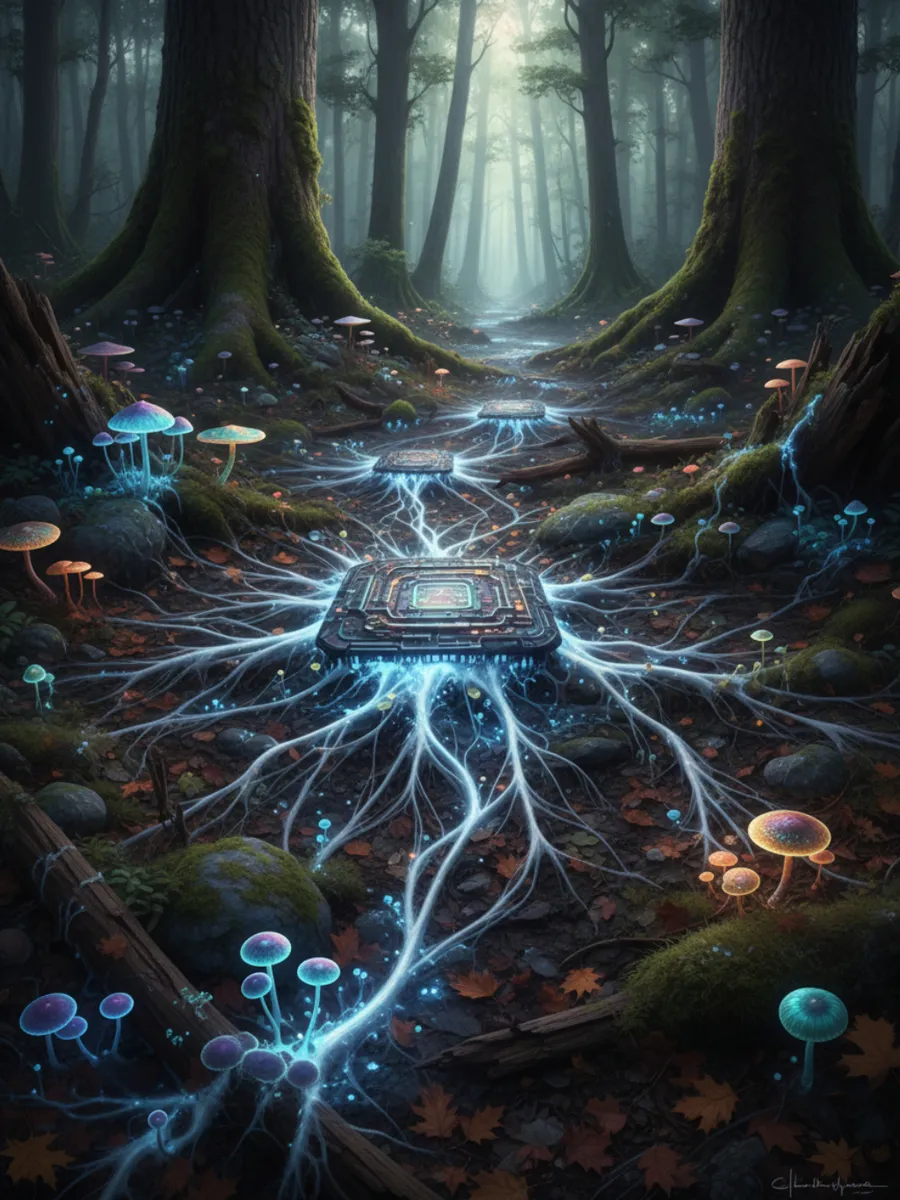
Beneath your feet in a forest, there is a hidden architecture more complex than any human city. This is the world of mycelium—a vast web of tiny, thread-like structures called hyphae. These threads belong to fungi that live in a symbiotic relationship with tree roots, forming what scientists call a "mycorrhizal network."
While we usually only see the mushrooms that pop up after rain, those are merely the "fruiting bodies" of the fungus. The real work happens underground, where a single teaspoon of healthy forest soil can contain several miles of fungal threads. This network acts as the biological hardware for the forest.
For decades, we viewed trees as individual competitors fighting for sunlight. However, research pioneered by ecologists like Dr. Suzanne Simard suggests that trees are actually deeply interconnected. This network, often dubbed the "Wood Wide Web," allows different plants to link their root systems together across vast distances.
Key Takeaway
The Wood Wide Web is a physical network of fungal threads (mycelium) that connects the roots of different trees into a shared system.
Test Your Knowledge
What are the tiny, thread-like structures that make up the underground fungal network called?
The relationship between trees and fungi is not charity; it is a sophisticated trade agreement. Trees are experts at photosynthesis—turning sunlight into energy-rich sugars (carbon). However, they aren't always great at mining the soil for minerals like phosphorus and nitrogen.
Fungi are the opposite. Their microscopic hyphae can slip into tiny crevices in the soil that tree roots are too thick to reach, making them highly efficient at extracting minerals. In a mutualistic exchange, the tree provides the fungus with up to 30% of the sugar it produces, while the fungus delivers essential nutrients back to the tree.
This partnership is roughly 450 million years old and is believed to be one of the key reasons plants were able to move from the ocean onto land. Without this underground marketplace, most of the world's forests would likely starve or fail to grow to their massive heights.
Key Takeaway
Trees trade carbon (sugars) with fungi in exchange for essential nutrients like phosphorus and nitrogen.
Test Your Knowledge
What is the primary resource that trees provide to their fungal partners?
In every forest, certain trees act as central command centers. These are often the oldest and largest trees, known as "Mother Trees." Because of their size and age, they have the most extensive root systems and the most connections to the fungal network.
Research has shown that Mother Trees can recognize their own kin. When seedlings from the same species sprout nearby, the Mother Tree can actually send them extra nutrients through the mycelium to help them survive in the shaded understory where sunlight is scarce.
If a Mother Tree is dying, it may even "dump" its remaining carbon and chemical wisdom into the network to benefit the next generation. This suggests that a forest is not just a collection of trees, but a social community where the elders support the youth.
Key Takeaway
Mother Trees are large, older trees that act as central hubs in the network, often providing extra resources to younger seedlings.
Test Your Knowledge
How do Mother Trees typically support seedlings in the forest understory?
When a tree is attacked by insects, it doesn't just suffer in silence. It sends out a chemical "SOS" signal through the fungal network to its neighbors. For example, if aphids begin eating a bean plant, that plant can release chemical signals that travel through the soil to nearby plants.
Once neighboring plants receive this warning, they begin to ramp up their own defenses. They might produce bitter-tasting chemicals or toxins that make their leaves unpalatable to the incoming pests. This happens before the insects have even reached the neighboring tree.
This early warning system increases the resilience of the entire forest. It’s similar to how a computer network might send a security alert to all connected devices when a virus is detected on one machine.
Key Takeaway
Trees use the fungal network to send chemical warning signals about pest attacks, allowing neighbors to prepare their defenses.
Test Your Knowledge
What is the primary benefit of the 'warning signals' sent through the network?
How exactly do these messages travel? There are two primary modes of communication within the Wood Wide Web: chemical and electrical. Chemical signals involve the movement of specific molecules, like jasmonates or salicylates, through the fungal threads.
However, chemical movement can be slow. Recent studies have found that fungi also transmit electrical impulses similar to the nerve signals in animals. These electrical waves can travel at a rate of roughly several millimeters per minute, which is much faster than the diffusion of chemicals through soil.
While it is important not to anthropomorphize trees too much—they don't "think" in the way we do—this system of electrical and chemical signaling functions like a primitive nervous system for the forest, allowing it to respond to environmental changes in real-time.
Key Takeaway
Forest communication uses both slow-moving chemical signals and faster electrical impulses that travel through fungal threads.
Test Your Knowledge
In addition to chemical signals, what other type of impulse has been observed in fungal networks?
The Wood Wide Web isn't always a scene of perfect cooperation. Like any network, it has "hackers" and "thieves." Some plant species, such as the Ghost Plant (Monotropa uniflora), have no chlorophyll and cannot produce their own food. Instead, they tap into the network and steal carbon from other trees without giving anything back.
There is also a phenomenon called allelopathy, where certain trees use the network to spread toxins. The Black Walnut tree, for instance, is known to release chemicals that can inhibit the growth of or even kill potential competitors nearby.
Furthermore, recent scientific debates (such as the work by Dr. Justine Karst in 2023) suggest that we should be cautious about seeing this as "altruism." Some scientists argue that trees may simply be "eavesdropping" on their neighbors' signals for their own selfish survival, rather than intentionally trying to help the group.
Key Takeaway
The network can be used for exploitation, such as nutrient theft by parasitic plants or the spreading of toxins to kill competitors.
Test Your Knowledge
What is 'allelopathy' in the context of forest networks?
Understanding fungal networks changes how we approach conservation. In the past, loggers would often clear-cut forests and replant them with a single species of tree. However, without the complex, multi-species fungal networks found in old-growth forests, these new plantations are often much more vulnerable to disease and climate stress.
Healthy, diverse networks help forests sequester more carbon and survive droughts. When the network is intact, water can be redistributed from deep-rooted trees to those with shallower roots during dry spells, acting as a natural irrigation system.
By protecting soil health and avoiding over-tilling or heavy chemical use, we protect the Wood Wide Web. As we face global environmental challenges, the "intelligence" of these ancient underground networks may be one of our best allies in maintaining the health of the planet.
Key Takeaway
Maintaining diverse fungal networks is essential for forest resilience, carbon storage, and survival against climate change.
Test Your Knowledge
Why are old-growth forests often more resilient than single-species tree plantations?
Track your progress, earn XP, and compete on leaderboards. Download NerdSip to start learning.