Ready to explore the most fascinating rule-breakers of reality?
Prompted by NerdSip Explorer #7380
Master advanced anomalies in science, art, and society.
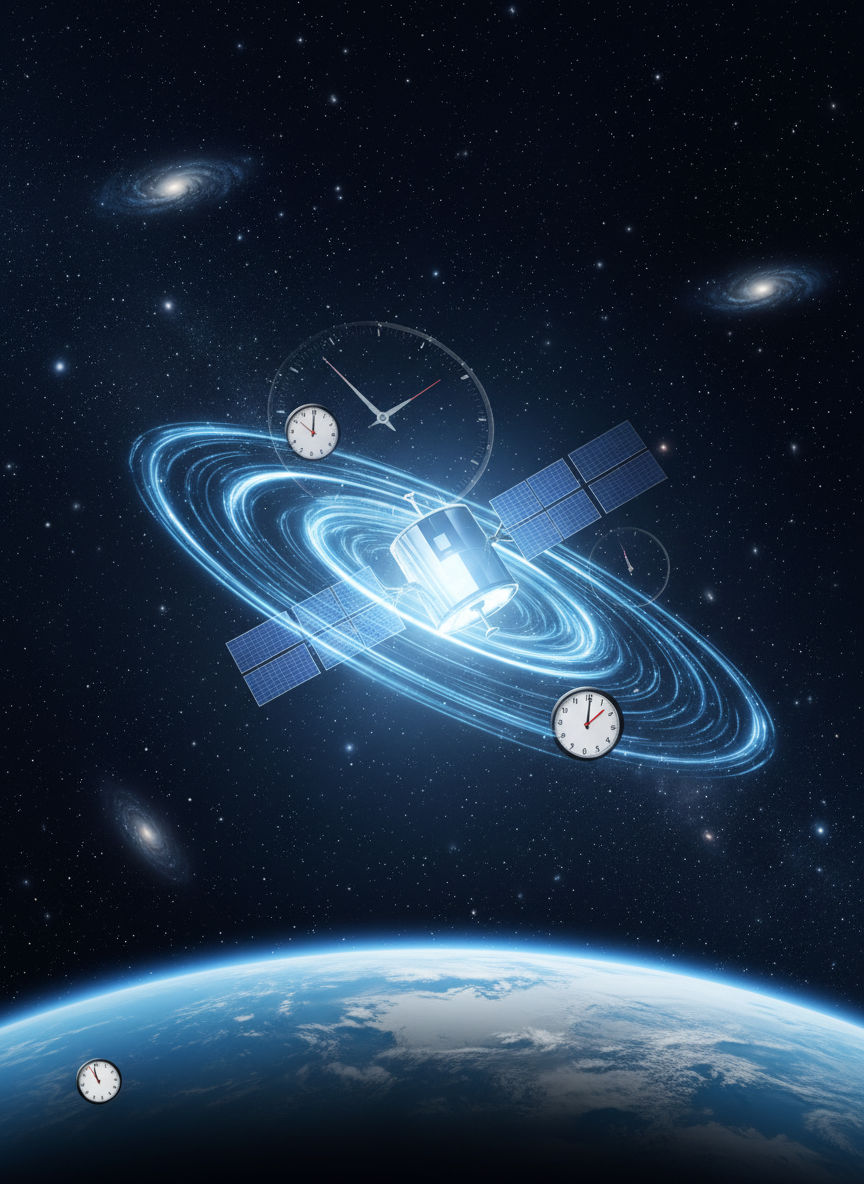
You already know that massive objects bend the fabric of space. But Albert Einstein’s theory of relativity holds an even more mind-bending consequence: gravity also warps the flow of time itself. This phenomenon is known as gravitational time dilation.
The closer you are to a massive object, the slower your clock ticks relative to an observer further away. To an astronaut floating in deep space, a clock resting on the surface of the Earth appears to be ticking just a tiny bit slower. Gravity is literally pulling on time.
This isn't just theoretical physics—it has massive real-world engineering consequences. The GPS satellites orbiting Earth experience less gravity than we do on the surface. Because of this, their onboard atomic clocks naturally tick slightly faster than clocks on the ground.
If engineers didn't program the system to mathematically compensate for this relativistic time shift, GPS navigation would fail within minutes, miscalculating your position by miles. Gravity doesn't just keep us grounded; it keeps us synchronized.
Key Takeaway
Gravitational time dilation causes time to pass more slowly in stronger gravitational fields.
Test Your Knowledge
What would happen to GPS satellites if engineers ignored gravitational time dilation?
The classic law of supply and demand states that when prices go up, demand goes down. But human psychology creates fascinating economic anomalies where this mathematical rule shatters. Enter the Veblen good, named after economist Thorstein Veblen.
A Veblen good is a high-quality luxury item where an increase in price actually *increases* its demand. Think of a rare vintage watch, a designer handbag, or exclusive modern art. If the brand were to lower the price, sales might actually drop.
This happens because the high price tag is an inherent part of the product's value. The exorbitant cost signals elite status, exclusivity, and wealth. The price doesn't just reflect the cost of production; it becomes a core feature of the item itself, driven by conspicuous consumption.
On the opposite end, economists observe Giffen goods—staple survival items where price spikes also increase demand, usually because struggling consumers can no longer afford better alternatives and must hoard the cheap staple. Both goods prove that economics is deeply emotional.
Key Takeaway
For Veblen goods, an increase in price causes an increase in demand due to the psychological appeal of exclusivity and status.
Test Your Knowledge
Why does lowering the price of a Veblen good sometimes reduce its sales?
Confirmation bias explains how we seek out information that validates our beliefs. But what happens when we are confronted with undeniable, factual evidence that contradicts our deeply held views? Surprisingly, we rarely change our minds. Instead, we experience the backfire effect.
The backfire effect is a psychological phenomenon where being presented with contradictory evidence actually strengthens your original belief. Rather than updating our worldview with new data, we subconsciously dig our heels in deeper.
Neuroscientists have observed that when our core beliefs are challenged, the brain's amygdala—the emotional processing center that triggers the fight-or-flight response—lights up. The brain literally treats intellectual threats to our identity exactly like physical threats to our safety.
To protect the ego, the mind deploys intense defensive rationalizations, hyper-scrutinizing the new evidence or attacking the messenger. Understanding this cognitive glitch is crucial: changing a mind is rarely about presenting the best facts, but rather about creating a psychologically safe space where the other person's identity isn't under attack.
Key Takeaway
The backfire effect is a cognitive bias where people strengthen their original beliefs when presented with contradictory evidence.
Test Your Knowledge
How does the brain's amygdala react to a challenge against a deeply held belief?
Impressionism revolutionized art by capturing the realistic, fleeting effects of light. But at the dawn of the 20th century, a group of rebel painters decided that color didn't need to be tied to reality at all. Art critics famously dubbed them *Les Fauves*—the "Wild Beasts."
Fauvism was a radical, short-lived movement led by Henri Matisse and André Derain. Instead of painting grass green and skies blue, they painted fiery red trees, vibrant yellow skies, and bright purple faces.
To the Fauves, color was no longer descriptive; it was purely emotional and structural. They applied paint directly from the tube in bold, aggressive brushstrokes. Their goal was to use color to express the artist's internal psychological state rather than accurately depict the external world.
While Impressionists wanted you to *see* the light of a landscape, the Fauves wanted you to *feel* the explosive energy of it. By divorcing color from its literal meaning, Fauvism paved the way for all modern abstract art.
Key Takeaway
Fauvism broke the rules of traditional art by using bold, unnatural colors to express emotion rather than objective reality.
Test Your Knowledge
How did Fauvism primarily differ from the Impressionist movement that came before it?
Symbiosis is nature's ultimate partnership, but some animals take this biological cooperation into the realm of outright theft. Welcome to the microscopic heist known as kleptoplasty.
Instead of simply living alongside another organism, an animal practicing kleptoplasty eats its prey, digests most of it, but intentionally preserves specific cellular structures. The most famous example is *Costasiella kuroshimae*, commonly known as the "leaf sheep" sea slug.
When this tiny marine animal grazes on algae, it carefully extracts the chloroplasts—the cellular engines that plants use for photosynthesis. Instead of breaking them down for energy, the slug incorporates these stolen chloroplasts into its own tissues.
Once embedded, the chloroplasts continue to function inside the animal. The sea slug effectively becomes a solar-powered hybrid, capable of surviving for months solely on the energy generated by sunlight. It represents a staggering evolutionary leap, blurring the fundamental biological line between animal and plant.
Key Takeaway
Kleptoplasty is a phenomenon where an animal steals chloroplasts from its prey and uses them to photosynthesize.
Test Your Knowledge
What does the 'leaf sheep' sea slug do with the chloroplasts it takes from algae?
Track your progress, earn XP, and compete on leaderboards. Download NerdSip to start learning.