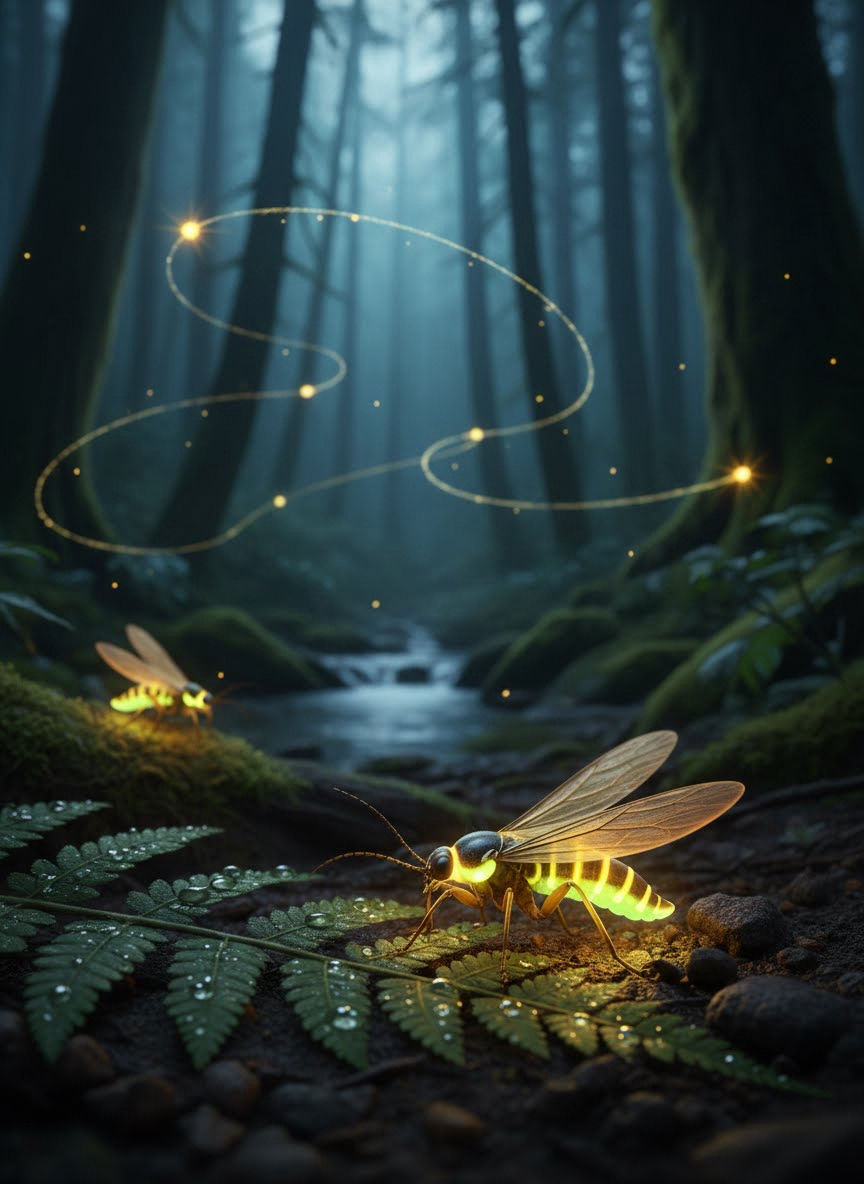
Ever wonder how a beetle turns its butt into a biological lightbulb?
Prompted by A NerdSip Learner
Explain the chemistry behind nature's coolest magic trick.
Imagine cracking a glow stick. You hear a snap, chemicals mix, and light appears. Fireflies do the exact same thing, but they are sophisticated little chemists mixing a potion inside their bodies! This phenomenon is called bioluminescence.
To make this magic happen, fireflies need a few specific ingredients. The most important one is a molecule called luciferin. Think of luciferin as the *fuel* for the lamp. But fuel doesn't burn on its own; it needs a spark.
That spark comes from an enzyme called luciferase. When luciferase meets luciferin, it kickstarts a reaction that releases energy. Unlike a regular lightbulb that gets hot, this reaction creates cold light—it's nearly 100% efficient, meaning almost no energy is wasted as heat!
Key Takeaway
Fireflies produce 'cold light' using a chemical fuel called luciferin and an enzyme helper called luciferase.
Test Your Knowledge
If luciferin is the fuel, what role does luciferase play?
So, we have the ingredients, but fireflies aren't just constantly glowing blobs. They flash on and off with amazing precision. How do they control the switch? The secret ingredient is the air you breathe: oxygen.
The chemical reaction we just learned about *requires* oxygen to shine. Inside the firefly's 'lantern' (the light organ in their abdomen), the insect manages a precise air supply system. When oxygen rushes in, it hits the luciferin, and *flash*—the light turns on!
To turn the light *off*, the firefly produces nitric oxide gas. This gas temporarily blocks oxygen from reaching the light-producing cells. It's essentially a biological valve. By rapidly pulsing this nitric oxide, the firefly can strobe its light like a tiny disco ball.
Key Takeaway
Fireflies control their flashing by regulating how much oxygen reaches their light organ.
Test Your Knowledge
What happens when oxygen enters the firefly's lantern?
Why go through all this trouble to glow in the dark? It's not just to look cool—it's a high-stakes conversation! The primary reason fireflies flash is for mating. It is essentially a romantic Morse code.
Male fireflies fly around flashing a specific pattern unique to their species. Meanwhile, the females hang out on blades of grass, watching the show. If a female likes a male's 'pickup line' (his specific flash pattern), she will flash back with a precise delay. They use these light signals to find each other in the pitch black.
But there is a secondary bonus: defense. The chemicals that make fireflies glow also make them taste absolutely terrible to predators. The glow serves as a neon warning sign to frogs and bats: "Do not eat me, I am gross!"
Key Takeaway
Fireflies primarily use light patterns to communicate with potential mates and warn predators.
Test Your Knowledge
What is the main function of the specific flash patterns used by males?
Track your progress, earn XP, and compete on leaderboards. Download NerdSip to start learning.