Can we actually break the ultimate speed limit of the universe?
Prompted by NerdSip Explorer #6116
Grasp the real physics behind FTL travel.
Have you ever looked at the stars and wondered why we haven't visited them yet? The biggest hurdle is the universe's absolute speed limit: the speed of light, often denoted as c. Clocking in at an astounding 299,792 kilometers per second, light is the fastest thing in existence.
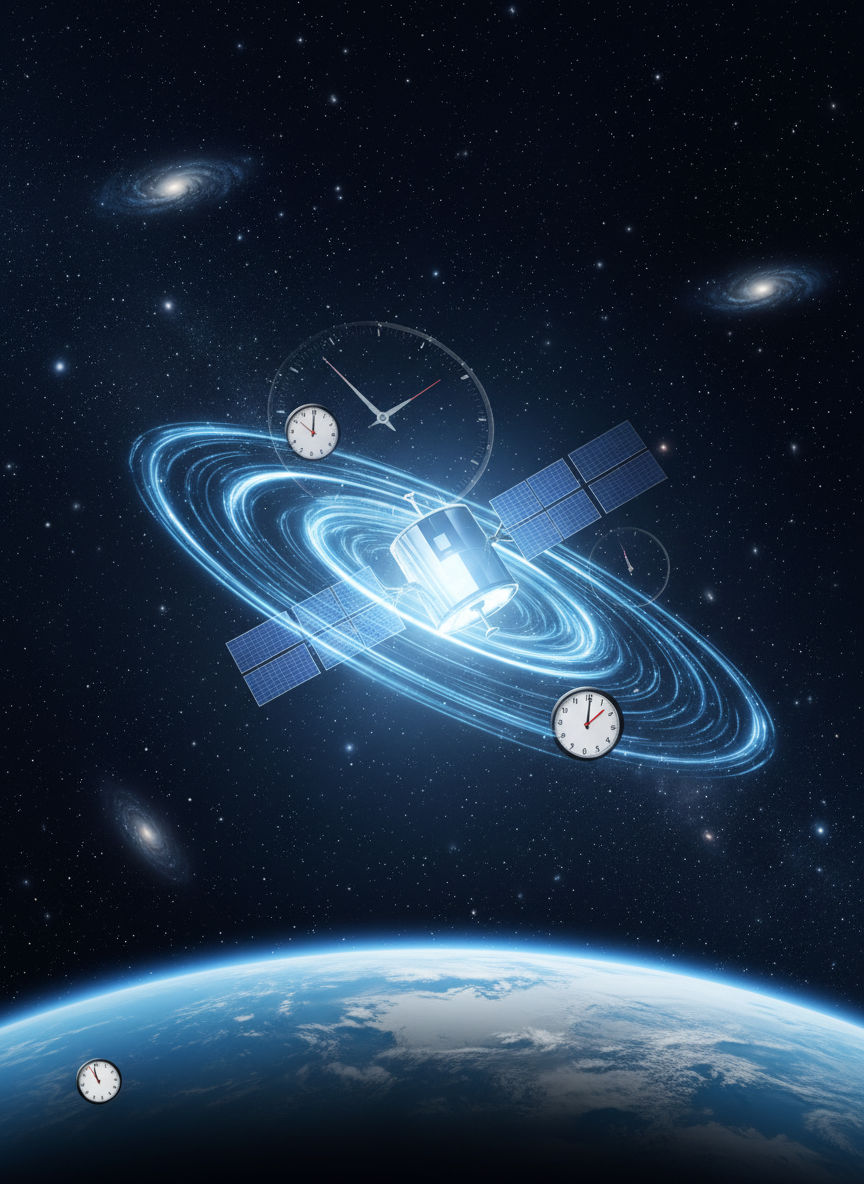
According to Albert Einstein's theory of Special Relativity, this speed isn't just a suggestion; it's a fundamental law woven into the fabric of the cosmos. When you accelerate an object, it gains kinetic energy. But as that object gets closer to the speed of light, something strange happens to its mass and its relationship with time.
Because of how space and time are linked, the faster you move through space, the slower you move through time relative to a stationary observer. To actually reach the speed of light, an object with mass would become infinitely heavy and require an infinite amount of energy, which is impossible.
This means that traditional rockets, no matter how powerful, can never push us past this cosmic barrier. To achieve Faster-Than-Light (FTL) travel, we can't just build a better engine. We have to look for theoretical loopholes in physics!
Key Takeaway
The speed of light is an absolute cosmic barrier for any object with mass due to the infinite energy required to reach it.
Test Your Knowledge
According to Special Relativity, what happens to the energy required to accelerate an object with mass as it approaches the speed of light?
If we can't physically accelerate through space faster than light, what are our other options? To understand FTL theories, we first need to look at Einstein's other masterpiece: General Relativity.
General Relativity teaches us that space and time are not just an empty void. They are a combined, flexible fabric known as spacetime. Imagine a large trampoline or a stretched rubber sheet. If you place a heavy bowling ball in the middle, the sheet dips and curves.
This curving of spacetime is what we experience as gravity. Planets, stars, and black holes all warp the fabric of the universe around them. But this flexibility also presents an exciting possibility for interstellar travel.
If spacetime can be bent, stretched, and folded by mass and energy, could we manipulate it on purpose? Instead of trying to fly *through* space at impossible speeds, the most promising theories of FTL travel rely on bending the actual fabric of the universe to our advantage.
Key Takeaway
Spacetime is a flexible fabric that can be bent and warped, offering potential theoretical loopholes for FTL travel.
Test Your Knowledge
In General Relativity, what does the 'rubber sheet' analogy represent?
The most famous loophole for FTL travel is the wormhole. Officially known as an Einstein-Rosen bridge, a wormhole is a theoretical tunnel through spacetime that could connect two distant points in the universe.
Think of a piece of paper. If you draw a dot at the top and a dot at the bottom, the fastest way for an ant to travel between them is a straight line. But if you fold the paper in half so the two dots touch, the ant can step instantly from one to the other.
In this scenario, you haven't broken the speed of light; you've simply shortened the distance. While traveling through the wormhole tunnel, you are moving at normal speeds, but you arrive at your destination faster than a light beam taking the long way around.
While the math of General Relativity allows for wormholes to exist, we have never observed one. Furthermore, theoretical physics suggests they would be incredibly unstable, likely collapsing the moment anything tried to pass through them.
Key Takeaway
Wormholes are theoretical tunnels that could connect distant parts of the universe by folding spacetime like a piece of paper.
Test Your Knowledge
How does a wormhole theoretically allow a traveler to arrive faster than light?
What if you didn't have to move the spaceship at all, but instead moved the space around it? In 1994, theoretical physicist Miguel Alcubierre proposed a mathematical model that does exactly that, giving serious scientific credibility to the idea of a 'warp drive'.
The Alcubierre drive proposes compressing the spacetime directly in front of a spacecraft while simultaneously expanding the spacetime directly behind it. Imagine standing on a rug. Instead of walking across the room, you pull the rug toward you from the front and push it away behind you.
The ship itself sits inside a 'warp bubble' of flat, unmoving spacetime. Because the space itself is doing the moving, the ship never actually travels faster than light locally. It simply rides the moving wave of space.
This brilliant loophole means the crew wouldn't experience mind-bending time dilation or be crushed by extreme acceleration. They would just surf the wave of spacetime right to their destination. It's the ultimate cosmic surfboard!
Key Takeaway
The Alcubierre drive proposes moving a ship by contracting space in front of it and expanding space behind it, avoiding relativity's speed limit.
Test Your Knowledge
What happens to the space inside the 'warp bubble' of an Alcubierre drive?
Both wormholes and warp drives sound incredible, but they come with a massive catch. To bend spacetime in the ways these theories require, you need a tremendous amount of negative energy.
In our everyday experience, mass and energy are positive. The gravity created by stars and planets pulls things together. But to prop open a wormhole or expand the space behind a warp drive, you need a repulsive force—something that pushes spacetime apart.
Physicists call the hypothetical substance that could provide this negative energy "exotic matter." Unlike regular matter, exotic matter would have negative mass. If you pushed a ball of exotic matter forward, it would theoretically accelerate backward!
While tiny amounts of negative energy have been observed in quantum mechanics (like the Casimir effect), no one knows if we can generate enough of it to fuel a starship. For now, the lack of exotic matter is the biggest roadblock preventing FTL from becoming a reality.
Key Takeaway
Theoretical FTL methods require negative energy or 'exotic matter' to stretch and warp spacetime, which we currently do not know how to produce in large amounts.
Test Your Knowledge
Why is 'exotic matter' theoretically required for warp drives and wormholes?
Let's pivot from warp drives to a fascinating thought experiment in quantum physics: Tachyons. Tachyons are a class of hypothetical particles that are fundamentally different from anything we know because they *always* travel faster than light.
Remember how normal matter requires infinite energy to reach the speed of light? The math of special relativity technically allows for particles that exist purely on the other side of that light-speed barrier.
For a tachyon, the speed of light isn't a ceiling; it's a floor. Just as normal matter would need infinite energy to speed up to light speed, tachyons would theoretically need infinite energy to slow down to light speed. Furthermore, they are theorized to possess 'imaginary mass'.
It is important to note that tachyons have never been discovered, and most physicists believe they do not exist. If they did, they would seriously mess with our understanding of cause and effect in the universe!
Key Takeaway
Tachyons are theoretical particles that always move faster than light and would require infinite energy to slow down to light speed.
Test Your Knowledge
What is the relationship between a hypothetical tachyon and the speed of light?
Why are physicists so skeptical about tachyons and FTL travel in general? It all comes down to a core tenet of relativity: if you can travel faster than light, you can travel backward in time.
Because space and time are interconnected, the order in which events happen depends on the observer's frame of reference. If you could send a signal—or a spaceship—faster than light, it is mathematically possible to arrange a scenario where the signal is received *before* it was sent.
This leads to major causality paradoxes. Imagine you have a gun that fires FTL bullets. You could theoretically shoot a target, and the bullet would hit the target before you ever pulled the trigger. What happens if the target moves before you fire?
Because causality (cause always preceding effect) seems to be a strict rule of our universe, many scientists believe that nature must forbid FTL travel entirely to prevent these paradoxes from unraveling reality.
Key Takeaway
In the framework of relativity, faster-than-light travel is mathematically equivalent to time travel, leading to impossible paradoxes.
Test Your Knowledge
Why does FTL travel create a problem for the concept of causality?
When people look for real-world phenomena that seem faster than light, they often point to quantum entanglement. Albert Einstein famously called it "spooky action at a distance."
Entanglement occurs when two particles become linked. If you measure the state of one particle, you instantly know the state of the other, even if they are billions of light-years apart. It seems like they are communicating faster than light!
However, this is a major misconception in pop science. While the particles share a quantum state, you cannot use them to send a message. When you measure your particle, the result is entirely random. You can't force it into a specific state to send a '1' or a '0'.
Because no usable information can be transmitted between the particles, the speed of light limit remains unbroken. Entanglement is a profound mystery of quantum mechanics, but it unfortunately won't give us a faster-than-light telephone.
Key Takeaway
While quantum entanglement instantly links particles across vast distances, it cannot be used to transmit information faster than light.
Test Your Knowledge
Why can't quantum entanglement be used for FTL communication?
Since macroscopic warp drives require impossible amounts of exotic matter, some physicists are turning their attention to the incredibly small. What if we can't build a starship, but we could warp space for a single atom?
Recent research in theoretical physics, including projects funded by DARPA, has explored the possibility of creating microscopic warp bubbles. By manipulating incredibly intense electromagnetic fields, scientists hope to observe tiny fluctuations in spacetime.
In 2021, a group of researchers claimed to have mathematically discovered a naturally occurring micro-warp bubble within a specific tiny structure known as a Casimir cavity. While this didn't result in a physical warp drive, it showed that the geometry of a warp bubble can exist in the real world without violating known physics.
If we can eventually prove that spacetime can be manipulated on a quantum level, it would be the first real stepping stone. A human-sized warp drive might be centuries away, but a microscopic one might be within our technological reach.
Key Takeaway
Current research focuses on creating microscopic warp bubbles, testing the feasibility of manipulating spacetime on a tiny scale.
Test Your Knowledge
What is the primary goal of current real-world research into warp drives?
So, will humanity ever truly conquer the stars using FTL travel? The honest answer is: we don't know yet. The journey from mathematical theories to engineering realities is long and full of dead ends.
Our current understanding of physics—split between General Relativity and Quantum Mechanics—is incomplete. We know that these two pillars of physics don't play well together, which means there is a deeper, undiscovered 'Theory of Everything' waiting to be found.
It is entirely possible that a future breakthrough in quantum gravity will either provide the exact blueprint for a warp drive or definitively prove that FTL is a cosmic impossibility.
Until then, the math of wormholes and Alcubierre drives gives us hope. It proves that the universe is far stranger and more flexible than we ever imagined. The cosmic speed limit might be strict, but humans have a long history of finding brilliant loopholes.
Key Takeaway
Our incomplete understanding of physics leaves the door open for future breakthroughs that could either enable or definitively rule out FTL travel.
Test Your Knowledge
Why might a future 'Theory of Everything' change our understanding of FTL travel?
Track your progress, earn XP, and compete on leaderboards. Download NerdSip to start learning.