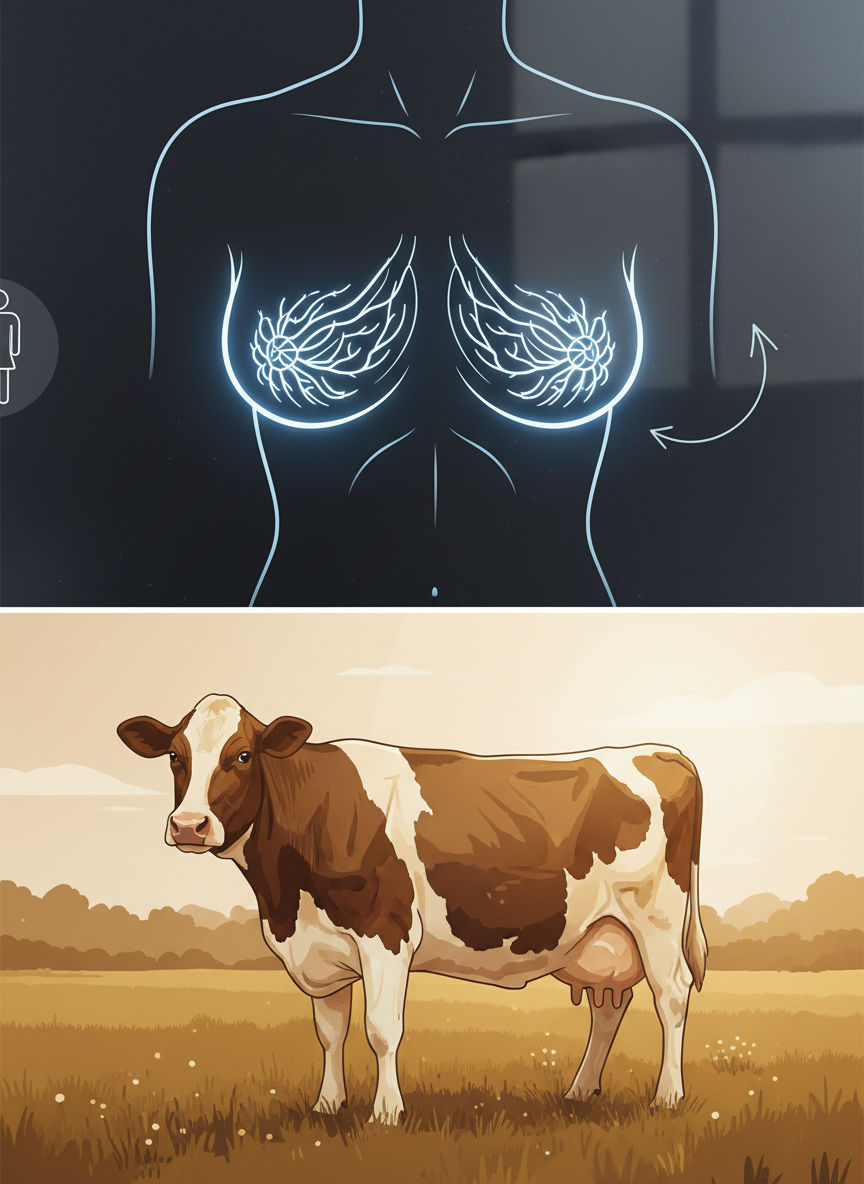
Why do humans have two breasts while cows rock four teats?
Prompted by A NerdSip Learner
Understand the evolutionary math behind mammalian milk.
Have you ever noticed that most mammals have an even number of nipples? From dogs to humans, the numbers vary wildly, but it’s not just a random coincidence! Evolutionary biologists use a fascinating guideline called the "one-half rule" to explain this.
Generally, the number of nipples an animal has is roughly double their average litter size. This biological math ensures there is always enough milk to go around for the offspring. It also provides a built-in "spare" in case a mother has twins, or if one gland isn't functioning perfectly.
Since humans typically give birth to just one baby at a time, two breasts represent the perfect evolutionary balance. It guarantees that a human newborn has a highly reliable food source. At the same time, the body doesn't waste precious energy and resources growing extra, unnecessary milk factories. Nature loves efficiency, and for humans, two is the magic number!
Key Takeaway
Mammals usually have twice as many nipples as their average litter size.
Test Your Knowledge
According to the "one-half rule," if a mammal typically has a litter of 4 babies, how many nipples is it likely to have?
So, if the "one-half rule" explains humans, what is going on with cows? A cow typically gives birth to just one calf at a time, so evolutionary math suggests they should only have two teats. Yet, they have an udder divided into four distinct quarters, each with its own teat!
This is an evolutionary quirk designed around survival and size. Calves are massive babies. Because their wild ancestors were born on the open plains where predators roam, calves needed to stand up and drink a massive amount of milk very quickly to gain strength.
Having four teats means the cow's body can produce and store a larger volume of milk. More importantly, it acts as an incredible insurance policy. If a cow gets an infection in one quarter of her udder, that specific teat might stop working. Because the udder has four independent sections, the calf can still happily feed from the remaining three and survive!
Key Takeaway
Cows have four teats to store massive amounts of milk and provide backup options if one gets infected.
Test Your Knowledge
Why is having an udder with four independent quarters a survival advantage for a calf?
While evolution gave cows their initial four teats to help their calves survive, human intervention pushed things to the extreme. For thousands of years, humans have selectively bred cattle to produce way more milk than a single calf could ever need.
By favoring cows with four large, well-spaced teats, ancient farmers accidentally shaped the modern dairy cow. Having an udder with four distinct quarters makes milking incredibly efficient. Today, modern milking machines are perfectly designed to attach to all four teats simultaneously, draining the udder quickly and safely.
Interestingly, biology sometimes gets a little carried away. Many dairy calves are actually born with five or six teats! These are known as supernumerary teats. Because they don't produce much milk and can get in the way of milking machines or cause infections, farmers often remove them. So, while nature occasionally tries to give cows even more, human breeding has locked in four as the ultimate sweet spot.
Key Takeaway
Humans selectively bred cows to have exactly four teats because it maximizes milk production and makes mechanical milking highly efficient.
Test Your Knowledge
What is a "supernumerary teat" in biology?
Track your progress, earn XP, and compete on leaderboards. Download NerdSip to start learning.