How do we print features smaller than a virus using invisible light?
Prompted by A NerdSip Learner
Master the core mechanics of next-gen semiconductor manufacturing.
Imagine trying to draw a detailed map of the entire world on the head of a pin. That is the kind of challenge engineers face when building computer chips! To make our phones faster and our gadgets smarter, we need to cram billions of tiny electronic parts onto a small slice of silicon. This process is called lithography, which is basically 'printing with light.' For a long time, we used regular ultraviolet light, but as parts got smaller, that light became too 'blurry' to draw the lines we needed.
That is where EUV, or Extreme Ultraviolet light, comes in. Think of EUV as the world's finest-tipped pen. While older methods were like trying to draw with a thick permanent marker, EUV uses a wavelength of light so short and precise that it can etch patterns thinner than a human hair—thousands of times thinner! By using this special light, we can pack more 'brain power' into our technology than ever before, paving the way for advanced AI and super-fast gaming consoles.
Key Takeaway
EUV lithography uses extremely short waves of light to 'print' incredibly tiny and complex patterns onto computer chips.
Test Your Knowledge
Why is EUV light better than older types of light for making chips?
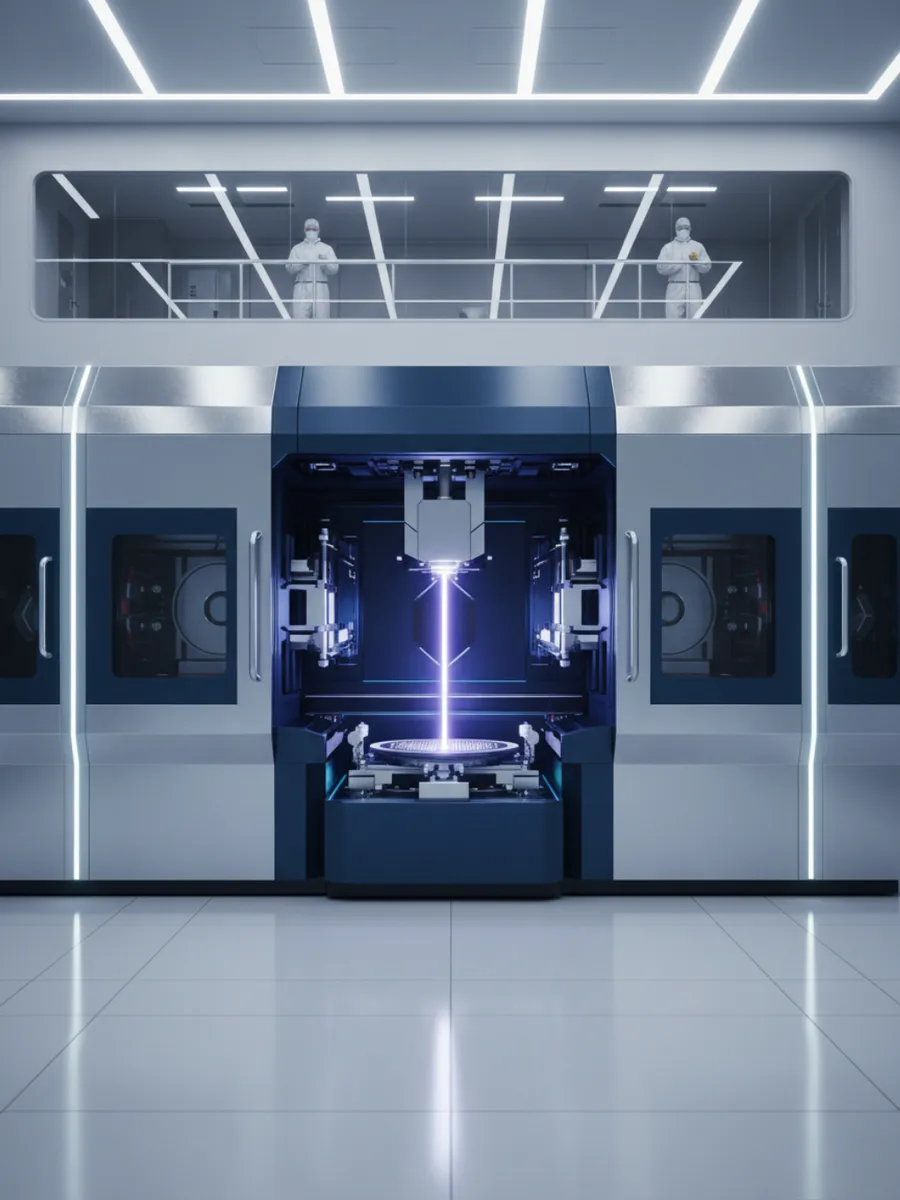
You can't just buy an EUV lightbulb at a hardware store. In fact, creating this light is one of the hardest things humans have ever done! To make EUV light, a machine blasts a tiny drop of molten tin—smaller than a grain of sand—with a high-powered laser. This happens 50,000 times every single second! When the laser hits the tin, the tin explodes into a super-hot plasma that glows with Extreme Ultraviolet light. It’s like creating a tiny, controlled star inside a machine.
This whole process has to happen inside a total vacuum. Why? Because EUV light is so delicate that even regular air would soak it up like a sponge! If the light tried to travel through the air in your room, it wouldn't make it more than an inch before being absorbed. This is why the machines are the size of a bus and are filled with nothingness—just so the light can reach its target without disappearing. It is a high-tech dance of lasers and metal happening at incredible speeds.
Key Takeaway
EUV light is created by hitting tiny drops of liquid tin with a laser 50,000 times a second inside a vacuum.
Test Your Knowledge
Why must the EUV light be created inside a vacuum?
In a normal camera or microscope, we use glass lenses to bend and focus light. But EUV light is a rebel—it doesn't play by the rules! Instead of passing through glass, EUV light is absorbed by it. This means engineers had to invent a way to move the light using only mirrors. These aren't your bathroom mirrors, though. They are the flattest surfaces ever created by humans. If one of these mirrors were expanded to the size of the United States, the biggest 'bump' on it would be less than a millimeter tall!
These mirrors are coated with dozens of layers of special materials to help reflect the EUV light toward the silicon chip. The light bounces through a 'mask'—which acts like a stencil of the chip's design—and is then shrunk down and projected onto the wafer. Because everything is so microscopic, even a tiny vibration from a passing truck outside the factory could ruin the chip. This is why the machines are kept in ultra-clean rooms and sit on massive, shock-absorbing foundations. It is the ultimate mix of extreme power and unbelievable precision.
Key Takeaway
EUV machines use the world's flattest mirrors instead of glass lenses because glass absorbs EUV light.
Test Your Knowledge
What happens if EUV light hits a regular glass lens?
Track your progress, earn XP, and compete on leaderboards. Download NerdSip to start learning.