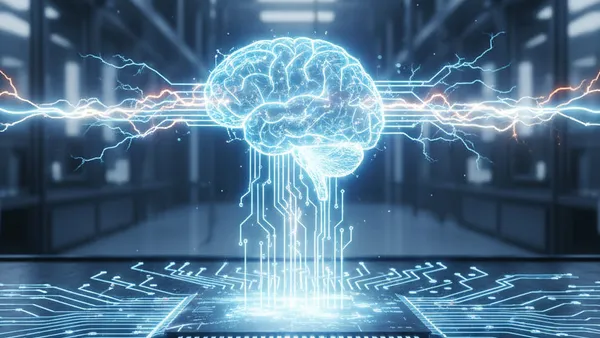
How does a tiny invisible spark power your entire life?
Prompted by NerdSip Explorer #4200
Understand the magic of electricity.
Have you ever wondered what actually happens when you flip a light switch? You can't see anything moving, but something incredibly powerful is flowing through your walls. That "something" is electricity.
To understand electricity, imagine a simple copper wire as a hollow pipe. Inside this pipe are billions of tiny, invisible particles called electrons. They are so small that you could fit trillions of them on the head of a pin.
When these electrons just sit still, nothing happens. But when they are forced to move together in the exact same direction, they create an electric flow. Think of it like water flowing through a garden hose.
This flow of tiny particles carries energy. When that rushing stream of electrons passes through your TV, your coffee maker, or a lightbulb, it transfers its energy to make them work! So, electricity is simply the movement of these microscopic workers.
Key Takeaway
Electricity is simply the flow of tiny, invisible particles called electrons moving through a path.
Test Your Knowledge
What is the flow of electricity compared to in this lesson?
Now that we know electricity is like water flowing through a hose, how do we actually get those tiny electrons to move? We need two main things to make it happen: Voltage and Current.
Imagine you have a water tank hooked up to a hose. If the tank is resting on the ground, the water just sits there. But if you raise the tank high up in the air, gravity creates pressure. In the electric world, this pressure is called Voltage. It’s the "push" that forces the electrons to start moving.
When the pressure pushes the water out, the actual amount of water flowing through the hose is the Current. A wide hose lets a lot of water flow, giving you a high current.
So, when you plug your phone charger into the wall, the outlet provides the invisible "push" (voltage), and the actual stream of electrons flowing into your battery is the "flow" (current). Together, they deliver the power you need!
Key Takeaway
Voltage is the pressure that pushes electricity, while current is the actual flow of the particles.
Test Your Knowledge
In the water tank analogy, what does Voltage represent?
We know how electricity moves, but where does the initial "push" come from? Unless you are using a battery, the electricity in your home comes from a massive, interconnected system called the Power Grid.
Think of a power plant as a giant, city-sized water pump. Inside the plant, massive machines called generators spin around extremely fast. This spinning motion acts like a giant magnet, "pulling and pushing" the electrons inside the wires to get them moving.
Once the plant gets the electrons flowing, they travel across huge transmission lines—those incredibly tall metal towers you see along the highway. These lines act like massive water mains, carrying the flowing electricity over long distances.
Finally, the flow is safely slowed down and funneled into smaller and smaller wires until it reaches the outlets in your home. The moment you plug something in and turn it on, you complete the path, letting the power plant's hard work light up your room!
Key Takeaway
Power plants act like giant pumps, using spinning generators to push electricity through the grid to your home.
Test Your Knowledge
How does a power plant get electrons moving into the power grid?
Track your progress, earn XP, and compete on leaderboards. Download NerdSip to start learning.