What if time travel isn't just a concept for science fiction movies?
Prompted by NerdSip Explorer #8722
Understand how space and time really work.
For a long time, scientists thought time and space were a fixed background stage, while everything else moved around on it. But in 1905, Albert Einstein changed the rules of the game completely.
He started with a mind-bending idea: the speed of light is always exactly the same, no matter how fast you are moving. Imagine you are driving down the highway at 60 mph and throw a baseball forward at 10 mph. To someone standing on the sidewalk, that ball is moving at 70 mph.
Light doesn’t work this way. If you are flying in a spaceship at 99% the speed of light and turn on your headlights, the light beam doesn't get a "boost" from your speed. It still zips away from you at the exact same cosmic speed limit: about 186,000 miles per second.
Because this speed limit is absolute, something else had to bend to make the universe make sense. That "something else" turned out to be the very concepts of space and time!
Key Takeaway
The speed of light is the absolute speed limit of the universe, and it never changes.
Test Your Knowledge
If you turn on a flashlight while running very fast, how fast does the beam of light travel?
Because the speed of light refuses to budge, time itself has to bend. This leads us to one of Einstein’s most famous discoveries: time is relative. It ticks at different rates depending on how fast you are moving.
The rule is simple but strange: the faster you move through space, the slower you move through time. If you were to board a rocket ship and travel close to the speed of light for a single year, you would only age by one year.
However, when you returned to Earth, you’d find that decades had passed for your friends and family. This isn't just a trick of the mind; your biological clock, your watch, and the atoms in your body literally experienced less time than the people back home.
Scientists have proven this using highly precise atomic clocks on airplanes. The clocks on the fast-moving jets always tick slightly slower than the identical clocks left on the ground!
Key Takeaway
Time is not a steady ticking clock; it slows down the faster you move through space.
Test Your Knowledge
According to relativity, what happens to your experience of time if you travel incredibly fast through space?
A decade after his first breakthrough, Einstein expanded his ideas to include gravity, calling it the General Theory of Relativity. Before this, people thought gravity was an invisible, magnetic-like pull between objects.
Einstein proposed something radical: space and time are woven together into a flexible, invisible fabric called "space-time." Everything in the universe rests on this fabric.
Imagine a trampoline. If you place a heavy bowling ball in the center, the fabric sags and creates a deep dip. If you roll a tiny marble across the edge, it won’t go in a straight line; it will naturally curve down into the dip toward the bowling ball.
This is exactly what the Sun does to the space-time fabric around it! The Earth is like that marble, simply following the natural curve created by the Sun's massive weight. Gravity is not a pull; it's a curve.
Key Takeaway
Gravity isn't an invisible magnetic force; it is the bending of the space-time fabric by heavy objects.
Test Your Knowledge
How does General Relativity explain why planets orbit the Sun?
You have probably seen the world’s most famous equation: E = mc². But what does it actually mean? It’s part of Einstein’s theory of relativity, and it acts as a cosmic exchange rate.
In this equation, E stands for Energy, m stands for mass (the amount of "stuff" in an object), and c stands for the speed of light. Because the speed of light squared is a spectacularly huge number, a tiny amount of mass equals an enormous amount of energy.
Before Einstein, scientists thought energy and mass were completely different things. Einstein showed that they are actually two sides of the same coin. Mass is just super-concentrated energy!
This elegant little equation explains how our Sun shines. Deep inside its core, the Sun constantly crushes lightweight atoms together, losing a tiny fraction of their mass. That "missing" mass transforms into the brilliant energy that lights up our entire solar system.
Key Takeaway
Mass and energy are interchangeable, meaning a tiny amount of matter holds a massive amount of energy.
Test Your Knowledge
What is the core message of the equation E = mc²?
It’s easy to think that Einstein’s theories only matter to astrophysicists staring into giant telescopes. But you actually carry the results of relativity in your pocket every single day!
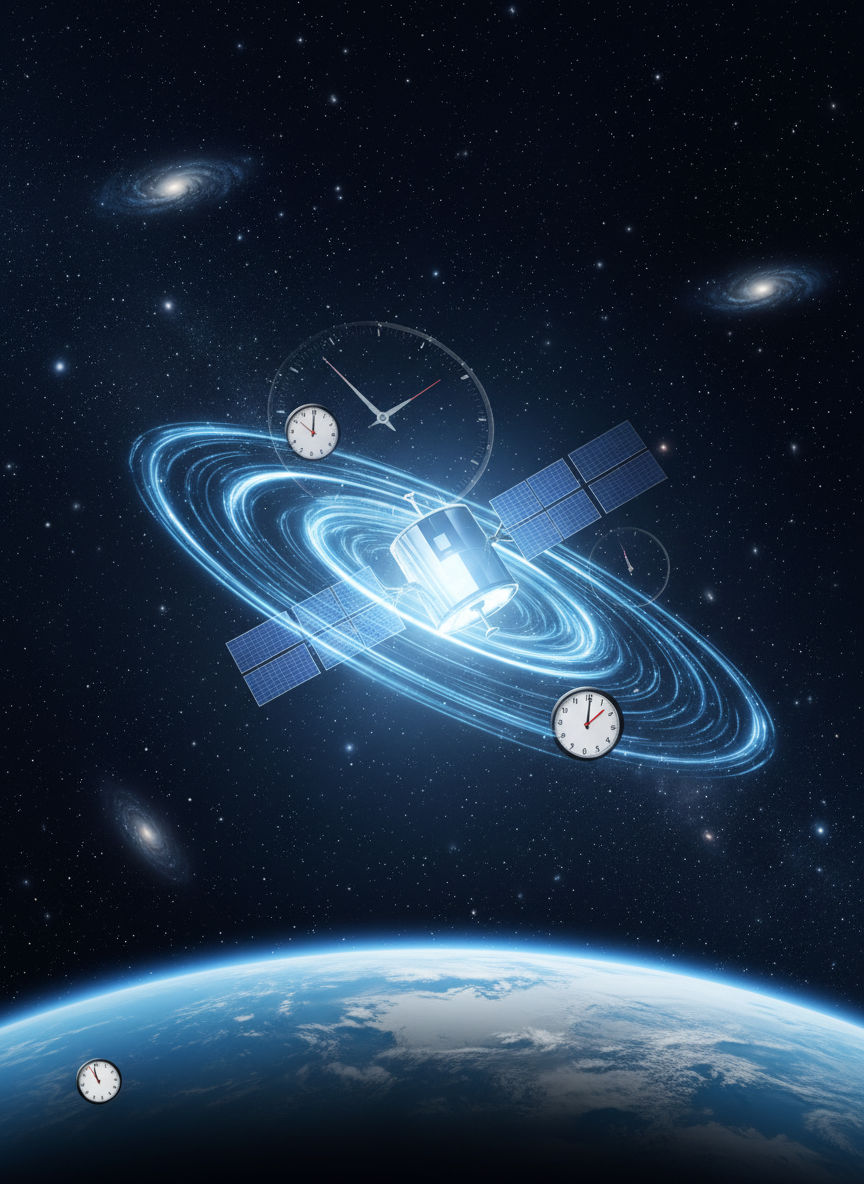
Your smartphone uses a global positioning system (GPS) to navigate. To pinpoint your exact location on a map, your phone talks to a network of satellites orbiting the Earth at roughly 9,000 miles per hour.
Because these satellites are moving very fast, Special Relativity says their onboard clocks should tick slower than clocks on Earth. However, because they are far away from Earth's strong gravity, General Relativity says their clocks should actually tick faster!
When scientists do the math, the gravity effect wins. The satellites' clocks run slightly faster than ours on the ground. If engineers didn't program the GPS system to adjust for this space-time bending, your navigation app would fail within minutes, misguiding you by miles!
Key Takeaway
Modern technologies like GPS rely on Einstein's theories to function accurately.
Test Your Knowledge
Why do GPS satellites need to account for relativity?
Track your progress, earn XP, and compete on leaderboards. Download NerdSip to start learning.