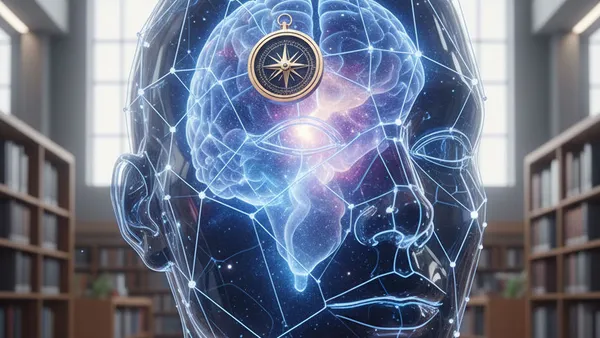
What is secretly driving your everyday choices?
Prompted by NerdSip Explorer #7304
Understand the hidden forces shaping your mind.
Imagine your mind is an enormous iceberg floating in the ocean. The small part you can see above the water is your conscious mind. This is your everyday awareness—what you are thinking about right now, what you plan to eat for dinner, and your daily tasks.
But the real magic (and mystery!) lies beneath the waves. The massive chunk of ice hidden underwater is your unconscious mind. Deep psychology is all about exploring this hidden underwater world. It holds your deepest memories, hidden desires, and long-forgotten experiences.
Even though you can't see the underwater part, it dictates how the whole iceberg moves! Similarly, our hidden unconscious often directs our daily behaviors, habits, and emotional reactions without us even realizing it.
By putting on our scuba gear and learning to explore what is beneath the surface, we can finally understand why we do the things we do. This is the core goal of deep psychology: making the invisible visible.
Key Takeaway
Your mind is like an iceberg, with the most powerful part hidden beneath the surface.
Test Your Knowledge
What does the underwater part of the iceberg represent in deep psychology?
Have you ever noticed that you act differently at a job interview than you do when relaxing with your best friends? In deep psychology, the 'face' we present to the outside world is called the Persona.
The word 'persona' actually comes from the Latin word for the theatrical masks worn by ancient actors. We all wear different psychological masks depending on who we are with and what society expects of us. It is completely normal and healthy to have one!
Your Persona helps you navigate the world smoothly. It allows you to be a professional at work, a polite neighbor, and a supportive friend. Think of it like a protective layer of clothing chosen for the right weather.
The only danger comes when we forget that we are wearing a mask. If you start believing that your job title or your polite exterior is *all* that you are, you lose touch with your true, messy, wonderful inner self. Deep psychology reminds us to take the mask off from time to time.
Key Takeaway
The Persona is the psychological mask we wear to fit into society, but it isn't our whole self.
Test Your Knowledge
What is the main risk associated with the Persona?
If the Persona is the shiny living room we show our guests, the Shadow is the dark basement where we hide our clutter. In deep psychology, the Shadow represents all the parts of ourselves that we don't want to look at.
When we are growing up, we learn that certain traits are 'bad' or 'unacceptable.' Maybe you were told that being angry was bad, or that being silly was foolish. To survive and fit in, you packed those traits away into boxes and locked them in your mental basement.
But just because those traits are locked away doesn't mean they disappear! Often, our Shadow parts pop out unexpectedly. When you find yourself getting instantly furious at someone else's minor flaw, it's often because they are displaying a trait that is secretly hiding in your own Shadow.
Exploring the Shadow sounds scary, but it's actually incredibly healing. By turning on the basement light and unpacking those boxes, we reclaim lost energy and become more complete, authentic human beings.
Key Takeaway
The Shadow holds the rejected parts of ourselves, and exploring it helps us become more whole.
Test Your Knowledge
Why do we originally put parts of our personality into the Shadow?
Have you ever wondered why almost every great movie features a Wise Old Guide (like Yoda or Gandalf) or a Brave Hero? Deep psychology suggests this isn't just a coincidence. It’s because of Archetypes.
Archetypes are like ancient, universal blueprints hidden inside human minds across the entire globe. Think of them as a shared storybook that every human being is born with. No matter where you grew up, you instinctively recognize the loving Mother, the playful Trickster, or the fierce Warrior.
Psychologists like Carl Jung believed these characters live in a deeper level of the mind called the collective unconscious. This is a shared pool of human memory and experience. It is why similar myths and legends popped up in ancient cultures that never even communicated with each other!
When we understand these universal blueprints, we can see which characters are currently running the story of our own lives. Are you currently playing the Hero facing a challenge, or the Caretaker looking after everyone else?
Key Takeaway
Archetypes are universal character blueprints shared by all humans, shaping our stories and myths.
Test Your Knowledge
What is an example of an Archetype?
So, how do we actually communicate with this massive underwater iceberg or look inside the basement? One of the most powerful tools in deep psychology is paying attention to our dreams.
When you go to sleep, your conscious mind finally takes a break. The strict bouncer at the door of your mind clocks out for the night. This allows your unconscious mind to step up to the microphone and start speaking!
However, the unconscious doesn't speak in plain English. It speaks in a highly creative language of symbols, metaphors, and emotions. If you dream about a house with a leaking roof, it might not be about plumbing at all. It could be your inner self telling you that your emotional boundaries need repair.
By writing down your dreams and looking at them like puzzles instead of random nonsense, you can receive deeply personal advice from your own inner wisdom. It’s like getting a secret letter from your truest self every single morning.
Key Takeaway
Dreams are symbolic messages from your unconscious mind, offering insight into your hidden self.
Test Your Knowledge
Why are dreams sometimes confusing to understand?
Track your progress, earn XP, and compete on leaderboards. Download NerdSip to start learning.