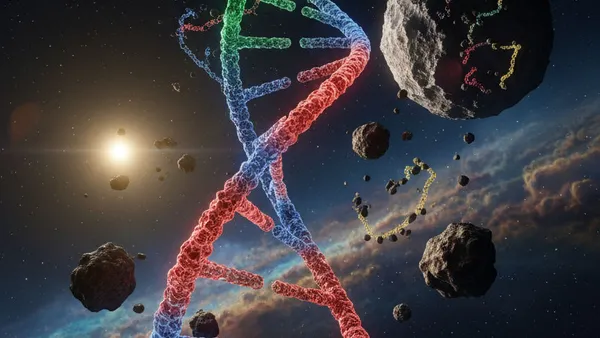
Did asteroids dictate the DNA recipe?
Prompted by NerdSip Explorer #1450
Master the advanced astrochemistry of space DNA.
When scientists analyzed Ryugu's samples, they didn't just find the five DNA and RNA nucleobases—they noticed a fascinating pattern in their ratios.
Nucleobases are split into two families: purines (Adenine, Guanine) and pyrimidines (Cytosine, Thymine, Uracil). Ryugu contained a near-perfect balance of the two. But samples from other space rocks, like the asteroid Bennu or the Murchison meteorite, heavily favored one family over the other.
Why the difference? Astrochemists believe the secret ingredient is ammonia. The data suggests a strong correlation between the amount of ammonia present in the asteroid and the resulting ratio of purines to pyrimidines.
Essentially, ammonia acts like a chemical steering wheel. Depending on the exact temperature and chemical environment inside the asteroid's parent body, different levels of ammonia steered the molecular "recipe" toward either purine or pyrimidine dominance.
Key Takeaway
Ammonia levels inside an asteroid dictate the chemical balance between purine and pyrimidine nucleobases.
Test Your Knowledge
According to recent data from asteroids, what molecule likely controlled whether purines or pyrimidines were more abundant?
For decades, many biologists supported the RNA World hypothesis. This theory suggests that life on early Earth started with RNA, and only later evolved the more complex DNA.
One major reason for this belief? Uracil (used in RNA) is chemically simpler to form without biological processes than Thymine (used in DNA). Scientists assumed early Earth's prebiotic soup was full of Uracil but lacked Thymine.
However, the recent Ryugu findings threw a massive curveball at this assumption. The discovery of Thymine sitting right next to Uracil on a sterile, 4.6-billion-year-old space rock proves that non-biological space chemistry doesn't strongly favor one over the other.
This suggests that early Earth didn't have to wait for biology to invent Thymine. The asteroids were already delivering the advanced, complex components of DNA directly to our planet's doorstep.
Key Takeaway
Finding Thymine on an asteroid proves it can form abiotically, challenging the assumption that early Earth only had access to RNA components.
Test Your Knowledge
Why does finding Thymine on Ryugu challenge the traditional RNA World hypothesis?
While the discovery of the five nucleobases stole the headlines, astrochemists were equally excited by another molecule found in massive abundance on Ryugu: urea.
On Earth, we mostly know urea as a biological waste product. But in the prebiotic chemistry of the early solar system, urea was incredibly valuable. It acted as a vital chemical stepping stone.
Nucleobases are complex N-heterocycles—molecules made of rings containing both carbon and nitrogen atoms. Building these rings from scratch in the freezing, harsh environment of space is chemically difficult.
Urea essentially acts as the molecular scaffolding. High concentrations of urea provide the perfect starting material, reacting with other simple molecules to form the intricate ring structures of purines and pyrimidines. Without urea, the "alphabet of life" might never have formed in space.
Key Takeaway
High levels of urea on Ryugu prove it acted as a vital chemical precursor to construct complex DNA bases in space.
Test Your Knowledge
Why is the high abundance of urea on Ryugu significant to astrochemists?
How do you cook up complex organic molecules in a freezing, airless vacuum? The process is a masterpiece of astrochemistry.
It begins long before the solar system even formed, inside ultra-cold molecular clouds. Simple molecules like water, carbon monoxide, and ammonia freeze onto microscopic dust grains. As these icy grains float through space, they are bombarded by UV photons and high-energy cosmic rays, which break chemical bonds and force them to recombine into new structures.
Later, these dust grains clumped together to form asteroids like Ryugu. Deep inside the asteroid, radioactive elements generated heat, melting the ice. This triggered aqueous alteration—a period where warm, liquid water allowed those early molecules to mix, react, and finalize their transformation into nucleobases.
It’s a spectacular two-step cosmic recipe: first, deep-freeze radiation, followed by a warm, watery bake inside a rocky oven.
Key Takeaway
Nucleobases formed through a two-step process: radiation in freezing molecular clouds, followed by liquid water reactions inside the asteroid.
Test Your Knowledge
What is 'aqueous alteration' in the context of asteroid chemistry?
It is tempting to look at the discovery of all five nucleobases on Ryugu and think we have solved the origin of life. But finding these molecules is like finding a pantry stocked with flour and sugar—it doesn’t mean you have a baked cake.
In living cells, nucleobases don't work alone. They must bond with a sugar molecule and a phosphate group to form a nucleotide. Millions of these nucleotides must then link together perfectly to create a functioning DNA strand.
So far, we have only found the raw bases on asteroids, not the complete nucleotides. This highlights a crucial boundary between prebiotic chemistry and actual biology.
This provides a sobering lesson for future missions to Mars or ocean moons like Europa. If a rover detects nucleobases, it is not an automatic biosignature. It might just be the same abiotic (non-living) chemistry that happened on Ryugu.
Key Takeaway
Nucleobases are a chemical signature of life's ingredients, but not a true "biosignature" of life itself.
Test Your Knowledge
Why isn't the mere presence of nucleobases considered a definitive 'biosignature' on another planet?
Track your progress, earn XP, and compete on leaderboards. Download NerdSip to start learning.