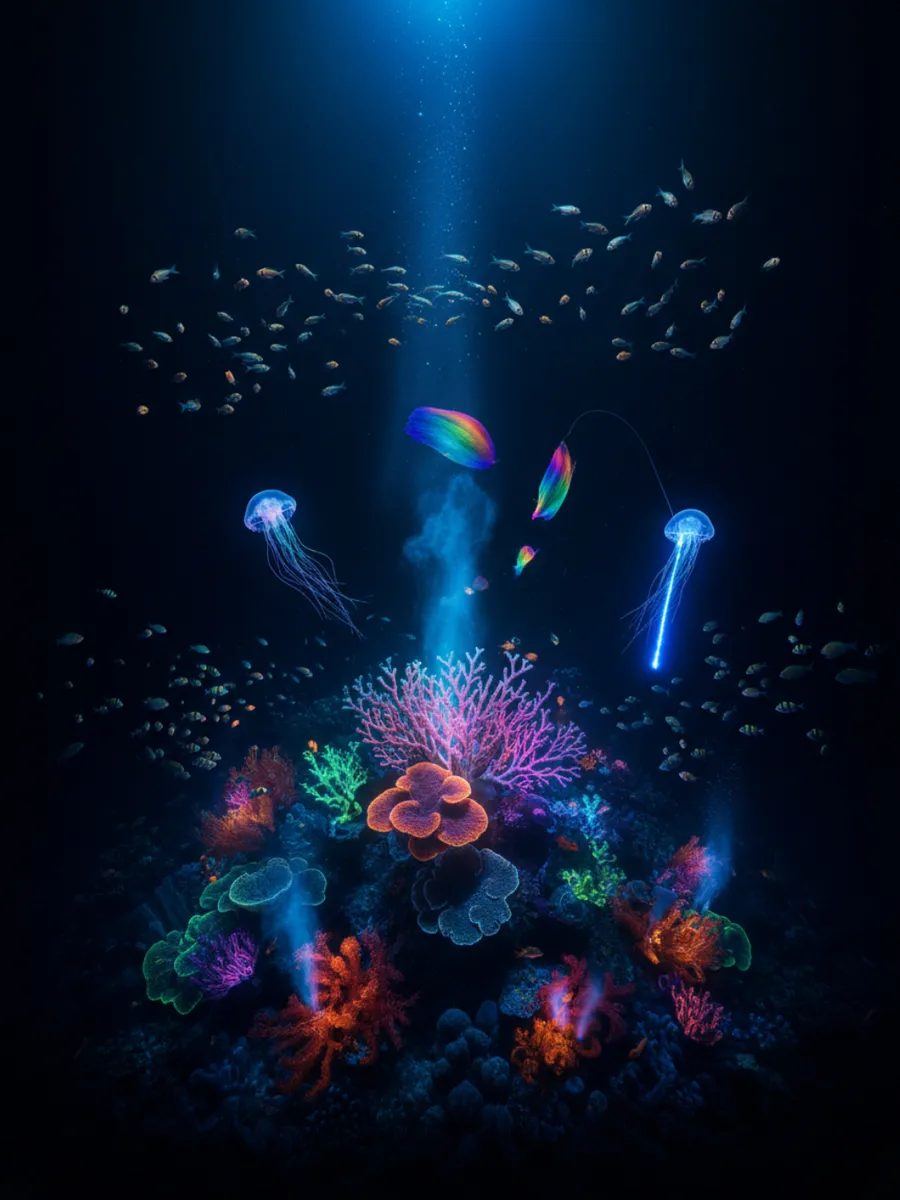
Why does 75% of the deep ocean glow in the dark?
Prompted by A NerdSip Learner
Master the secrets of nature's living light.
Imagine a world where light isn't hot. In the pitch-black deep sea, animals create bioluminescence, a biological chemical reaction that produces 'cold light.' Unlike a standard lightbulb, which wastes most of its energy as heat, these creatures are incredibly efficient, converting nearly 100% of the energy into visible glow.
This biological magic happens when a molecule called luciferin reacts with oxygen. This reaction is sparked by an enzyme called luciferase. Think of luciferin as the fuel and luciferase as the match that starts the fire. Without these two working together, the abyss would remain entirely dark.
While we see many colors on land, deep-sea light is almost exclusively blue or green. This isn't just an aesthetic choice; blue light has a shorter wavelength, allowing it to travel much further through dense seawater than red or yellow light. This ensures their signals reach across the vast, lonely void of the midnight zone.
Key Takeaway
Bioluminescence is a highly efficient chemical reaction between luciferin and oxygen, primarily appearing as blue or green light to travel further underwater.
Test Your Knowledge
What role does the enzyme 'luciferase' play in creating light?
Why glow in a world where hiding is survival? In the Bathypelagic Zone, light is a Swiss Army knife. For predators like the Anglerfish, a glowing dorsal lure acts as a deadly 'fishing light' to attract curious prey right into their waiting, needle-like teeth.
Defense is just as bright. Some shrimp spew bioluminescent clouds of chemicals—the underwater version of a smoke bomb—to blind predators while they make a getaway. Others use 'burglar alarms,' glowing brilliantly when attacked to attract an even larger predator that might eat their attacker instead.
Perhaps the most clever trick is counter-illumination. By using light organs on their bellies to match the faint sunlight filtering down from above, fish like the Hatchetfish erase their own shadows. To a predator swimming below, the fish becomes totally invisible against the surface light.
Key Takeaway
Deep-sea creatures use light for complex tactical survival, including attracting prey, creating distractions, and camouflaging their silhouette.
Test Your Knowledge
How does 'counter-illumination' help a fish stay safe?
Meet the icons of the deep. The Vampire Squid doesn't actually drink blood; it uses glowing organs called photophores covering its body to disorient enemies. When threatened, it can even release glowing mucus from its arm tips to leave a 'ghost' of itself behind while it vanishes into the dark.
Then there are the Comb Jellies. While their famous rainbow shimmer is actually light refracting off tiny hairs called cilia, many species are also bioluminescent. When bumped, they can pulse with brilliant blue-green flashes, turning the water into a living neon light show to startle intruders.
Finally, consider the Dragonfish. Most deep-sea life is blind to red light, but the Dragonfish produces a unique red beam. This works like a sniper’s night-vision goggles, allowing the Dragonfish to illuminate and see its prey without the prey ever knowing it is being watched. It's the ultimate unfair advantage in the dark.
Key Takeaway
Specialized organs like photophores allow creatures to produce light for unique species-specific advantages, from 'night vision' to decoy maneuvers.
Test Your Knowledge
Why is the Dragonfish's red light considered a 'secret' weapon?
Track your progress, earn XP, and compete on leaderboards. Download NerdSip to start learning.