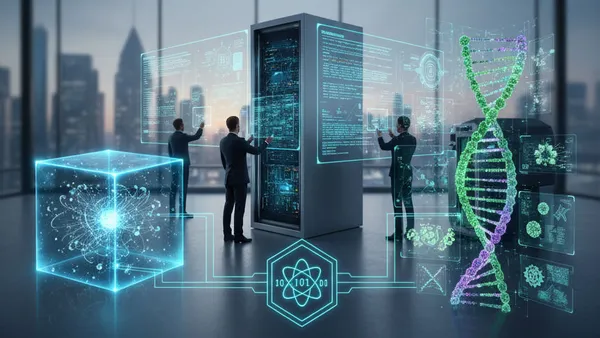
Can quantum computers and software unlock the hidden code of human life?
Prompted by A NerdSip Learner
See how code and quantum physics revolutionize human biology.
Imagine if your body was a video game. To build a game, you need code. In our bodies, that code is DNA. It holds the brilliant, microscopic instructions for making you, *you*.
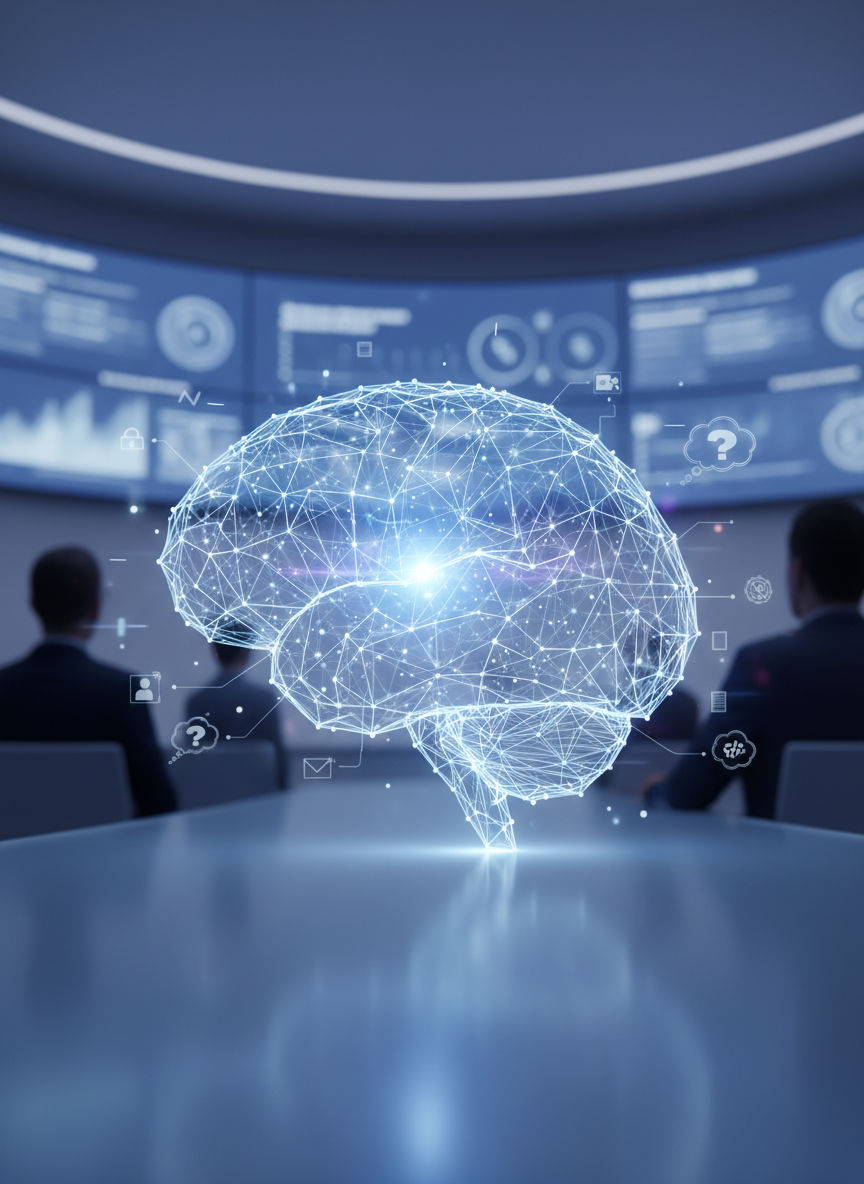
Bioinformatics is simply the science of treating this biological DNA like computer data. It uses computers to read, store, and understand the massive instruction manual hidden inside our cells.
But there is a catch! Biological data is unimaginably huge and complex. If we try to read and compare all the DNA in a population, a normal computer might freeze up.
This is where Quantum Physics starts to peek into the picture—promising a completely new, mind-bending way to process information much faster than ever before. Let's explore how these fields collide!
Key Takeaway
Bioinformatics treats biological information like DNA as digital data that computers can read.
Test Your Knowledge
What is the main idea behind bioinformatics?
A computer is like an incredibly fast chef, but it has absolutely no idea what to cook. It needs a recipe.
Software engineering is the art of writing those recipes. Software engineers build the programs, apps, and systems that tell a computer exactly what to do with the data it receives.
When dealing with the "code of life" (DNA), software engineers design specialized biological databases and search engines. Think of it like a Google search, but instead of searching for websites, scientists are searching for genes!
Without software engineering, bioinformatics wouldn't exist. We would just have a giant pile of biological letters and no way to organize, read, or make sense of them.
Key Takeaway
Software engineers write the instructions that allow computers to process and organize complex biological data.
Test Your Knowledge
What role does software engineering play in analyzing DNA?
So, we have the biological data, and we have the software. But what happens when the math gets too big for a normal computer? Enter Quantum Physics.
A regular computer thinks in simple switches: either a 0 or a 1. It is like flipping a coin and looking at heads or tails.
But a quantum computer uses the bizarre rules of quantum physics. Its switches, called qubits, can be a 0, a 1, or *both at the same time*! Imagine a coin spinning in the air—it is a blur of both heads and tails until it lands.
Because qubits can exist in multiple states at once, quantum computers can explore thousands of possibilities simultaneously, rather than one at a time. This makes them incredibly powerful problem-solvers.
Key Takeaway
Quantum computers use qubits, which can represent multiple possibilities at once, making them insanely fast at complex tasks.
Test Your Knowledge
How is a quantum qubit different from a regular computer bit?
Let's bring it all together. Our bodies are full of proteins, which do everything from digesting food to fighting viruses.
Proteins are like long strings of beads that fold into very specific 3D shapes. Understanding exactly how they fold is a massive puzzle. A normal computer might take millions of years to guess the right shape for a complex protein.
This is the ultimate bottleneck in bioinformatics. Software engineers write the code to solve the puzzle, but standard hardware just isn't fast enough.
By tapping into quantum computing, scientists hope to calculate these crazy biological puzzles in a fraction of the time. The spinning "coins" of quantum physics can check millions of folding combinations all at once!
Key Takeaway
Quantum computers can rapidly solve complex biological puzzles, like protein folding, that regular computers cannot.
Test Your Knowledge
Why do scientists want to use quantum computers for biological puzzles?
What happens when you combine bioinformatics, software engineering, and quantum physics? You get a revolution in medicine.
Right now, discovering a new drug can take over a decade. Scientists have to manually test thousands of chemicals to see if they fit perfectly into a disease cell, almost like finding a key for a microscopic lock.
But in the future, software engineers will write advanced quantum algorithms. These algorithms will look at the bioinformatic data of a disease, and use a quantum computer to instantly simulate which chemical "key" will cure it.
Instead of trial and error in a physical lab, we will design perfect, life-saving medicines entirely inside a computer simulation. That is the magic of combining these three incredible fields!
Key Takeaway
Combining these three fields will allow us to simulate and design life-saving drugs instantly inside a computer.
Test Your Knowledge
How will combining these three fields improve the future of medicine?
Track your progress, earn XP, and compete on leaderboards. Download NerdSip to start learning.